.svg)
China's Manufacturing Slowdown: What NZ Importers Need to Know in August 2026

.svg)
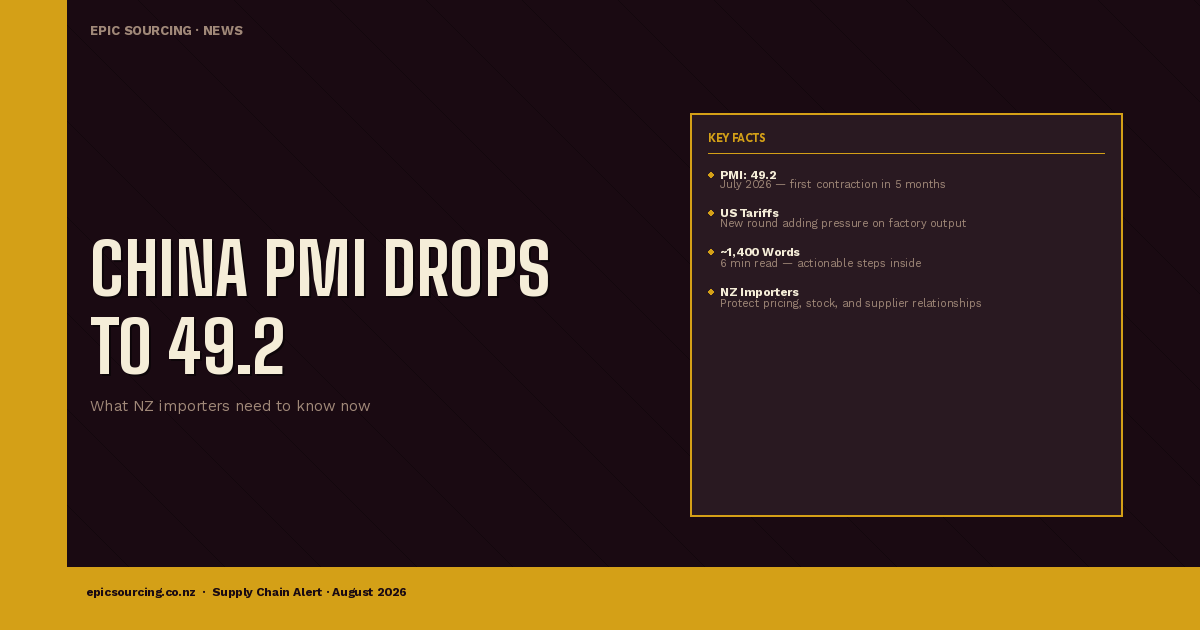
If you source products from China — whether that's activewear, homewares, electronics, or anything in between — you'll want to read this one carefully. In July 2026, China's official manufacturing PMI dropped to 49.2, slipping into contraction territory for the first time in five months. Combined with a new round of US tariffs and shifting global supply chains, the signals are worth paying attention to.
This isn't a panic post. Manufacturing in China isn't going anywhere fast. But the landscape is shifting, and as a Kiwi importer, being ahead of the curve means better decisions, better pricing, and fewer nasty surprises. Let's break down what's happening and — more importantly — what you should actually do about it.
What the PMI Number Actually Means
PMI stands for Purchasing Managers' Index. A reading above 50 signals expansion; below 50 means contraction. China's July 2026 reading of 49.2 (down from 50.3 in June) tells us that factory managers are seeing fewer new orders, reduced output, and tighter conditions. The new orders sub-index dropped to 48.5 — the lowest since 2023. Construction PMI hit a record low of 47.0.
Two things drove this: summer typhoons disrupting logistics in coastal provinces, and slumping domestic demand inside China itself. Some of that pressure flows downstream to exporters.
Sourcing Hack #1: Check your supplier's region — Before your next order, ask which province your supplier is based in. Coastal provinces (Guangdong, Zhejiang, Fujian) are more likely to have been impacted by typhoon disruptions. Inland factories may have a cleaner production pipeline right now.
The New US Tariff Situation — And Why It Affects You
On 24 July 2026, the US imposed a new 12.5% Section 301 tariff on a broad range of Chinese goods — on top of existing duties from the ongoing US-China trade dispute. As a Kiwi importer, here's why this matters:
- Suppliers may raise FOB prices to offset losses on US orders, and NZ buyers can end up absorbing that increase.
- The tariffs are accelerating supply chain diversification to Vietnam, India, and Mexico — reshaping global factory capacity and pricing dynamics.
- Chinese factories losing US business often have spare capacity and are more motivated to negotiate with non-US buyers.
Sourcing Hack #2: Use the tariff moment to negotiate — If you have a solid supplier relationship, now is a good time to ask for better unit pricing or MOQ flexibility in exchange for order commitment. Factories with spare capacity are more receptive than they've been in years.
Freight Rates: Still Climbing
There's no ambiguity on freight: rates to NZ jumped hard in July. FCL 20-foot container rates are now $1,890–$2,310 — up approximately 36% month-on-month. FCL 40-foot rates have risen to $3,735–$4,565, up 38%.
LCL rates have held relatively stable at around $38/cbm, and air freight remains at $4–$8/kg. If you have time-sensitive, lower-volume cargo, LCL or air may be worth considering. The FCL spike is driven by Oceania peak-season capacity crunches — fewer container slots are available to NZ and Australia as southern hemisphere spring-summer approaches.
Sourcing Hack #3: Recalculate your landed costs now — If it's been more than 2 months since you last ran the numbers, do it again. A 36–38% freight increase changes the maths significantly — a product that was profitable at last quarter's shipping rates may need a price adjustment or a switch to LCL.
Vietnam: The Rising Alternative
China's slowdown is Vietnam's opportunity, and this is showing up in real investment. Apple, Samsung, Intel, and Foxconn are all actively expanding Vietnamese operations. The ITWA@Vietnam 2026 expo in Hanoi (5–7 August) drew 500+ exhibitors and 10,000+ visitors across electronics, automation, and smart manufacturing.
Vietnam won't replace China for most product categories — China's manufacturing ecosystem is simply too deep. But Vietnam is genuinely strong for textiles, apparel, furniture, footwear, and electronics assembly, and worth building into your supply chain mix as a resilience measure.
What Smart NZ Importers Are Doing Right Now
- Requesting updated lead times and production slot availability from existing Chinese suppliers.
- Getting fresh freight quotes — last quarter's numbers are materially wrong right now.
- Reviewing which product categories are most exposed to the new Section 301 tariff ripple effects.
- Exploring at least one Vietnamese or Indian supplier alternative to reduce single-country risk.
- Locking in forward orders earlier than usual ahead of the pre-Christmas production rush.
If you're unsure how all of this applies to your specific products and sourcing situation, Epic Sourcing exists to help. We work with New Zealand businesses to navigate sourcing strategy, supplier vetting, and freight planning. Book a free consultation and let's take a look at where you stand.
Related Articles


Let’s Make It Epic
We're here to make sourcing simple – and a whole lot less stressful.
We are experiencing a higher volume of enquiries than usual. Our standard reply time for form submissions and emails is within 72 hours.
If your matter is urgent, please schedule a video call using the link below.
