
.svg)
China to NZ Shipping Rates: What Kiwi Importers Need to Know (April 2026)

.svg)
Welcome back to the Epic Sourcing blog — your go-to resource for navigating the wild and wonderful world of importing from Asia to New Zealand.
If you've been keeping an eye on your freight invoices lately and thinking, "hang on, this seems higher than usual" — you're not imagining it. Shipping rates from China to New Zealand have climbed noticeably in April 2026, and we want to make sure you're across it before it catches your margins off guard.
Whether you're a Kiwi business owner importing clothing, electronics, homewares, or construction materials, understanding what's happening with freight costs right now is genuinely important. The good news? We've got the full breakdown here, plus some practical tips to help you manage the impact.
So, without further ado, let's dive into what's happening with China to NZ shipping rates in April 2026.
What Are the Current China-NZ Shipping Rates?
Here's the real talk on where freight rates sit right now for the China to New Zealand lane:
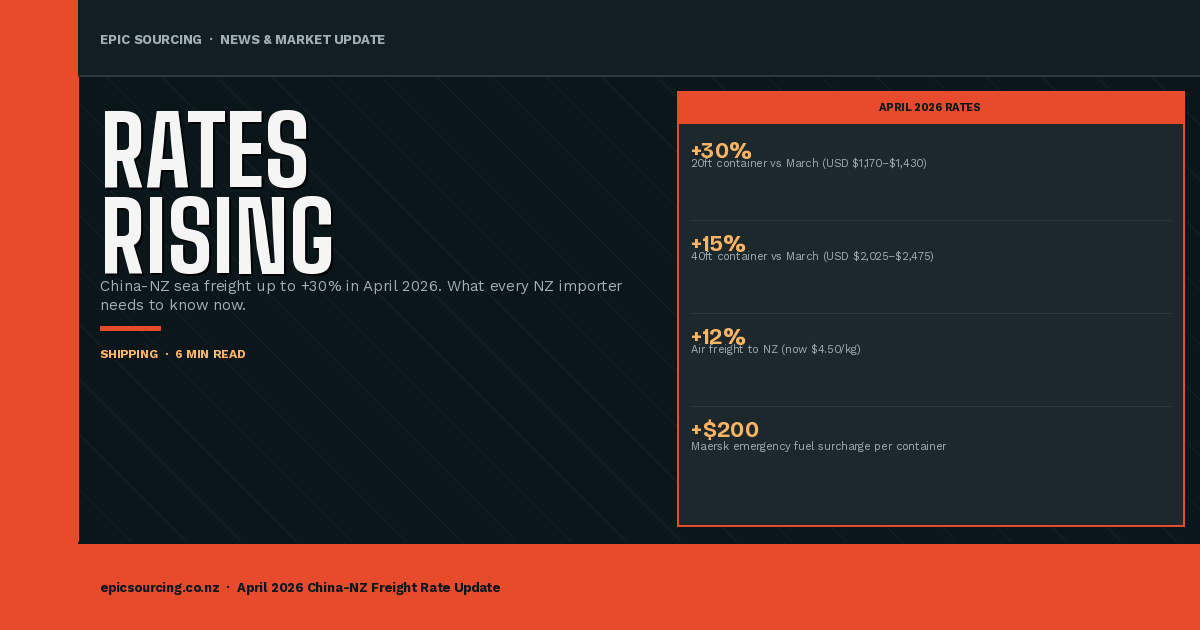
- 20GP (20-foot container): USD $1,170–$1,430 — up 30% from March
- 40GP (40-foot container): USD $2,025–$2,475 — up 15% from March
- LCL (Less than Container Load): ~$5/cbm — Stable
- Air Freight: ~$4.50/kg — up 12% from March
The short version: if you're moving full containers, you're paying more. Significantly more in the case of 20GP containers, which are up 30% in just one month. LCL (where you share container space with other importers) remains the stable option for smaller shipments right now.
Why Are Shipping Rates Rising in 2026?
Fair question. A few things are colliding at once:
- US-Iran geopolitical tensions — Ongoing instability in the Middle East is constraining bunker fuel supply, which pushes up operating costs for carriers.
- Emergency fuel surcharges — Maersk and other major shipping lines are now pushing emergency fuel surcharges of up to US$200 per container. That gets passed straight through to importers.
- Renewed buyer activity — Made-in-China.com reported a 25% surge in buyer activity during their 'Amazing April' procurement event, which tightens capacity on key lanes.
- Post-Chinese New Year demand — Factories have been ramping back up since February, and shipping demand is peaking as Q2 orders move.
The lesson here is: this isn't just a blip. Freight rate volatility is the new normal in global trade, and building this into your sourcing budget is essential.
How Does This Affect Your Landed Costs?
Here's the thing — landed cost is what actually matters when you're calculating whether a product is worth importing. And freight is a significant chunk of that equation.
Let's say you're importing a 40GP container of activewear from Guangzhou. If that container costs you $2,200 in freight (mid-range for April), and you've got 3,000 units on board, that's roughly $0.73 per unit in freight alone — before you factor in NZ Customs duties, MPI biosecurity checks, port and terminal handling, domestic transport, and freight forwarder fees.
A 15% increase in ocean freight might seem small in isolation, but when you're running tight margins (as most Kiwi SMEs are), it absolutely matters. Build freight cost buffers into your product pricing, and don't quote customers on landed costs until you have a confirmed freight quote.
Sourcing Hack #1: Always get a fresh freight quote before confirming your product pricing to a customer. Rates can shift significantly within a single week. Use your freight forwarder's live rate tool or ask Epic Sourcing to get you a current quote — never assume last quarter's rate is still valid.
LCL vs FCL: Which One Saves You Money Right Now?
With FCL rates surging, it's worth revisiting whether LCL makes more sense for your business right now.
Use LCL if: your shipment is under 15 CBM, you're ordering smaller quantities or testing new products, or you want to spread risk across multiple small orders.
Use FCL if: your shipment is 15+ CBM, you're doing regular repeat orders, you need faster transit times, or you're importing fragile or high-value goods.
LCL remains stable at around $5/cbm, making it a genuinely competitive option for businesses importing smaller quantities in the current environment.
What About Air Freight?
Air freight has also crept up to around $4.50/kg — a 12% jump from March. Air is faster (5–7 days vs 20–25 days for sea) but generally only worth considering for high-value/low-weight products, urgent restocks, small samples, or time-sensitive seasonal goods.
5 Practical Tips to Manage Rising Freight Costs
- Book earlier and lock in space. Capacity tightens fast when demand spikes. Talk to your freight forwarder as soon as your order is confirmed.
- Consolidate orders where possible. Combining multiple smaller orders reduces cost per unit.
- Use LCL for test orders. LCL lets you import small quantities without the fixed cost exposure of a full container.
- Review your product mix. High-volume, low-margin products are most exposed to freight increases.
- Work with a sourcing partner. A good sourcing agent can help you negotiate better freight deals and flag rate increases before they hit your invoices.
Sourcing Hack #2: Ask your freight forwarder about 'slow steaming' options. Some carriers offer a slightly longer transit time (adding 3–5 days) at a meaningfully lower rate. For non-urgent shipments, this can shave 10–15% off your freight costs.
Will Rates Come Down?
Honestly? It's hard to say with certainty. What we can say is: the current increases are largely supply-side driven, LCL stability is a good sign for smaller importers, and NZ-China trade volumes hit NZ$30 billion in 2025 — carriers won't want to price themselves out of this lane long-term.
Our recommendation: plan as if current rates persist for at least Q2 2026, and treat any softening as a bonus.
The Bottom Line
China to NZ shipping rates in April 2026, unpacked. The 15–30% increases in FCL rates are real, the causes are understandable, and there are practical steps you can take to manage the impact on your business.
If you're unsure how these changes affect your specific importing situation — whether that's a clothing range, hotel furniture, construction materials, or anything in between — the Epic Sourcing team is here to help. Book a free consultation with us today and let's make sure your supply chain is set up to handle whatever the freight market throws at it.
Related Articles

Let’s Make It Epic
We're here to make sourcing simple – and a whole lot less stressful.
We are experiencing a higher volume of enquiries than usual. Our standard reply time for form submissions and emails is within 72 hours.
If your matter is urgent, please schedule a video call using the link below.
