
.svg)

China-to-NZ Shipping Rates Have Surged 38% in July — Is Air Freight Now the Smarter Choice?

.svg)
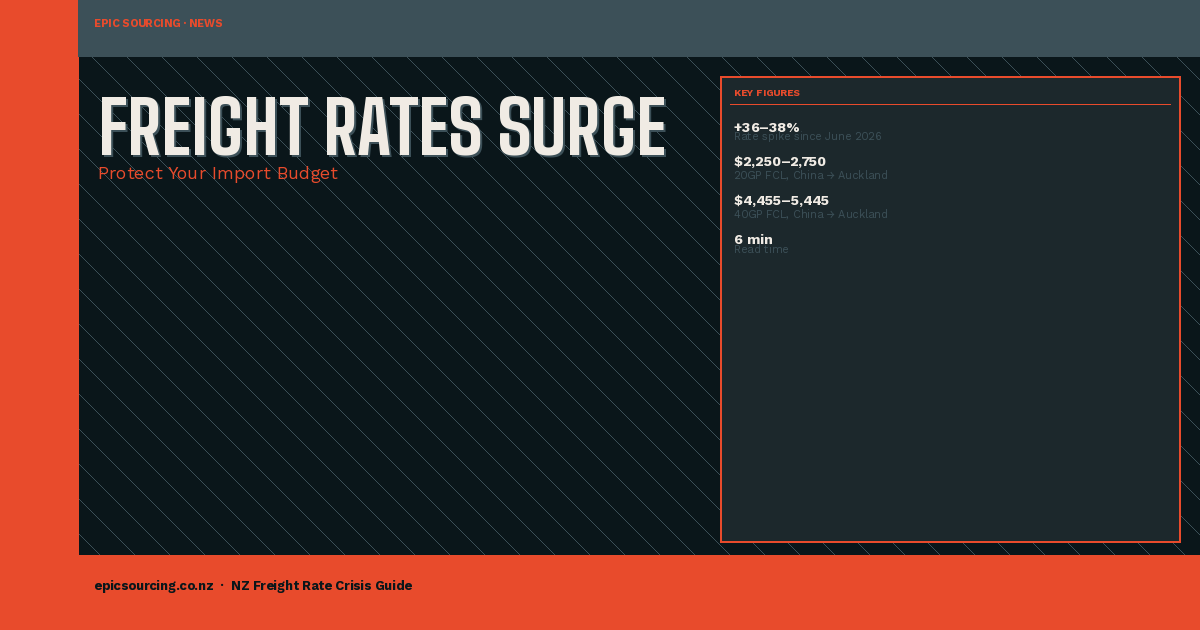
If you've been getting freight quotes lately and doing a double-take, you're not alone. China-to-NZ ocean freight rates have spiked sharply in July 2026, jumping 36–38% compared to June. That's a big move in a short time — and it's caught a lot of Kiwi importers off guard.
The good news? Air freight hasn't followed suit. In fact, rates have softened slightly to around USD $3.60/kg, making it — in some cases — a genuinely competitive option right now. Not always, but more often than you'd think.
In this post, we'll break down exactly what's happening with shipping in July 2026, what it's actually costing, and how to figure out whether sea or air makes sense for your next order. Let's dive in.
What's Actually Happening with Ocean Freight in July 2026?
July marks the beginning of Oceania's peak shipping season. Carriers are filling capacity fast, and that demand pressure is pushing FCL (full container load) rates up sharply. Vessel operations remain reliable — this isn't a disruption, it's a seasonal capacity crunch. Here's where rates currently sit:
- 20-foot container (FCL 20GP): USD $1,890–$2,310 — up 36% from June
- 40-foot container (FCL 40GP): USD $3,735–$4,565 — up 38% from June
- LCL (less than container load): USD $38/cbm — flat
- Air freight: USD $3.60/kg — softening
Transit times are holding steady: Sea freight FCL to Auckland takes 20–23 days, LCL takes 21–27 days, and air freight reaches Auckland in 3–7 days. The surge is expected to ease towards Q4 2026, but for now, it's a very real cost you need to plan around.
When Does Air Freight Make Sense?
At $3.60/kg, air freight isn't cheap — but it's more competitive right now than it's been in months. Here are four scenarios where air might actually win:
- Small, high-value orders under 100kg — Air is often comparable once you factor in FCL minimums and port fees on LCL.
- Time-sensitive stock replenishment — If you've run out of a hero SKU and can't wait 3–4 weeks, air's 3–7 day transit might save a lost sale.
- New product samples or test orders — Air makes sense when you're validating a product before committing to a sea freight MOQ.
- Products with high value-to-weight ratios — Electronics, jewellery, high-end accessories — the freight cost per unit is low enough to absorb air.
Sourcing Hack #1: The Cost-Per-Unit Test — Before choosing air vs sea, calculate freight cost per unit — not just total freight. A $500 air freight bill on 200 units = $2.50 per unit. If your product retails at $50, that's 5% of COGS. Run this calculation before dismissing air as too expensive.
When Sea Freight Still Wins
For most Kiwi importers, sea freight remains the right call — even with the July surge. If you're ordering large volumes (a full container or 3+ CBM of LCL), heavy low-value goods like furniture or construction supplies, or anything where a 3–4 week lead time is fine, sea freight is almost certainly your better option.
LCL at $38/cbm is holding flat, which means small-to-mid volume orders are still cost-effective by sea. And remember — even with the FCL spike, NZ importers pay 0% duty on Chinese goods under the NZ-China Free Trade Agreement. That's a significant cushion that most other countries don't have.
How to Lock In Better Ocean Rates Right Now
You don't have to just accept peak-season pricing. Here's what smart importers are doing in July:
- Book early — Carriers reward forward bookings. If your next order is coming in August or September, get quotes now.
- Consolidate shipments — Combine two smaller LCL shipments into one to reduce handling and per-unit costs.
- Consider port flexibility — Auckland is the primary port, but Tauranga sometimes offers better rates or faster turnarounds.
- Use a freight forwarder with local buying power — They buy space in bulk and can often pass on better rates than you'd get going direct.
Sourcing Hack #2: The Float Your Order Strategy — If your cash flow allows, order slightly earlier than you need and let goods travel by the cheapest sea route. Build transit time into your reorder point and it becomes a non-issue.
The NZ Advantage — Zero Tariffs Under the China FTA
Here's some reassuring context: New Zealand's trade with China hit NZ$30B in 2025 — imports up 12% on electronics and renewables. China remains NZ's largest trading partner at NZ$41B+ two-way. The relationship is strong, and the 0% tariff advantage under the NZ-China FTA means our landed costs are still among the most competitive in the world.
US importers are currently paying ~30% tariffs on Chinese goods. Even with the July freight surge, the total cost equation for Kiwi businesses importing from China is genuinely solid — we're in a privileged position.
Your July 2026 Action Plan
If you have an upcoming order, here's what to do right now:
- Get quotes for both sea and air, then run the cost-per-unit calculation for each.
- Check your stock levels — do you have runway to wait for sea freight, or is air justified?
- Talk to your freight forwarder about LCL consolidation options if you're doing smaller volumes.
- Start planning Christmas stock orders now — the peak season will ease, but August/September will be another busy window.
Not sure how freight costs will affect your landed price? That's exactly the kind of thing we work through with clients at Epic Sourcing. Book a free consultation at epicsourcing.co.nz and we'll help you model the numbers for your next order — sea, air, or a mix of both.
Related Articles


Let’s Make It Epic
We're here to make sourcing simple – and a whole lot less stressful.
We are experiencing a higher volume of enquiries than usual. Our standard reply time for form submissions and emails is within 72 hours.
If your matter is urgent, please schedule a video call using the link below.
