
.svg)
China to NZ Shipping Rates Are Up 30%: How to Protect Your Import Budget in 2026

.svg)
What Are China-to-NZ Freight Rates Looking Like Right Now?
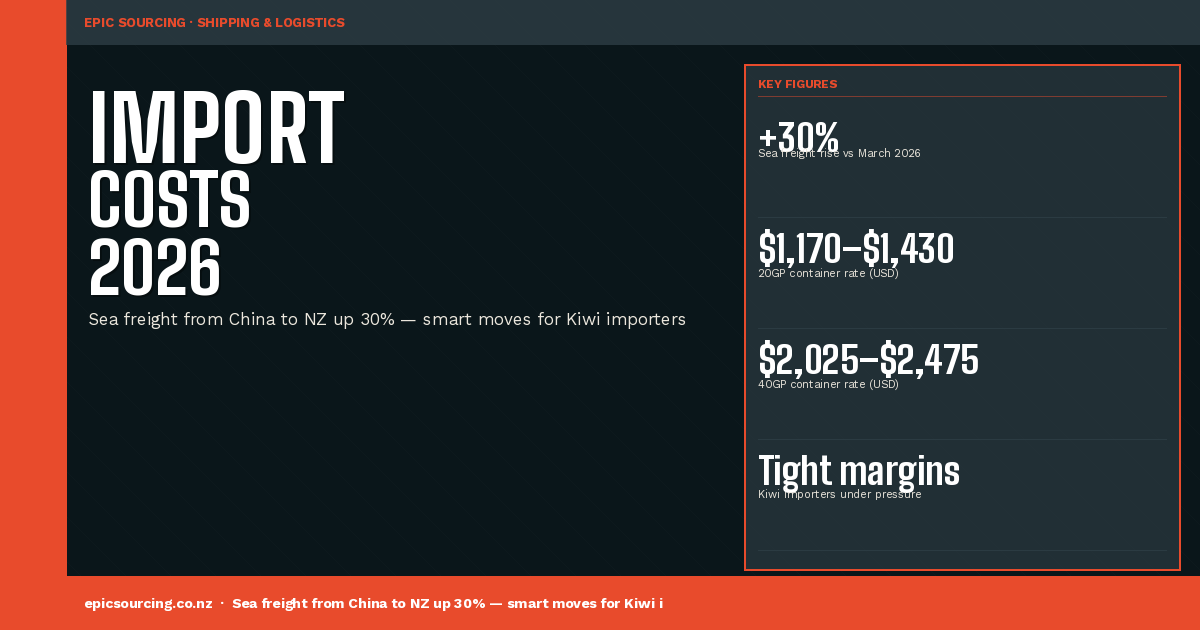
If you've been importing products from China over the past few months, you've probably noticed your freight invoices are looking a wee bit heavier than usual. And no, it's not your imagination — shipping rates on the China-to-New Zealand corridor have jumped significantly in 2026, with sea freight up as much as 30% compared to March.
Here's a snapshot of current rates as of May 2026:
- 20ft container (20GP): USD $1,170–$1,430 — up 30% vs March
- 40ft container (40GP): USD $2,025–$2,475 — up 15% vs March
- LCL (less-than-container-load): USD $5/cbm — stable (great news for smaller shipments!)
- Air freight: USD $4.50/kg — up 12%
- Express courier: USD $7.55/kg — up 12%
Transit times remain at around 20–23 days for FCL and 25–30 days for LCL. So it's not slower — just more expensive.
Why Are Shipping Rates Rising Again?
A few things are going on at once. The US-China trade war continues to reshape global container flows. With US tariffs on Chinese goods sitting around 30%, many US importers are scrambling to front-load shipments, eating up available vessel capacity globally — and NZ, being at the end of a long supply chain, feels the squeeze.
Add to that the ongoing disruptions in key shipping lanes and you've got freight forwarders reporting unpredictable capacity. The advice from NZ freight forwarders is consistent: book early, secure your space, and don't rely on last-minute capacity being available at reasonable rates.
Sourcing Hack #1: Book Early, Save Big
If you know you're placing an order in the next 60–90 days, talk to your freight forwarder now. Booking space 6–8 weeks in advance versus last-minute can save you hundreds — sometimes thousands — of dollars per shipment. Ask for a rate lock if possible.
The Silver Lining: LCL Rates Are Holding Steady
Here's something that might actually make your day — LCL rates are stable at around USD $5 per cubic metre. For businesses that don't have enough volume to fill a full container, LCL is often the smart move anyway. Right now, while FCL rates are elevated, LCL looks even more attractive by comparison.
If you're importing product lines like gift boxes, wellness packaging, pet accessories, or craft supplies — the kind of goods that might only take up a fraction of a 20ft container — LCL could save you a significant chunk of change on your next shipment.
5 Practical Ways to Protect Your Import Budget Right Now
- Consolidate your orders. If you've got multiple products or SKUs coming from different suppliers in China, talk to your sourcing agent about consolidating into a single shipment. Fewer shipments = lower total freight cost.
- Go LCL for smaller loads. Don't pay for a full container if you don't need one. LCL rates are stable and much more cost-effective for shipments under 10–12 CBM.
- Renegotiate on Incoterms. If your current arrangement is FOB, consider negotiating CIF temporarily. Suppliers with volume relationships often get better rates than individual importers.
- Review your order frequency. If you're doing quarterly orders, consider consolidating into semi-annual shipments to take advantage of full container economics when you have enough volume.
- Budget in a freight buffer. When building your landed cost calculations, add 15–20% on top of quoted freight rates. Rates are volatile right now.
Sourcing Hack #2: Calculate Your True Landed Cost First
Before committing to a new product order, always work out your full landed cost: factory price + freight + insurance + customs duty + MPI inspection + your margin. A common mistake Kiwi importers make is falling in love with a factory price without running the full numbers. Your landed cost is the only number that matters.
Should You Consider Air Freight?
Air freight is up 12% too, sitting at around USD $4.50/kg. There are situations where it makes sense: you're dealing with a genuine stockout, your product is high-value relative to its weight (jewellery, electronics accessories, beauty products), you have a time-critical launch, or your shipment is small (under 200kg). For most standard restocks, sea freight remains the right choice — just plan ahead and book early.
What's the Outlook for the Rest of 2026?
It's hard to call precisely, but NZ freight forwarders are consistently saying: expect volatility, book early, and don't leave it to the last minute. The reassuring note is that LCL rates are holding firm, and the NZ-China Free Trade Agreement means most manufactured goods still enter NZ at 0% duty. The overall import economics for Kiwi businesses remain strong compared to many other countries.
Want to make sure you're getting the best deal without the headaches? Book a free consultation with the Epic Sourcing team — we'll take a look at your situation and give you straight-talking advice at no cost. Head to epicsourcing.co.nz to get started.
Related Articles


Let’s Make It Epic
We're here to make sourcing simple – and a whole lot less stressful.
We are experiencing a higher volume of enquiries than usual. Our standard reply time for form submissions and emails is within 72 hours.
If your matter is urgent, please schedule a video call using the link below.
