.svg)
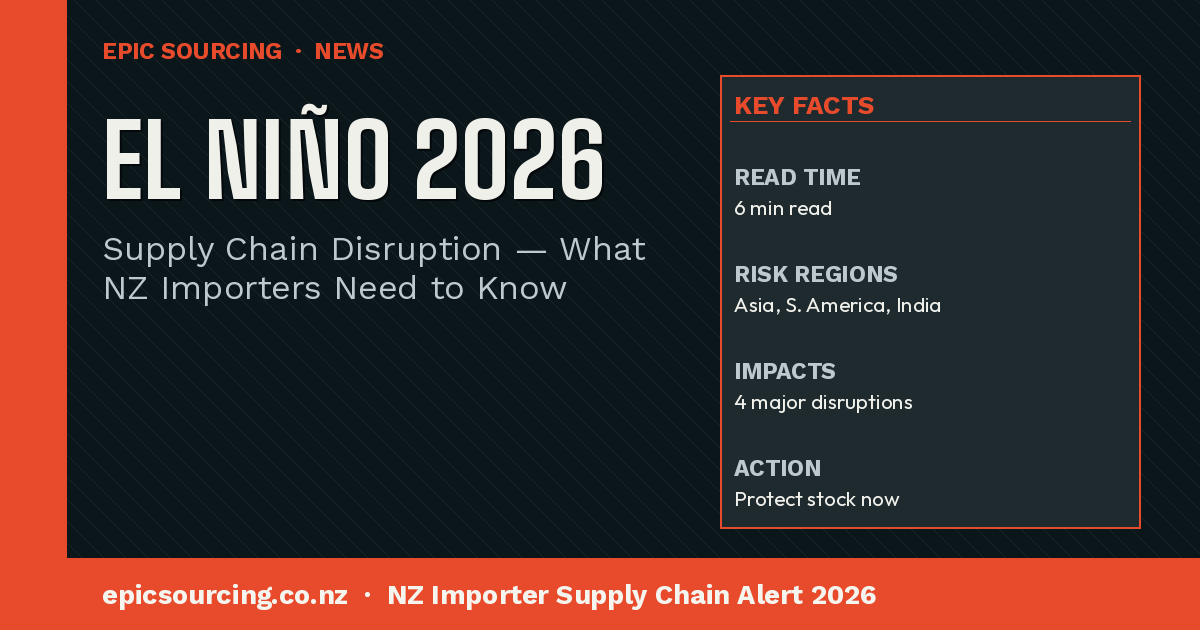
El Niño 2026: What NZ Importers Need to Know About Supply Chain Disruption

.svg)
Here's something that doesn't get nearly enough airtime in the NZ business community: the weather is messing with your supply chain. Seriously.
El Niño conditions are intensifying through 2026, and while most Kiwi businesses are bracing for a dry domestic summer, the global implications for importers are significant — and largely flying under the radar. If you're sourcing products from Asia or South America, this affects you more directly than you might think.
In this post, we're breaking down exactly what El Niño 2026 means for New Zealand importers, which supply chains are most at risk, and — more importantly — what you can do right now to protect your business before the disruption bites.
What Is El Niño — And Why Does It Affect Importing?
Most Kiwis know El Niño as the weather pattern that brings dry, warm conditions to much of New Zealand. But on a global scale, El Niño causes far more widespread disruption than a dry summer at home.
El Niño conditions — driven by warming in the central and eastern tropical Pacific — affect weather patterns across Asia, South America, and the Indian Ocean region. For importers, that means:
- Drought in parts of Southeast Asia — affecting agricultural raw materials and water-intensive manufacturing (cotton, bamboo, timber)
- Flooding in South America — disrupting commodities like soy, coffee, and copper
- Monsoon disruptions in India — affecting cotton, textiles, and food production
- Low water levels in key shipping canals — impacting global freight routes and adding transit time
If your products are manufactured in Vietnam, China, or India — or if your raw materials come from South American or African commodity markets — El Niño 2026 could directly affect your production timelines, costs, and product availability.
The Supply Chain Risks NZ Importers Should Watch
Here are the specific risks to monitor closely in 2026:
- Raw material shortages — Drought in parts of Asia can affect the availability of natural materials like cotton, bamboo, linen, and timber. If your products rely on any of these, get conversations started with your suppliers now.
- Factory downtime — Water-intensive manufacturing (including dyeing, washing, and finishing for apparel) can slow down significantly during drought. Factories may reduce production schedules or run at reduced capacity.
- Shipping route delays — Low water levels in key shipping canals like the Panama Canal (which saw significant restrictions during the 2023-2024 El Niño event) can force vessels onto longer routes, adding 1-3 weeks to transit times.
- Cost increases — Any constraint on supply or shipping capacity typically pushes costs up. If you're mid-negotiation with a supplier, lock in pricing as soon as possible.
- Port congestion — Diverted shipping routes create congestion at certain port hubs, causing delays even for goods not directly affected by El Niño.
Sourcing Hack #1: Map Your Supply Chain Risk Now
Ask your suppliers two key questions: (1) What raw materials do you use, and where do you source them from? (2) Have you seen any El Niño-related impacts on your production this year? A good supplier will be happy to discuss this. If they're sourcing materials from drought-affected regions, discuss buffer stock options before lead times blow out.
Which NZ Importers Are Most at Risk?
Not all importers face the same level of risk. Here's a quick breakdown:
Higher risk:
- Apparel and textile importers (cotton, linen, bamboo sourced from Southeast and South Asia)
- Wooden furniture and homewares importers (timber from Southeast Asian forests)
- Agricultural and food product importers (South America or Indian supply chains)
- Businesses with tight lead times and seasonal launch windows
Moderate risk:
- General consumer goods importers from China (more at risk through shipping cost increases than raw material shortages)
- Electronics and hardware importers
Lower risk:
- Businesses with deep buffer stock already in NZ warehouses
- Importers of commoditised products with multiple alternative supplier options
What You Can Do Right Now
Here's the action plan. Even if El Niño doesn't end up being as severe as forecast, these steps protect your business regardless:
- Talk to your suppliers now — Ask them directly how current conditions are affecting their operations and raw material availability. Don't wait for a 'sorry, there's a delay' email mid-season.
- Review your lead times — Add a buffer of 2-4 weeks to expected production and shipping timelines for the next 6 months.
- Order earlier than usual — If you have a seasonal product (summer gear, Christmas stock, promotional items), place your order earlier this year.
- Diversify your supplier base — If you rely on a single factory or country, identify alternatives now. Having a backup supplier isn't paranoid — it's resilience planning.
- Keep an eye on the Panama and Suez canals — Both have been flashpoints for shipping disruptions in recent years. Monitor for capacity restriction announcements.
Sourcing Hack #2: Build a Simple Supply Chain Risk Register
Create a spreadsheet with: Supplier name, Country, Key raw materials, Material source region, Current buffer stock (weeks), Last communication date. Review it monthly through 2026. It takes 30 minutes to set up and could save you from a very stressful conversation with customers down the track.
The Bigger Picture: Building Supply Chain Resilience
El Niño 2026 is a useful reminder that the most resilient businesses aren't necessarily the ones with the lowest costs — they're the ones with the most flexible supply chains.
For NZ importers, that often means working with a sourcing partner who has relationships across multiple factories and countries. A China-plus-Vietnam sourcing strategy, for example, gives you real optionality when conditions change in one market. It also means maintaining open communication with your suppliers year-round — not just when you're placing an order.
The Bottom Line
Supply chain disruptions tend to hit businesses that are caught off guard — not those who've done their homework and built some flexibility into their operations. The good news is that NZ importers who act early have a real advantage.
If you'd like help reviewing your current supply chain setup or identifying alternative suppliers as a contingency, Epic Sourcing NZ is happy to help. We offer a free initial consultation — no obligation, just a straight conversation about your situation.
Related Articles



Let’s Make It Epic
We're here to make sourcing simple – and a whole lot less stressful.
We are experiencing a higher volume of enquiries than usual. Our standard reply time for form submissions and emails is within 72 hours.
If your matter is urgent, please schedule a video call using the link below.
