
.svg)
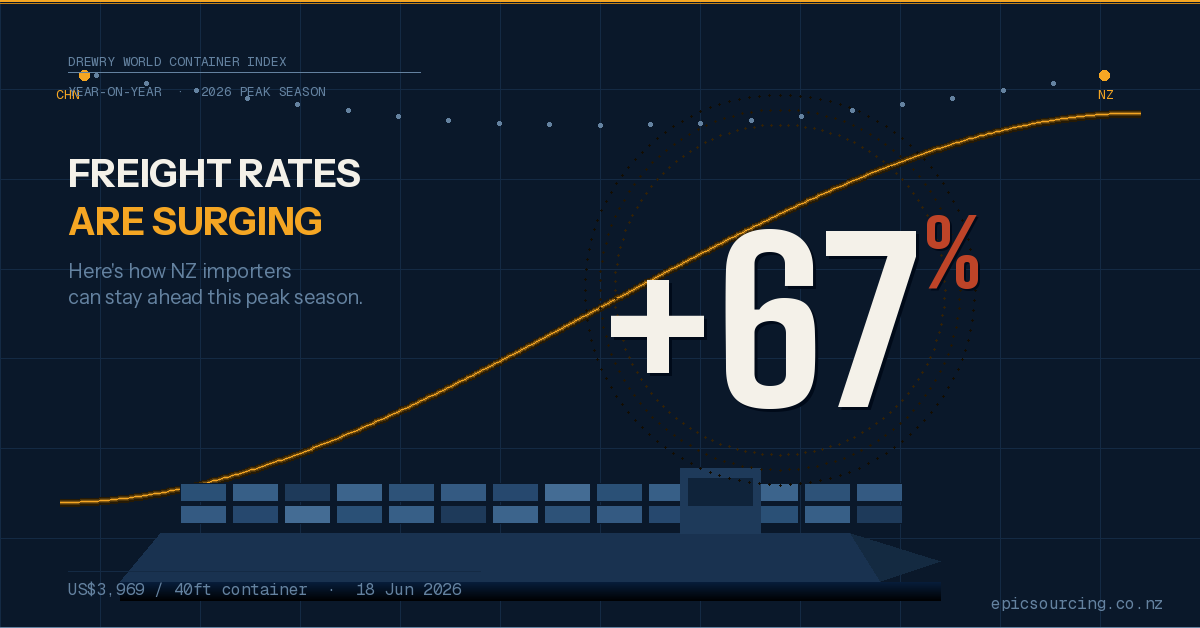
Freight Rates Are Up 67% — Here's What NZ Importers Need to Do Right Now

.svg)
What's Actually Driving the Rate Spike?
Container freight rates are climbing for a combination of reasons, and understanding them helps you anticipate what comes next:
- Peak season demand: Q2–Q3 is traditionally peak shipping season as retailers stock up for Christmas and summer. Demand for container space surges while supply stays roughly fixed.
- Geopolitical disruptions: Ongoing tensions in key shipping corridors have pushed vessels onto longer routes, reducing effective capacity and inflating transit times.
- Port congestion: Major Asian export hubs are experiencing delays, creating ripple effects across global schedules.
- Carrier capacity management: Shipping lines have gotten better at managing capacity to protect profitability — meaning they won't flood the market with cheap space even when demand softens.
The Drewry World Container Index hit $3,969 per 40ft container on 18 June 2026, up 12% in a single week and 67% year-on-year versus June 2025. For Kiwi businesses importing from China, this isn't just a number on a spreadsheet — it's money that comes directly out of your margin.
The silver lining for NZ importers specifically? Shipping from China to New Zealand has remained more stable and reasonably priced than many other trade lanes. NZ imports from China actually increased 15% in early 2026. But that doesn't mean you should be complacent.
The NZ-China Trade Relationship: Some Good News
The NZ-China Free Trade Agreement (FTA) remains one of the most valuable tools in any NZ importer's toolkit. By obtaining a Certificate of Origin from your supplier, you can access preferential tariff rates under the FTA — reducing the landed cost of goods in a way that partially offsets freight increases. If you're not already using this, you're leaving money on the table.
Sourcing Hack #1: Use Your FTA Certificate of Origin — Make sure every shipment from China includes a valid Certificate of Origin to claim NZ-China FTA preferential tariff rates. On a $50,000 shipment, the savings can easily exceed $2,000–$5,000 depending on your product category. Ask your supplier or freight forwarder to arrange this before your next shipment departs.
Pre-Stocking: The Strategy That Pays
One of the most effective things you can do when freight rates are rising is to get your orders in early. Pre-stocking — ordering more inventory now, before rates climb further — might feel counterintuitive when cash flow is tight, but the maths often work out strongly in your favour.
Consider this: if you normally place a $30,000 product order with $4,000 in freight costs, and rates rise another 20% before your next order, you're looking at an extra $800 in freight. Pre-stocking and consolidating two orders into one can often be cheaper than waiting, even after accounting for storage costs.
- Review your sales velocity data and identify your top 10 best-selling SKUs.
- Calculate how many months of stock you could hold without cash flow strain.
- Talk to your supplier about placing a larger order for a small MOQ discount — many factories will negotiate.
- Book your container early — spot rates are volatile, so locking in a rate now via a freight forwarder can save headaches.
LCL vs FCL: Choosing the Right Shipping Mode
If you're not filling a full 20ft or 40ft container, you've probably been using Less than Container Load (LCL) shipping — where your goods share a container with other importers. In a rising rate environment, it's worth doing the maths on whether consolidating orders to fill a Full Container Load (FCL) makes more sense.
As a rough guide: if you're regularly shipping 6 CBM or more per month, run the numbers on switching to FCL. The break-even point varies by lane, but many importers find FCL becomes cheaper above 8–10 CBM on the China-NZ route.
Sourcing Hack #2: Consolidate Orders to Maximise Container Space — Work with your supplier or sourcing agent to time multiple product orders together so you can ship in one FCL container rather than multiple LCL shipments. On the China-NZ route, this can reduce per-unit freight costs by 20–35% compared to LCL — especially during peak season surges.
Working with a Freight Forwarder You Can Trust
The freight market is complex, and the difference between a good and a great freight forwarder can be significant — especially when the market is volatile. A good freight forwarder will:
- Provide you with rate forecasts and market intelligence so you can plan ahead
- Help you navigate biosecurity requirements (NZ's MPI rules can be surprisingly strict)
- Manage documentation including Bills of Lading, Certificates of Origin, and customs entries
- Offer options like sea freight, air freight, or express courier for urgent shipments
What to Expect for the Rest of 2026
Freight analysts generally expect rates to remain elevated through Q3 2026 as peak season demand continues. Some moderation is possible in Q4 as the Christmas rush subsides, but the days of ultra-cheap freight from 2023 appear to be behind us for now.
The key message for NZ importers is this: treat freight as a strategic cost, not just an operational one. Build it into your product pricing, review your supply chain structure, and work with experienced partners who can help you navigate the volatility.
Thinking about how to restructure your importing to manage costs better? Book a free consultation with the team at Epic Sourcing — we help NZ businesses source smarter from China and Vietnam, from factory vetting to freight coordination.
Related Articles



Let’s Make It Epic
We're here to make sourcing simple – and a whole lot less stressful.
We are experiencing a higher volume of enquiries than usual. Our standard reply time for form submissions and emails is within 72 hours.
If your matter is urgent, please schedule a video call using the link below.
