.svg)
Importing from Vietnam to New Zealand: Your Complete 2026 Guide

.svg)
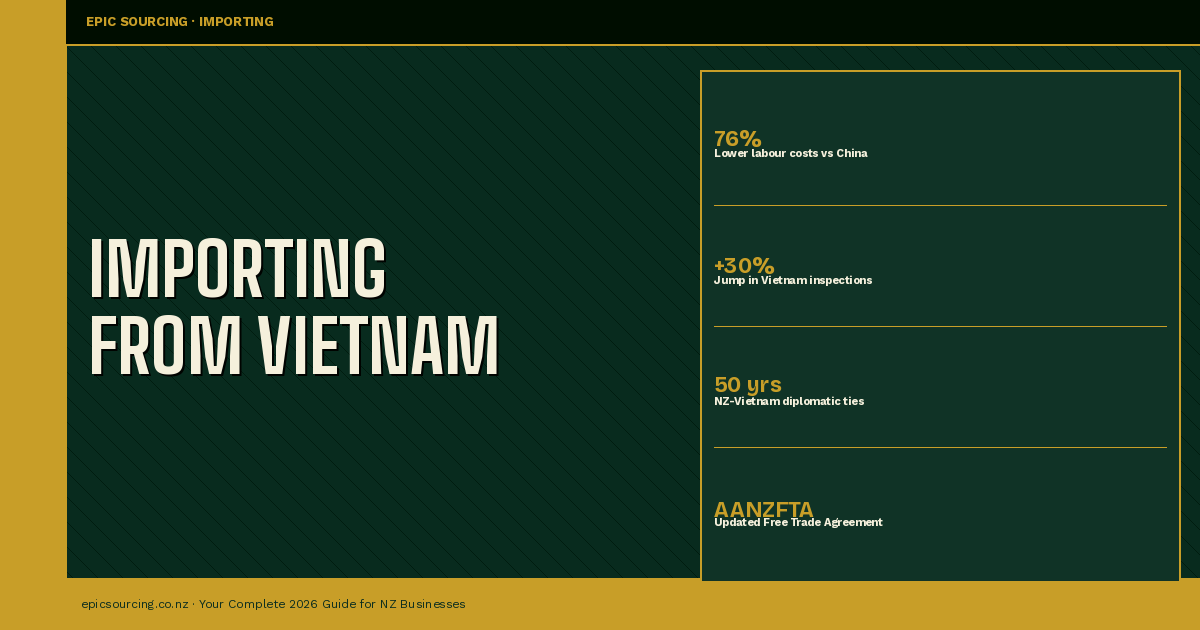
Vietnam has been talked about as the next China for sourcing for years — but in 2026, it's no longer hype. New Zealand and Vietnam just celebrated 50 years of diplomatic relations with a Comprehensive Strategic Partnership upgrade, the AANZFTA free trade agreement has been overhauled, and Vietnam's export industry is genuinely on fire.
Demand for inspections and supplier audits in Vietnam jumped 30% year-on-year according to QIMA's latest data. The country is now the preferred manufacturing destination for mid-to-premium furniture, and it's rapidly expanding into apparel, homewares, and eco products. For NZ importers, that's a significant opportunity — and one that's easier to access than ever. Let's dive in.
Why Vietnam Is a Serious Option for NZ Businesses in 2026
A few years ago, Vietnam was primarily on the radar for large-volume apparel importers. That's changed significantly. Here's what's shifted:
- Labour costs are approximately 76% lower than China, keeping manufacturing price-competitive
- Vietnam has matured its capabilities beyond labour-intensive goods — furniture, technical textiles, and eco products are all growing
- The supply chain ecosystem (logistics, components, quality management) has caught up considerably
- Western brands have invested in Vietnamese factories, lifting quality standards across the board
For NZ businesses that want production diversity — not putting all eggs in the China basket — Vietnam is now a credible alternative or complement.
The NZ-Vietnam Free Trade Agreement — What It Means for You
New Zealand accesses Vietnam through the ASEAN-Australia-New Zealand Free Trade Agreement (AANZFTA). In April 2025, the Second Protocol of the AANZFTA entered into force — and it's genuinely significant for importers.
What the AANZFTA upgrade gives you:
- Streamlined tariff preferences: Many product categories now attract 0% or reduced duty rates under the FTA
- E-commerce provisions: New rules covering digital trade, making cross-border transactions easier to manage
- Customs facilitation: Faster clearance processes and more predictable documentation requirements
- Clearer rules of origin: Better guidance on what genuinely qualifies for preferential tariff treatment
The practical upshot? Goods manufactured in Vietnam and shipped to NZ can attract meaningfully lower import duties than equivalent goods from non-FTA countries. On a large order, tariff savings can easily exceed $10,000. That's not nothing.
What Products Is Vietnam Best At Making?
Vietnam has distinct manufacturing strengths. Knowing where it excels helps you decide if it's right for your products. Vietnam's sweet spots include furniture (solid timber, upholstered, rattan and bamboo — Vietnam is now the world's second-largest furniture exporter), apparel and textiles (strong in activewear, casualwear, and technical garments), footwear, bags and travel accessories, homewares (ceramics, hand-crafted decoratives), and eco and natural products (bamboo goods, natural fibre, rattan).
Vietnam's limitations are worth knowing too. China still dominates electronics and technical components, large-volume production with short lead times, and complex multi-material products where supply chain maturity is important.
Sourcing Hack #1: Match Your Product to the Country — Don't source from Vietnam just to diversify for its own sake. Vietnam is genuinely excellent for furniture, timber goods, apparel, and eco products. If your product needs technical components or very fast turnaround at scale, China may still be the better call. Get advice specific to your category before committing.
Vietnam vs China — Which Is Right for Your Product?
This is the big question for most NZ importers. China advantages: broader product range (almost anything can be made there), established supply chain infrastructure, more English-speaking factory contacts, faster production at scale, and better for technical and electronic products.
Vietnam advantages: lower labour costs (significant for labour-intensive products), attractive FTA tariff rates under AANZFTA, excellent quality for furniture and apparel, lower US tariff exposure (relevant if you also export to US markets), and growing quality and compliance credentials.
The truth is, many savvy NZ importers source from both. China for high-volume, technically complex, or time-sensitive goods; Vietnam for furniture, premium apparel, and eco lines where quality and value are the priority.
How to Find Reliable Vietnamese Suppliers
Finding good suppliers in Vietnam takes more legwork than in China, where platforms like Alibaba aggregate thousands of manufacturers. Here's where to start:
- Global Sources and Alibaba: Vietnam suppliers increasingly list here, especially in furniture and apparel
- Industry trade shows: Vietnam International Furniture Fair (VIFF), Vietnam Manufacturing Expo
- Country trade pages: Vietnam Chamber of Commerce (VCCI) supplier directories
- Sourcing agents based in Vietnam: Local agents can access factories without English-language online presence — often the hidden gems
- Direct referrals: Other importers who've worked with Vietnamese factories are the best leads you'll find
One important note: due diligence in Vietnam is critical. Verify factory registration, check for export history (ask for shipping records), and always get samples before committing to production.
Sourcing Hack #2: Start with an Audit, Not Just Samples — Before placing a first order with a new Vietnamese factory, commission a third-party audit (approx USD $300-500) through QIMA, Bureau Veritas, or SGS. Inspection demand in Vietnam jumped 30% in 2025 — there's a reason experienced importers are investing in this step. The audit report will tell you more in one day than six months of email back-and-forth.
Quality Control and Compliance When Importing from Vietnam
Quality control in Vietnam follows the same principles as China, with some nuances. Factory staff are less likely to speak fluent English than in major Chinese export hubs — a Vietnamese-speaking agent or QC firm is a significant advantage. Make sure your goods genuinely qualify for AANZFTA preferential treatment; they need to be manufactured in Vietnam, not just transshipped. All goods imported to NZ must meet relevant standards — Vietnamese factories may not know NZ-specific requirements, so brief them explicitly. Letter of Credit (LC) or Escrow is advisable for payment on first orders with new suppliers.
Ready to Explore Vietnam Sourcing?
Vietnam is genuinely exciting for NZ importers right now — but it rewards those who go in informed. Epic Sourcing has experience sourcing from both China and Vietnam and can help you figure out the right approach for your products. Book a free consultation at epicsourcing.co.nz and let's talk through your options.
Related Articles


Let’s Make It Epic
We're here to make sourcing simple – and a whole lot less stressful.
We are experiencing a higher volume of enquiries than usual. Our standard reply time for form submissions and emails is within 72 hours.
If your matter is urgent, please schedule a video call using the link below.
