.svg)
Private Label Sourcing in New Zealand: The Complete Kiwi Business Guide

.svg)
You've probably noticed them at the supermarket, on Instagram, or in your local boutique — brands with clean logos, quality products, and surprisingly affordable price points. There's a good chance many of them are private label products: goods manufactured by a third-party factory and sold under the brand's own name.
Private labelling isn't some dark art reserved for big corporations. In fact, it's how thousands of small Kiwi businesses have launched successful product brands — from skincare lines to outdoor gear to kitchen accessories — without needing to build their own manufacturing facility.
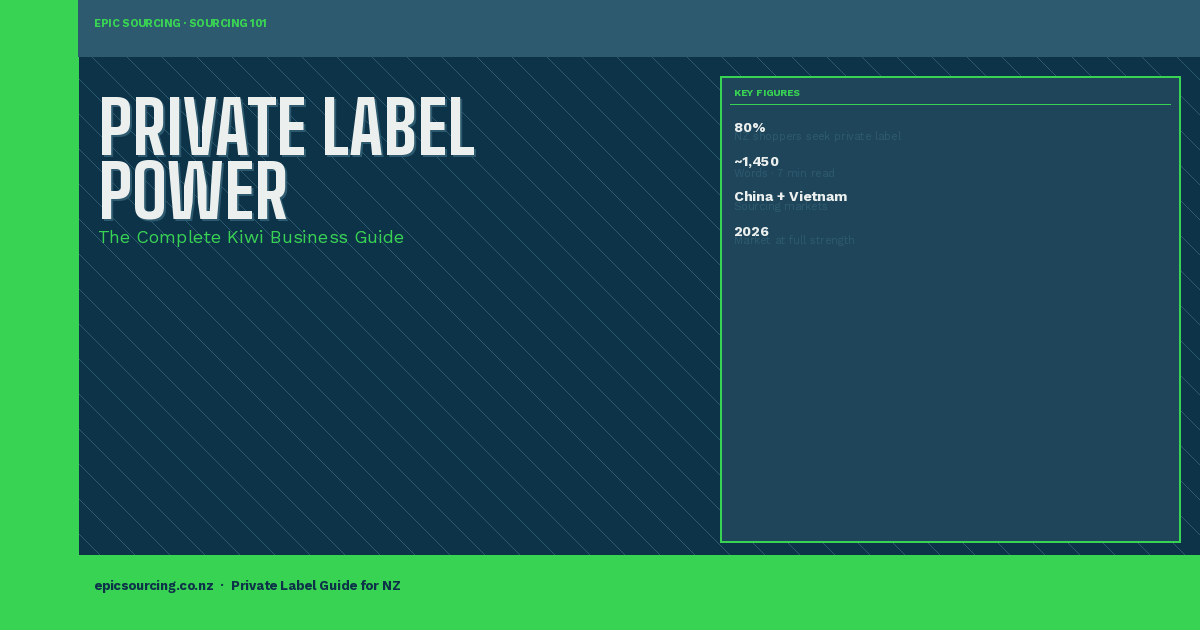
In 2026, with 80% of NZ shoppers actively seeking private label alternatives to big-name brands, the market for own-brand products has never been stronger. Here's everything you need to know about making it work.
What Is Private Label Sourcing, Exactly?
Private labelling means you purchase a product from a manufacturer, brand it with your logo, packaging, and design, and sell it as your own. You don't design the core product from scratch — you select from existing or lightly customised designs that the factory already produces, and apply your branding on top.
This is different from white labelling (where the exact same product is sold under many brand names) and product development (where you design something entirely new). Private label sits in the sweet spot: more differentiation than white label, lower risk and cost than full product development.
What Types of Products Work Best?
- Skincare and beauty: Moisturisers, serums, cleansers, sunscreens
- Activewear and clothing: Sports bras, leggings, training tops
- Homewares: Candles, glassware, kitchenware, storage solutions
- Supplements and health products: Protein powders, vitamins
- Outdoor and sporting goods: Yoga mats, resistance bands, balance boards
- Eco-friendly accessories: Reusable bottles, bamboo products
Sourcing Hack #1: Start With a Product You Already Buy — The best private label businesses often start with a founder who personally uses a product category and sees a gap in the market. If you're already buying activewear, supplements, or homewares regularly, you have built-in product knowledge that's genuinely hard to fake.
How to Source Private Label Products from China (Step by Step)
- Define Your Product Specification. Write a clear spec: dimensions, materials, colours, certifications required, target unit cost, and desired MOQ. Without this, quotes won't be comparable.
- Find Qualified Manufacturers. Look for factories with OEM/ODM experience, existing export history, and ISO or GMP certification for your category.
- Request Samples. Never order private label stock without sampling first. A sample order might cost $200–$500, but it can save you from a $15,000 mistake.
- Negotiate MOQs and Pricing. Chinese factories often have MOQs of 200–1,000 units for private label. Ask if you can pay a slightly higher per-unit price for a smaller initial run.
- Lock In Quality Control. Arrange a pre-shipment inspection before your goods ship. This catches defects before they arrive in NZ and become your problem.
- Plan Your Freight and Compliance. All manufactured goods from China enter NZ at 0% duty under the NZ-China FTA. Ensure your products meet NZ labelling requirements.
Sourcing Hack #2: Use a Sourcing Agent for Your First Order — Navigating Chinese manufacturing for the first time is complex — language barriers, payment terms (30% deposit, 70% on completion), and quality verification all require expertise. A good NZ sourcing agent pays for themselves by catching problems before they become expensive.
How Much Does It Cost to Launch a Private Label Product?
- Product sampling: $200–$600
- Minimum order (500 units at $8–12/unit): $4,000–$6,000
- Custom packaging: $500–$1,500
- Freight from China: $800–$2,500
- NZ customs/compliance: $300–$600
- Total first-run estimate: approximately $6,000–$11,000
The Private Label Opportunity in 2026
Consumer behaviour has shifted decisively. The 'dupes' trend has normalised private label buying in categories that previously felt premium-only. NZ shoppers are price-sensitive right now, and a well-presented private label product that delivers quality can genuinely compete with established names.
Mobile commerce accounts for 65.7% of NZ ecommerce sales — and private label gives you full control over your brand presentation. Growth sectors perfect for private label: Recreation & books (+18% YoY), clothing (+12%), and health & beauty (+9%).
Common Mistakes to Avoid
Over-ordering on your first run is the most common trap. Start with the minimum viable quantity, sell through it, and scale once you have proof of demand. Skipping compliance checks is another costly error — NZ has specific labelling and product standards. And choosing a supplier on price alone tends to end badly — the cheapest factory quote often comes with the highest defect rate.
Want help sourcing for your business? Book a free 30-minute consultation with the Epic Sourcing NZ team at epicsourcing.co.nz. No obligation, no jargon — just honest advice from people who've been doing this for years.
Related Articles

Let’s Make It Epic
We're here to make sourcing simple – and a whole lot less stressful.
We are experiencing a higher volume of enquiries than usual. Our standard reply time for form submissions and emails is within 72 hours.
If your matter is urgent, please schedule a video call using the link below.
