
.svg)
How to Source Homewares from China for NZ Retail (and Save a Serious Amount of Money)

.svg)
If you run a homewares store, a gift shop, or an online NZ retail business, you've probably noticed that margins can be tight. And when you're buying wholesale from local distributors, there's a good chance you're paying a significant mark-up before the product even lands in your hands.
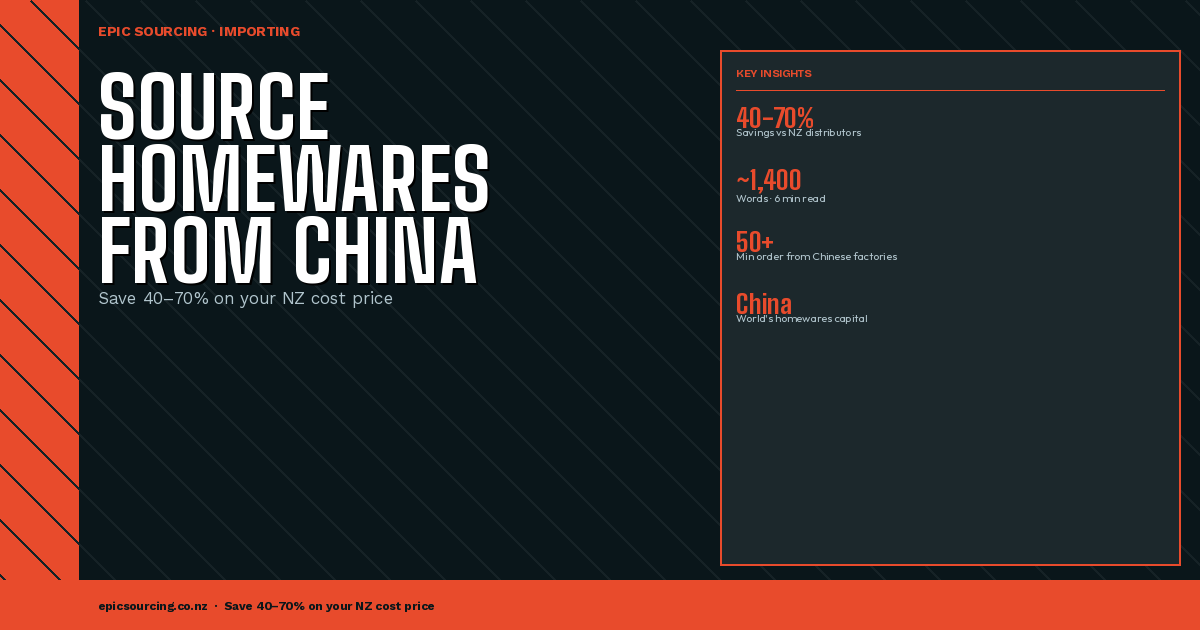
The good news? Sourcing homewares directly from China can cut your cost price dramatically - we're talking 40-70% savings compared to buying through NZ distributors. Whether you're selling cushions, candles, ceramic mugs, bamboo chopping boards, or decorative storage baskets, this guide is for you.
Why China Is Still the World's Homeware Capital
China produces the majority of the world's homewares. From Foshan's ceramics hub to Yiwu's small goods market to Guangzhou's furniture district, there are entire cities built around manufacturing the kinds of products you'd find in a NZ homewares store.
- Scale - manufacturers can produce from small runs (50-200 units) all the way to container loads
- Variety - whatever you can imagine in homewares, there's almost certainly a factory already making something close to it
- Competitive pricing - labour costs remain lower than most Western markets
- Infrastructure - freight networks from China to New Zealand are well-established
Sourcing Hack #1: Start with a niche, not a range. Don't try to source your entire homeware collection from scratch. Pick one or two hero product categories first - say, ceramic servingware or natural fibre baskets - nail the supplier relationships, and expand from there.
The Best Homeware Categories to Source from China
Great candidates include ceramic mugs and bowls (Chaozhou and Jingdezhen are the ceramic heartlands), natural fibre products like rattan, bamboo, and seagrass, candles and fragrance accessories, textiles such as cushion covers and throws, kitchen accessories like bamboo cutting boards and silicone utensils, and decorative storage like wicker baskets and wooden boxes.
Categories that need more diligence: anything with electrical components (NZ compliance required), children's items (toy safety standards apply), and food-contact items (NZ food safety requirements).
Where to Find Homeware Suppliers
Alibaba (alibaba.com) is the go-to starting point for most importers. Use the Verified Supplier and Trade Assurance filters, and look for factories that specialise in your product type. 1688.com, Alibaba's Chinese-language cousin, often has lower prices but you'll need a buying agent. The Canton Fair in Guangzhou, held twice a year, has a massive homewares section. And a good sourcing agent like Epic Sourcing NZ can identify qualified suppliers on your behalf and manage quality control.
Sourcing Hack #2: Use reverse image search on Alibaba. If you've spotted a product you love in a competitor's store, try uploading the image directly to Alibaba's image search. It's surprisingly effective at finding the manufacturer quickly.
What to Expect on Pricing and MOQs
MOQs for homewares vary: generic stock products often 50-200 units per SKU, semi-customised products typically 200-500 units, and fully custom designs usually 500+ units. For unit pricing, ceramic mugs (custom logo) run NZD $3-6 per unit ex-factory, natural rattan storage baskets NZD $8-20, linen cushion covers NZD $5-12, and bamboo cutting boards NZD $4-10. Even with freight and customs added, these prices typically land well below NZ wholesale pricing.
Getting Your Products to NZ
Sea freight (LCL or FCL) is the most cost-effective option, with transit times of 18-28 days from China. Air freight is faster (5-10 days) but costs significantly more per kilogram. You'll also need to factor in NZ Customs duties (most homewares attract 5%, some are duty-free under FTA provisions), GST at 15%, customs brokerage fees, and local delivery.
Quality Control - Don't Skip This Step
For homeware orders over NZD $5,000-10,000, we strongly recommend: pre-production approval (confirm materials and specs in writing), in-line inspection during production, and a pre-shipment inspection before goods leave the factory.
Sourcing Hack #3: Always order a packaging sample. Ask your supplier to pack a single sample unit as they would for export and courier it to you. Open it and check: would this survive being knocked around in a container for 3 weeks?
Is It Worth Using a Sourcing Agent?
If this is your first time sourcing homewares from China, honestly - yes. At Epic Sourcing New Zealand, we help Kiwi retailers find and import homeware products from China every day. Whether you're after custom ceramic tableware or natural fibre baskets, we've got the supplier network to make it happen. Book a free consultation at epicsourcing.co.nz to explore what's possible for your business.
Related Articles

Let’s Make It Epic
We're here to make sourcing simple – and a whole lot less stressful.
We are experiencing a higher volume of enquiries than usual. Our standard reply time for form submissions and emails is within 72 hours.
If your matter is urgent, please schedule a video call using the link below.
