
.svg)
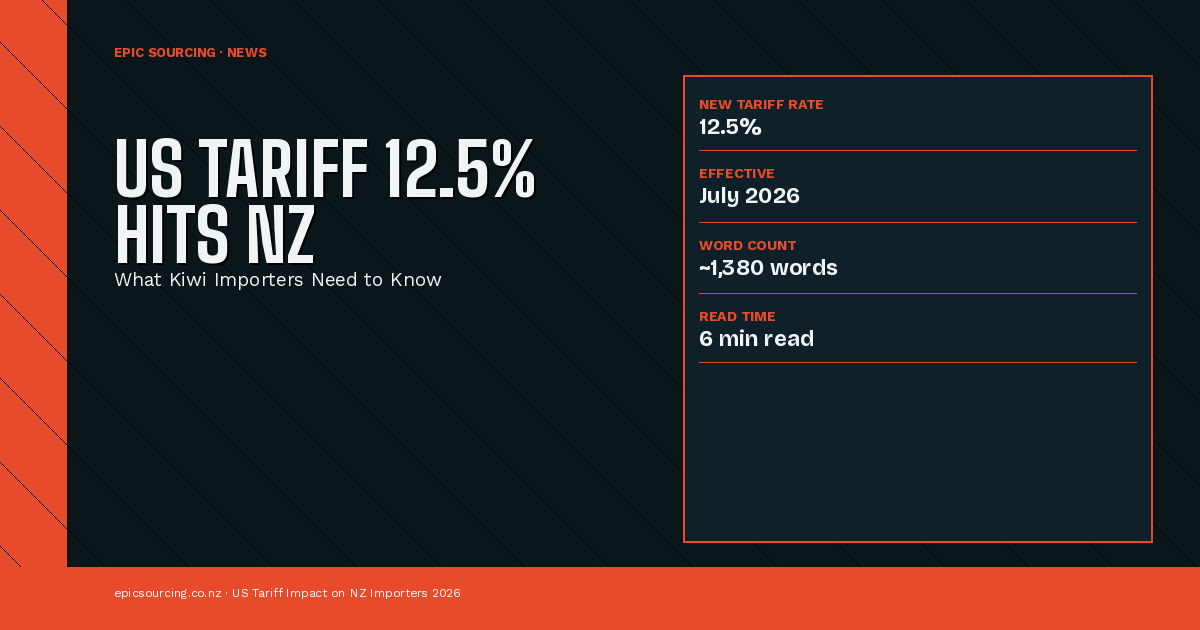
The New US Tariff on NZ Goods: What Kiwi Importers and Business Owners Need to Know

.svg)
What Exactly Did the US Do?
On 28 July 2026, the United States imposed a 12.5% tariff on New Zealand goods — up from 10%. While that might sound like it's only relevant if you're exporting to America, the knock-on effects for Kiwi importers and local businesses are worth paying attention to.
Trade policy rarely stays in its lane. When major economies shift their tariff structures, it creates ripple effects through supply chains, currency markets, and even the way manufacturers in Asia price their products. If you import anything from China or Vietnam for resale in New Zealand, this is worth reading.
Under the Trump-era tariff framework, the US has been steadily adjusting its trade barriers with non-aligned countries. The new 12.5% rate applies to NZ goods exported to the US — things like dairy products, meat, wine, timber, and manufactured goods.
When NZ export industries face headwinds in their biggest markets, it can affect:
- The NZD exchange rate — a weaker NZ dollar makes your Chinese imports more expensive
- Global shipping capacity — reduced NZ export volumes can shift container availability on certain routes
- Supply chain competitor dynamics — other markets may pivot their sourcing strategies, affecting factory capacity and pricing
The NZD Exchange Rate Factor — Why This Matters Most
The most direct way this affects importers is through the exchange rate. If US tariffs dampen NZ export earnings, it can put downward pressure on the New Zealand dollar. And a weaker NZD means your USD-priced Chinese or Vietnamese imports cost more in NZ dollars.
As of August 2026, the NZD/USD rate has been hovering around 0.60–0.62. Any further weakness adds cost pressure on top of the 36–38% freight rate surge we've seen since June.
Sourcing Hack #1: Lock in your exchange rate — Consider using a forward exchange contract through your bank or a foreign exchange service like Convera or OFX. Even locking in your rate for 3 months can protect your margins if the NZD weakens further.
Will This Affect Chinese Factory Pricing?
Indirectly, yes — though not immediately. Many Chinese factories have been redirecting capacity toward other buyers including Australasia, as US tariffs on Chinese goods remain elevated (30–145% on many categories since 2024). This has actually been positive for pricing and lead times for NZ buyers.
Bottom line: factory pricing from China remains relatively stable for NZ buyers in the short term. The bigger risk is freight and currency, not ex-factory cost — at least for now.
What This Means for Your Import Strategy
If you're currently importing from China or planning to start, here's the practical reality for August 2026:
- Freight rates are up 36–38% from June 2026 — this is a bigger immediate cost pressure than tariffs.
- The NZD is under mild pressure — every cent of weakness adds cost.
- The NZ-China FTA remains fully intact — 0% duty on manufactured goods from China entering NZ.
- Vietnam remains a strong alternative for certain categories — Vietnam International Sourcing 2026 (VIS 2026) is running Aug–Sep 2026.
Hybrid Sourcing: The Risk Mitigation Strategy Smart Kiwis Are Using
The most resilient importers are using a hybrid model: China for cost-effective manufacturing of core products, Vietnam for finished goods in certain categories, and NZ local production for items where lead time is critical.
Vietnam wages remain approximately 50% lower than China's, and Vietnam's FTA network now covers the EU, UK, ASEAN, and other major markets. For the right product categories, it's a genuinely compelling complement to China.
Sourcing Hack #2: Audit your supplier concentration risk — List every product you import and which country it comes from. If more than 70% comes from a single country and factory, you're exposed. Even having a second-quoted supplier in a different country gives you negotiating leverage and a backup plan.
Action Items for August 2026
- Book your Q4 shipments now — freight capacity is tight and rates are elevated.
- Review your pricing — with freight and currency moves, your margins from 6 months ago may no longer apply.
- Get a supplier quote from Vietnam if you haven't already.
- Consider a forward exchange contract for the next 90–180 days.
- Talk to a sourcing expert who monitors these shifts daily.
Trade policy will keep shifting. That's the reality of importing in 2026. But businesses that stay informed and agile — and that have expert help on their side — will continue to source profitably regardless of what Washington and Beijing do next.
Related Articles


Let’s Make It Epic
We're here to make sourcing simple – and a whole lot less stressful.
We are experiencing a higher volume of enquiries than usual. Our standard reply time for form submissions and emails is within 72 hours.
If your matter is urgent, please schedule a video call using the link below.
