
.svg)
China-NZ Shipping Rates Are Rising in April 2026: What NZ Importers Need to Know

.svg)
If you've been importing goods from China recently, you've probably noticed something uncomfortable happening to your freight invoices. That number at the bottom — the one that covers getting your goods from a factory in Guangdong to a warehouse in Auckland — has gone up. Noticeably. And it's not your imagination.
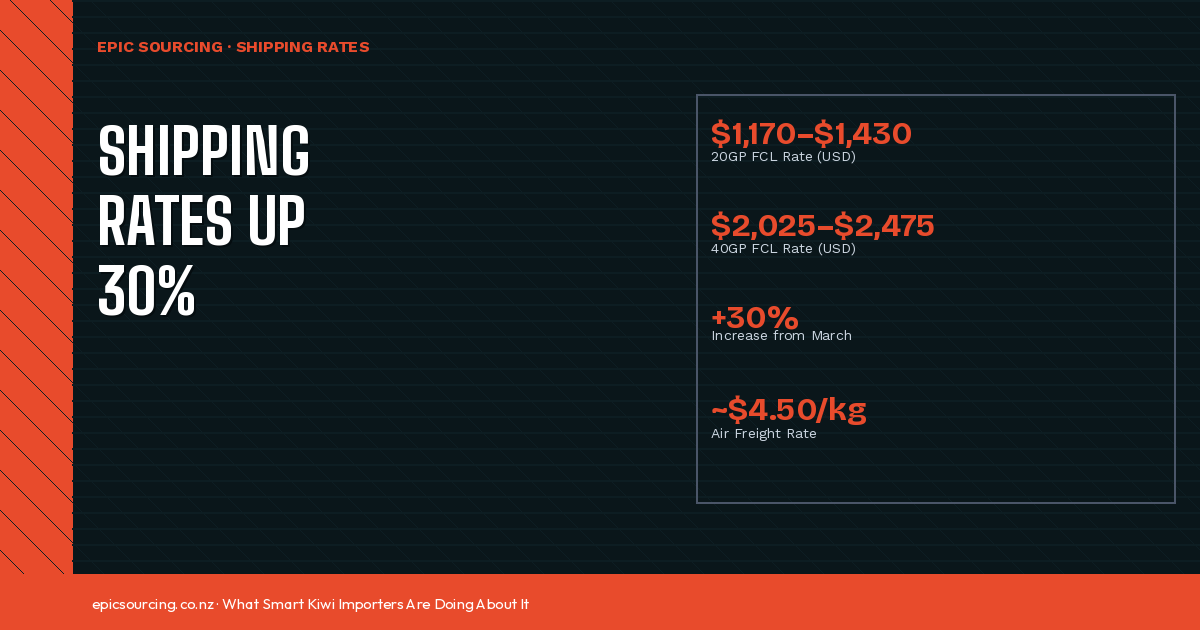
China-NZ sea freight rates have risen sharply in April 2026, with 20-foot containers up 30% compared to March, and 40-foot containers up 15%. Add in new emergency fuel surcharges from carriers like Maersk, and you've got a meaningful cost hit that every NZ importer needs to plan around right now.
So, let's dive into what's happening, why it's happening, and — most importantly — what you can actually do about it.
The April 2026 China-NZ Freight Rate Update
Here's the current state of play on freight rates from China to New Zealand this month:
- China-NZ 20GP (20-foot container): USD $1,170–$1,430 (+30% vs March)
- China-NZ 40GP (40-foot container): USD $2,025–$2,475 (+15% vs March)
- China-NZ LCL (less-than-container-load): USD $5/cbm (stable — good news!)
- China-NZ Air Freight: USD $4.50/kg (+12% vs March)
- Global 40ft average: USD $2,287
On top of base rates, Maersk is pushing emergency fuel surcharges of up to US$200 per container. That's not a typo. So if you were budgeting based on Q1 rates, your cost calculations need a refresh before you place your next order.
Why Are China-NZ Freight Rates Rising?
The short answer: geopolitical tension is messing with fuel costs, and that's flowing straight through to freight rates.
US-Iran tensions have been constraining bunker fuel supply — the heavy fuel oil that powers cargo ships. When fuel costs jump, carriers pass that through to importers via surcharges and rate increases. It's not personal; it's just how global shipping works.
There's also a broader tightening of capacity as we move into mid-year. Q2 traditionally sees stronger demand as brands stock up for second-half seasonal products. Combine that with fuel surcharge pressure and you've got the recipe for where we are right now.
The upshot? This doesn't look like a short-term blip. If you're planning imports over the next few months, build current rates — plus a buffer — into your numbers.
What This Means for Your Landed Cost
Here's where it gets practical. Freight is just one component of your total landed cost — but when it moves 15–30%, it can make a real dent in your margins.
Let's say you're importing a run of custom activewear from a factory in Fujian province. You've ordered a 40GP container, with a product cost of NZD $15,000. Add NZ customs duties at roughly 5%, standard handling and port charges, and April's freight at around USD $2,300 (approximately NZD $3,800 at current rates), and your total landed cost is meaningfully higher than it would've been in January.
The key lesson: don't model on the cheapest freight quote you saw six months ago. Price in current rates plus a 10–15% buffer for surcharges — and you'll sleep a lot better.
Sourcing Hack #1: Lock In Rates Early
Don't book freight last-minute. Contact your freight forwarder 4–6 weeks before your goods are ready to ship and lock in rates early. Booking in advance also secures container space — which can be tight during peak demand periods. A small planning effort now saves you a nasty surprise on your invoice later.
Should You Switch to LCL to Save Money?
Here's a silver lining in the current rate environment: LCL (less-than-container-load) rates are holding steady at around USD $5 per cubic metre. That's genuinely good news if your orders don't fill a full container.
LCL makes sense when you're ordering a smaller volume (typically under 12–15 cbm), testing a new product line and don't want to over-commit, or want more flexibility on shipment timing. The trade-off is that LCL can take a bit longer due to consolidation at origin and deconsolidation at destination. But for the right order size, LCL right now is actually a smart call.
5 Strategies to Protect Your Margins When Freight Costs Rise
Rising freight rates don't have to crush your margins — if you're proactive about it. Here's what experienced NZ importers do when freight moves against them:
- Order in larger quantities. The freight cost per unit drops significantly when you spread it across a larger order. A 40GP container costs roughly the same whether it's half-full or full — so filling it matters.
- Switch to LCL for smaller, more frequent orders. If your cash flow doesn't support a big order, LCL at the current stable rate is your friend right now.
- Build a freight buffer into your pricing. Smart importers price in freight at a rate 10–15% above current quotes. That buffer absorbs surcharges and rate shifts without cutting into margin.
- Negotiate FOB pricing with your supplier. FOB (Free On Board) means the supplier hands responsibility over at the port of origin. This gives you more control over your freight choice and often results in a lower total cost than CIF.
- Consider air freight for high-margin, low-volume products. At USD $4.50/kg, air freight is expensive — but for small, high-margin products like bamboo sunglasses, premium supplements, or custom jewellery, the maths can still work if you need it urgently.
Sourcing Hack #2: Do the Per-Unit Freight Calculation
Before deciding between sea, LCL, or air — run the per-unit freight number. Divide your total freight cost by the number of units in your shipment. For a product retailing at $30–$50, you generally want per-unit freight to stay under $2–3. If it creeps higher, look at optimising carton sizes, increasing order volume, or switching modes.
How Long Will These High Rates Last?
Honestly? Nobody knows for sure. Freight markets are notoriously cyclical and respond to geopolitical events in ways that are genuinely hard to predict. What we can say is that Q2 2026 is unlikely to see rates drop significantly — especially with ongoing fuel supply uncertainty.
The global average for a 40ft container sits at USD $2,287, and China-NZ routes are currently priced right in line with that global benchmark. Until fuel supply normalises or demand softens, expect elevated rates to continue.
What you can control is how well-prepared you are. Book early, model at current rates, use LCL where it makes sense, and make sure your freight forwarder is giving you regular updates. The good news is that even at April 2026 rates, importing from China still delivers enormous cost savings versus domestic manufacturing or local wholesalers for most product categories. The maths still works — it just needs to be done carefully.
Need help navigating rising freight costs and calculating your true landed costs? Book a free consultation with the Epic Sourcing team at epicsourcing.co.nz — we'll help you model your numbers and optimise your shipping strategy.
Related Articles



Let’s Make It Epic
We're here to make sourcing simple – and a whole lot less stressful.
We are experiencing a higher volume of enquiries than usual. Our standard reply time for form submissions and emails is within 72 hours.
If your matter is urgent, please schedule a video call using the link below.
