.svg)

How to Source Hotel FF&E from China — A Practical Guide for NZ Hospitality & Construction Projects

.svg)
If you're building, refurbishing, or fitting out a hotel, lodge, or resort in New Zealand, you've probably already realised that sourcing all that furniture, fixtures, and equipment locally would blow your budget in about five minutes. That's where China comes in — and for good reason.
Hotel FF&E (that's Furniture, Fixtures & Equipment, for the uninitiated) is one of the fastest-growing categories in Kiwi import enquiries right now. Construction companies, hospitality groups, and interior designers are increasingly turning to China to supply everything from custom joinery and bedroom furniture to restaurant seating and hotel bathroom accessories.
Here's the thing though: hotel FF&E is not like ordering a pallet of activewear. The stakes are higher, the specifications are more complex, and the consequences of getting it wrong — delayed opening, poor quality furniture, non-compliant fittings — can be seriously costly. So, let's walk through how to do this properly.
What is Hotel FF&E and Why Source It From China?
FF&E stands for Furniture, Fixtures & Equipment — the collective term for all moveable, non-structural items in a hospitality property. Think:
- Bedroom furniture (beds, bedside tables, wardrobes, desks)
- Lounge and lobby furniture (sofas, armchairs, coffee tables)
- Restaurant and bar seating and tables
- Custom joinery (headboards, built-in wardrobes, reception desks)
- Lighting fixtures
- Bathroom accessories and fittings
- Outdoor furniture for pools, decks, and gardens
China is the world's largest producer of hotel-grade furniture and FF&E, with manufacturing clusters concentrated in Foshan, Guangzhou, and Shunde. These factories supply hotel groups globally — including major international chains — and can produce to rigorous specifications and international quality standards.
The cost advantage over buying locally or from Australian distributors can be substantial: 30–60% savings on comparable product is common, even after accounting for freight, duties, and sourcing fees.
Step 1 — Get Your Specifications Right Before You Talk to Suppliers
This is where most first-timers go wrong. They approach Chinese factories without clear product specifications and end up with furniture that doesn't meet their standard, doesn't match the design brief, or simply doesn't fit the space.
For hotel FF&E, you should have — or work with your interior designer to create — a proper specification document that includes:
- Dimensions (in millimetres — Chinese factories work in metric)
- Materials — timber species, fabric types, foam density, frame construction
- Finishes — paint colours (Pantone or RAL codes), timber stains, upholstery colours
- Quantity per room type and total across the project
- Quality standards — fire retardancy requirements (especially for upholstered items), load ratings
- Reference images or mood board for design intent
The more detail you provide upfront, the more accurate your quotes will be — and the less room there is for misaligned expectations down the track.
Sourcing Hack #1: Always Request a Sample Unit Before Full Production
For any FF&E item being produced in quantity (say, 20+ units), always request a physical “golden sample” before approving full production. This sample should be signed off by your designer and project manager before the factory runs the full order. Yes, samples cost time and money — typically USD $200–800 per piece plus international courier. But it's a tiny fraction of the cost of receiving a full container of wrong-colour, wrong-dimension furniture.
Step 2 — Finding the Right Factory
Not all Chinese furniture factories are set up to supply international hotel projects. You want factories that:
- Have experience supplying hotel-grade or commercial-grade furniture (not just residential)
- Can demonstrate capacity for your order size
- Hold relevant quality certifications (ISO 9001 is a good baseline)
- Have an English-speaking export team or trading company relationship
- Can provide fire retardancy test certificates if required (essential for NZ Building Code compliance)
Where do you find them? Options include trade platforms like Alibaba and Made-in-China.com for initial screening, the Canton Fair in Guangzhou (the world's largest trade fair, held in April and October), or working with a sourcing agent who has established factory relationships in relevant manufacturing clusters.
For a project of meaningful scale — say, 40+ rooms or a commercial refurbishment — working with a sourcing agent is strongly recommended. The time you'll spend screening factories, negotiating, and managing production remotely isn't free, and mistakes at this scale are expensive.
Step 3 — Managing Quality Control
Quality control (QC) is non-negotiable for hotel FF&E. Unlike a consumer product where a small defect might be acceptable, hotel furniture needs to be consistent, durable, and exactly to specification — because guests will use it hard, every single day.
A proper QC programme for a hotel FF&E order should include:
- Pre-production inspection — verify materials and components before production begins
- During-production inspection (DUPRO) — check a sample of units mid-production
- Pre-shipment inspection (PSI) — inspect the full batch before it's packed and loaded
- Container loading supervision — ensure goods are packed properly to avoid damage in transit
Each of these can be performed by a third-party QC inspection company operating in China (companies like QIMA and Bureau Veritas operate extensively in China's furniture manufacturing clusters). Budget roughly USD $200–400 per inspection visit.
Sourcing Hack #2: Use a Defects Classification System
When briefing your QC inspector, define what constitutes a Critical, Major, and Minor defect — and specify your Acceptance Quality Limit (AQL) for each. A typical hotel-grade standard might be: 0 critical defects allowed, max 2.5% major defects, max 4.0% minor defects. Putting this in writing means your inspector and factory are aligned on what's acceptable before the final inspection, not during it.
Step 4 — Shipping and Delivery Planning
Hotel FF&E orders typically ship in full containers (FCL) given the volume involved. For a 50–80 room project, expect multiple 40-foot containers — sometimes 10 or more, depending on what's included.
Key shipping considerations for hotel FF&E:
- Lead times are long — from order confirmation to delivery, allow 90–120 days minimum (30–45 days production + 2–3 weeks sea transit + NZ Customs clearance + delivery to site)
- Pack properly — furniture must be properly wrapped, padded, and braced inside containers to survive ocean transit
- Stagger your deliveries if the project timeline allows — not everything needs to arrive at once
- Coordinate with your contractor — furniture delivery to site needs to align with construction progress
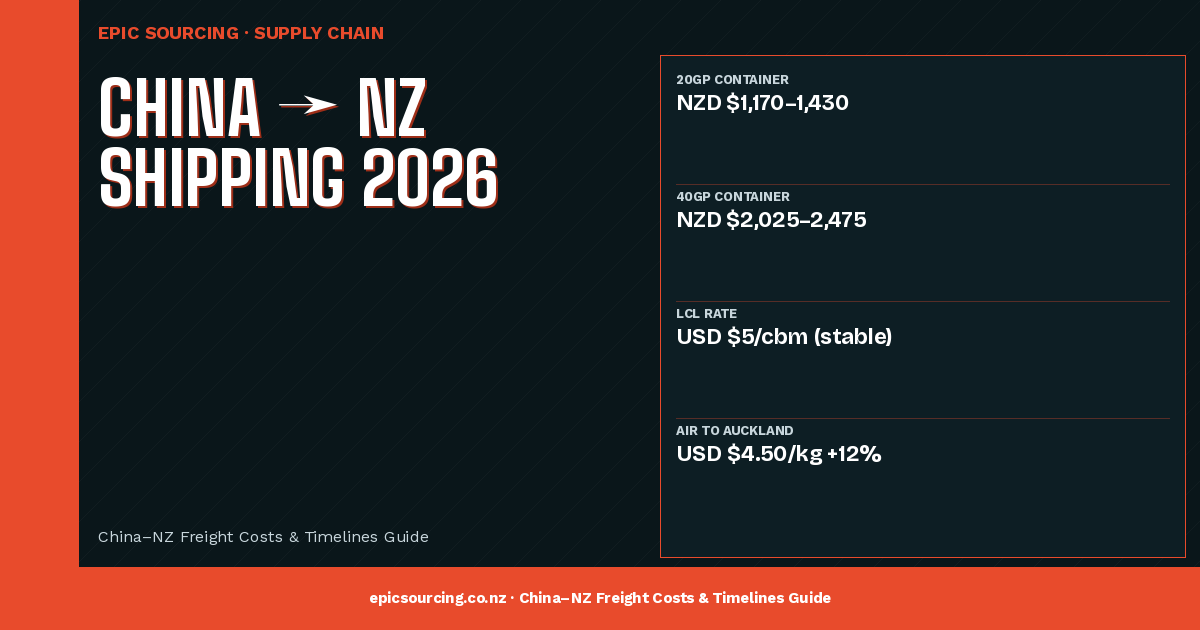
On current China-NZ rates (April 2026), a 40-foot container is running USD $2,025–$2,475. Factor this into your project cost modelling from day one.
Is It Worth It? The Bottom Line
For most NZ hotel and hospitality projects of any meaningful scale — yes, sourcing FF&E from China absolutely stacks up. The savings over local or Australian supply can fund multiple additional rooms or significantly upgrade the finish quality across your property.
The risks are real but manageable with the right process: clear specifications, careful factory selection, sample approvals, QC inspections, and a well-managed shipping programme. Done properly, it's a genuine game-changer for hospitality project budgets.
If you've got a hotel, lodge, or hospitality fit-out project in the pipeline — or you're a construction company looking to add FF&E sourcing to your capabilities — we'd love to talk. Book a free consultation with the Epic Sourcing team and let's see how we can help you get more quality for your project budget.
Related Articles


Let’s Make It Epic
We're here to make sourcing simple – and a whole lot less stressful.
We are experiencing a higher volume of enquiries than usual. Our standard reply time for form submissions and emails is within 72 hours.
If your matter is urgent, please schedule a video call using the link below.
