
.svg)
Why China to NZ Shipping Rates Just Jumped 38% — And What Smart Importers Are Doing About It

.svg)
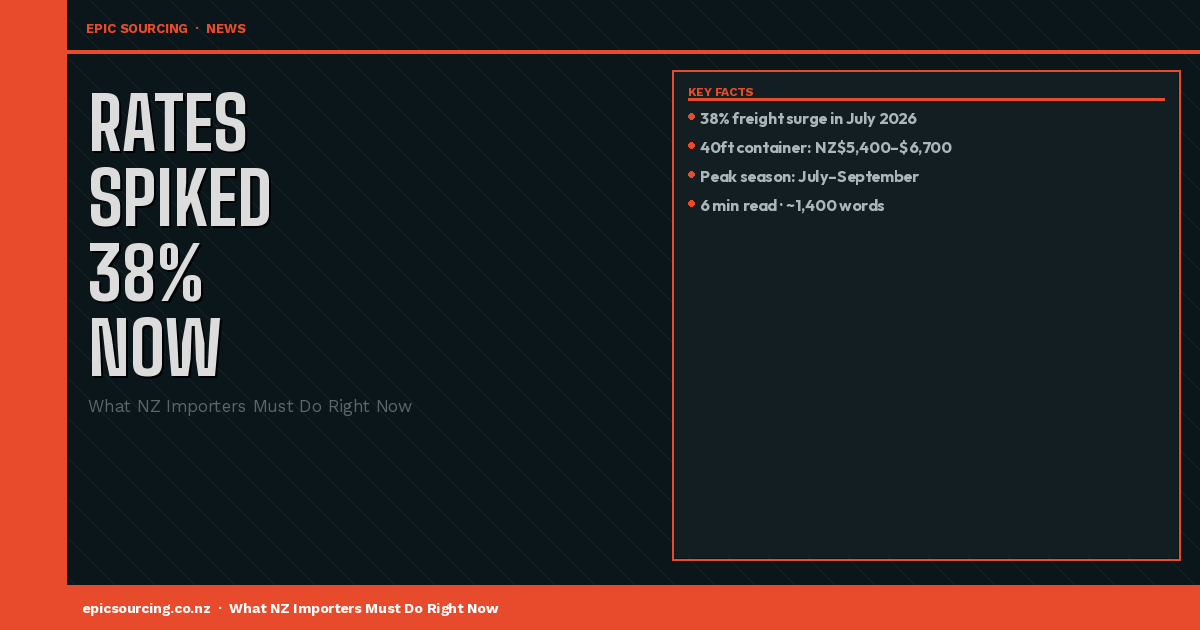
If you've got a shipment coming from China right now — or you're about to pull the trigger on an order — you need to know this: sea freight rates from China to Auckland just surged by up to 38% compared to last month. That's not a typo. A standard 40-foot container that cost around NZ$4,000–$5,000 to ship in June is now sitting closer to NZ$5,400–$6,700 in July 2026.
This is peak season hitting hard. Every year, July through September is when global shipping lanes heat up as retailers and brands rush to stock for the Christmas season. Add in tight vessel capacity out of Chinese ports right now, and you've got a perfect storm for higher prices.
But here's the thing — this doesn't have to wreck your margins. The savvy importers we're working with right now are making smart moves to offset the cost spike. Let's break down exactly what's happening, what it means for your business, and what you should be doing about it.
What Are the Current Freight Rates From China to NZ?
Here's where things stand as of July 2026 for the main China to Auckland route:
- FCL 20-foot container (20GP): USD $1,890 – $2,310 (+36% vs June 2026)
- FCL 40-foot container (40GP): USD $3,735 – $4,565 (+38% vs June 2026)
- LCL (Less than Container Load): USD $38/cbm — essentially flat
- Air freight: USD $3.60/kg — actually softening slightly
Transit times haven't blown out — you're still looking at 20–23 days for FCL and 21–27 days for LCL by sea. Air freight gets you here in 3–7 days if you need speed.
The big headline here? Air freight is looking more competitive than it has in months relative to sea. If your order is lower volume or time-sensitive, it's genuinely worth getting an air quote alongside your sea option this month.
Why Did Rates Jump So Sharply?
A few things collided at once to drive this spike:
- Peak season demand — retailers globally are front-loading Christmas stock orders, flooding capacity on major trade lanes.
- Vessel capacity constraints — shipping lines are managing capacity tightly, keeping utilisation high and space competitive.
- Middle East tensions — geopolitical uncertainty continues to affect fuel costs and routing decisions, adding surcharges.
- Post-CNY rebound effect — factories ramped back up fully in Q2 2026 and export volumes out of China are near record levels.
The good news? LCL rates have held flat, which means if you're a smaller importer or you're not filling a full container, you might not feel this as sharply.
Sourcing Hack #1: Get an LCL Quote First — If your shipment is under 12–15 cubic metres, LCL could be your best friend right now. With FCL rates up 38% and LCL holding flat at USD $38/cbm, LCL is punching above its weight this July. Don't assume FCL is always cheaper — do the maths.
Should You Switch to Air Freight?
This is the question we're getting asked a lot right now. The honest answer is: it depends on your product and your margins.
Air freight at USD $3.60/kg works brilliantly for high-value, low-weight products — think activewear, bamboo sunglasses, electronics accessories, jewellery, or personal care products like eco-certified wipes or skincare. If your product is dense or heavy (think furniture, construction materials, or large outdoor gear), air freight won't make economic sense.
Here's a rough rule of thumb: if your product is worth more than NZ$100 per kilogram, air freight can often justify itself on the carrying cost savings and speed-to-market advantage alone. If it's under NZ$30/kg, stick with sea and plan accordingly.
Sourcing Hack #2: Use the Air vs Sea Break-Even Calculator — Take your product's weight in kilograms, multiply by NZD equivalent of USD $3.60, and compare that to what you'd pay for your portion of an LCL shipment (USD $38/cbm × your volume). Then add in 2–4 weeks of holding costs if you're importing seasonal stock. You might be surprised how close the numbers get.
How to Manage Freight Costs When Rates Are High
Higher rates aren't ideal, but they don't have to kill your margins. Here's what experienced NZ importers do during peak season:
- Order earlier next cycle — plan your next Q3 order to ship in April or May before peak kicks in.
- Consolidate orders — combine orders from multiple suppliers into one container shipment to maximise space efficiency.
- Negotiate DDP or FOB terms carefully — if a supplier is quoting DDP (Delivered Duty Paid), make sure you understand what freight rate they've built into that price during peak season.
- Use a freight forwarder with volume buying power — larger forwarders lock in block space agreements (BSAs) that can buffer you from spot rate spikes.
- Consider warehousing in China — if you're a regular importer, storing a buffer stock in a China warehouse and shipping out in smaller batches via LCL can smooth costs year-round.
What This Means for NZ Businesses Planning Orders Now
If you're currently in the planning phase for an order, July 2026 is a critical moment. The decision you make in the next 2–4 weeks will affect your landed cost significantly.
Our recommendation for most NZ importers right now: if your order is ready and your supplier is confirmed, ship now and absorb the rate — waiting for rates to drop risks pushing into August or September when peak can intensify further. If you have flexibility, consider whether LCL or air might suit your product better at current price relativities.
NZ also has a meaningful advantage here that's worth remembering: our FTA with China means 0% import tariffs on most goods. While US importers are paying ~30% in tariffs on top of elevated freight costs, you're not. That's a genuine edge, and one worth leveraging.
Sourcing Hack #3: Lock in Your Freight Rate Early — When you get quotes from freight forwarders this month, ask specifically about 'spot rate validity.' Many forwarders can lock in a quote for 7–14 days. If rates keep rising (as they did in July), you're protected. If rates drop, you can re-quote. Always ask.
Looking Ahead: When Will Rates Come Down?
Historically, peak season freight pressure eases in October–November as the Christmas stock rush winds down. Based on past cycles, you'd expect China–NZ FCL rates to soften back toward June levels by Q4 2026 — but that's not guaranteed given global supply chain dynamics.
The LCL market and air freight market are showing resilience right now, which is a useful sign. The spike is real but it's not unprecedented, and it won't last forever.
Ready to take the next step? Book a free consultation with the team at Epic Sourcing — we'll walk you through your options, current freight rates, and how to get the most out of your importing budget. No obligation, just straight-up sourcing advice from people who do this every day.
Related Articles


Let’s Make It Epic
We're here to make sourcing simple – and a whole lot less stressful.
We are experiencing a higher volume of enquiries than usual. Our standard reply time for form submissions and emails is within 72 hours.
If your matter is urgent, please schedule a video call using the link below.
