
.svg)
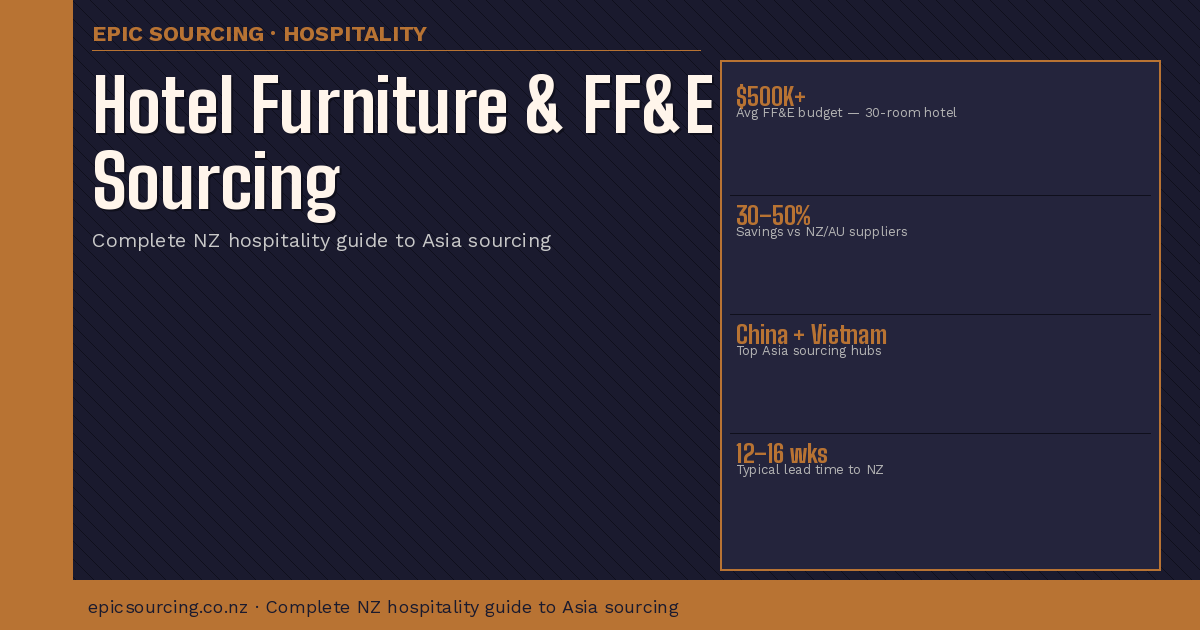
How to Source Hotel Furniture and FF&E from China: A Complete Guide for NZ Hospitality Businesses

.svg)
What Is FF&E and Why Does It Matter?
FF&E stands for Furniture, Fixtures and Equipment — the moveable items that make a hospitality space functional and appealing. In a hotel context, this typically includes:
- Guest room furniture (beds, headboards, bedside tables, wardrobes, desks, chairs, minibars)
- Soft furnishings (mattresses, linen, curtains, cushions, rugs)
- Bathroom fittings and accessories (vanities, mirrors, towel rails, soap dispensers)
- Lobby and common area furniture (sofas, coffee tables, reception desks)
- Restaurant and bar furniture (dining chairs, tables, bar stools)
- Lighting fixtures throughout the property
For a mid-size hotel of 50–100 rooms, FF&E procurement is typically one of the largest single expenditure categories during development or refurbishment. Getting it right — in terms of quality, budget, and timeline — can make or break a project.
Why Foshan Is the World's Furniture Capital
Foshan, in Guangdong Province, is home to over 6,000 furniture manufacturers within a 50km radius. It's where virtually every major global hotel brand — from Marriott to Accor to IHG — sources at least part of their FF&E. The concentration of manufacturers, material suppliers, skilled craftspeople, and export logistics infrastructure makes it uniquely efficient for furniture procurement at scale.
What makes Foshan particularly valuable for hospitality procurement:
- Full category coverage. You can source bedroom furniture, bathroom vanities, upholstered seating, lighting, and decorative accessories from multiple specialist factories within the same industrial zone.
- Custom manufacturing capability. Unlike retail suppliers, Foshan factories are set up for custom projects. You can specify your own dimensions, materials, finishes, upholstery fabrics, and hardware.
- Hospitality experience. Many Foshan factories specifically serve the hospitality sector and understand commercial-grade specs, flame-retardant requirements, and durability standards.
- Competitive pricing at quality. For equivalent quality, Foshan prices are typically 40–60% lower than NZ supply.
What You Can Source from China for Your Hotel
Excellent value from China: solid wood and veneer furniture, upholstered seating, metal frame beds and bedside tables, custom joinery and cabinetry (wardrobes, reception desks, bar fronts), curtains and soft furnishings, decorative lighting, bathroom mirrors and vanity units, ceramic accessories.
Good but needs careful QC: mattresses, upholstery in specific fabric grades, laminated board furniture, electronic components (safes, minibars).
Exercise caution or source locally: items requiring NZ electrical certification that's hard to obtain from Chinese suppliers, and items with very specific NZ Building Code compliance requirements.
Sourcing Hack #5: Request a 'Sample Room' Before Full Production — Before ordering furniture for 60 rooms, ask your shortlisted factory to produce a complete sample room set. This might cost NZD $3,000–8,000, but it lets you assess quality, dimensions, finish, and material consistency before committing to full production. If a factory is reluctant to do a sample room, that's a red flag.
Quality Control: The Most Critical Step
This is where hotel FF&E sourcing goes wrong most often. Here's what a robust QC approach looks like:
- Material specification. Go beyond 'solid wood' — specify the exact timber species, leather or fabric grade, foam density, veneer thickness. Get it in writing in your purchase order.
- Pre-production samples. Before manufacturing begins, request material samples and finish samples to approve. This catches issues at the design stage.
- In-production inspection. At roughly 50–70% completion, commission a third-party inspector to visit the factory. This is when assembly issues are easiest to correct.
- Pre-shipment inspection. A full inspection at 100% completion before container loading. Items are randomly selected and checked against specification.
- Container loading supervision. For large orders, supervise the container packing to ensure correct handling and packaging.
Sourcing Hack #6: Get a Full Bill of Materials in Your Purchase Order — The most common quality dispute in hotel FF&E sourcing comes from vague specifications. Your PO should include the specific timber species and grade, thickness of each component, hardware specifications, fabric grade and composition, and finish details. If the factory substitutes cheaper materials during production, a detailed BOM in the PO gives you clear grounds for rejection or price adjustment.
Logistics: Getting Your FF&E to Site
For hotel-scale FF&E orders, sea freight is the only practical option. Here's the current logistics picture:
- Transit time: Currently 6+ weeks from Chinese port to NZ port (extended from the usual 4 weeks)
- Container types: Most hotel furniture ships in 40GP or 40HC (high cube) containers
- A 100-room hotel might require 8–15 containers depending on FF&E scope
- Current 40GP rate: NZD $2,025–$2,475 per container (April 2026)
Planning note: with 6+ week shipping times, your FF&E order needs to be placed well ahead of your site completion date. If you're targeting an opening in Q4 2026, your orders should be in production by July at the latest.
Working with a Sourcing Agent vs Going Direct
You can approach Chinese hotel furniture factories directly — Alibaba, trade fair contacts, and manufacturer websites all provide access. But for hotel-scale FF&E procurement, most experienced operators use a sourcing agent. Here's why:
- Language and negotiation: Chinese business negotiations are relationship-driven and nuanced. An agent with existing factory relationships gets better prices and priority treatment.
- Factory pre-qualification: Not every Foshan factory that claims hospitality experience actually delivers to hotel standards. An experienced agent knows which factories are genuinely capable.
- Coordination across multiple factories: A 100-room hotel may need 6–8 different factories for different product categories. Coordinating production timelines, QC, and container consolidation is complex.
- Problem resolution: When something goes wrong during production, having a local agent in China to escalate and resolve issues is invaluable.
Ready to Source Smarter?
If you're importing into New Zealand and want expert guidance without the guesswork, Epic Sourcing offers a free 30-minute consultation to help you figure out the best approach for your product and budget. No obligations, just straight-up sourcing advice from people who do this every day. Book yours at epicsourcing.co.nz.
Related Articles

Let’s Make It Epic
We're here to make sourcing simple – and a whole lot less stressful.
We are experiencing a higher volume of enquiries than usual. Our standard reply time for form submissions and emails is within 72 hours.
If your matter is urgent, please schedule a video call using the link below.
