
.svg)

China to NZ Shipping Rates Are Surging in 2026 — Here's What Kiwi Importers Need to Know

.svg)
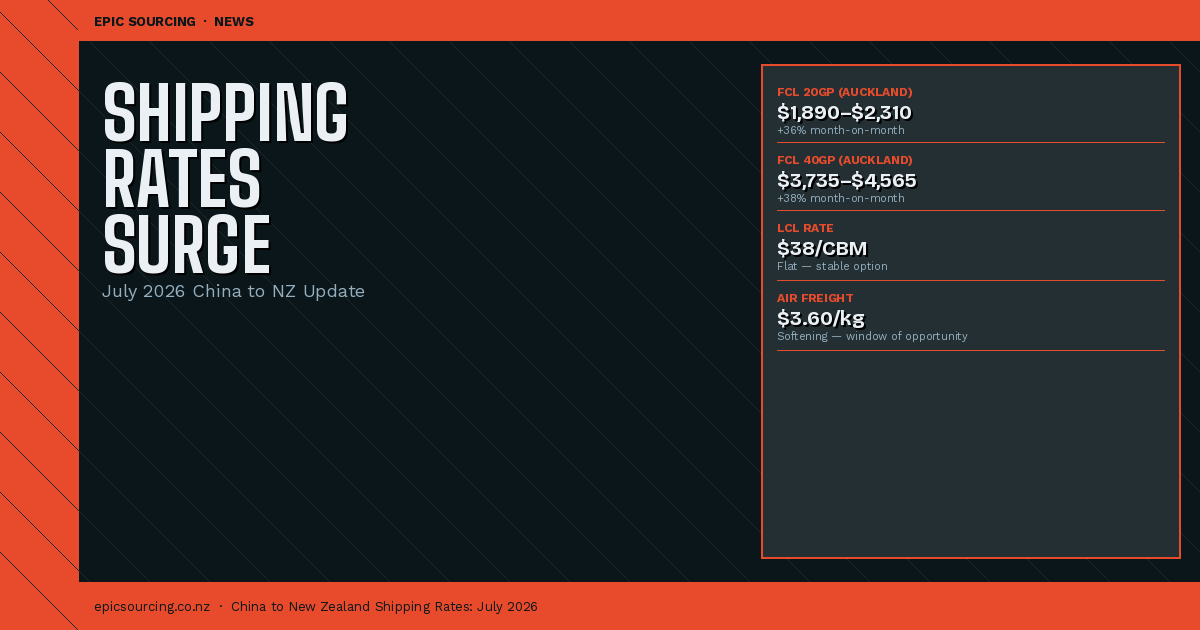
How Much Have Rates Actually Gone Up?
Here's the hard data from April 2026:
- 20-foot container (20GP) from China to NZ: NZD $1,170–$1,430 (up ~30% vs. March)
- 40-foot container (40GP) from China to NZ: NZD $2,025–$2,475 (up ~15% vs. March)
- Air freight: approximately NZD $4.50/kg (up ~12%)
- Express shipping: approximately NZD $7.55/kg (up ~12%)
That's not a small blip — a 30% jump on a 20GP container can add hundreds, sometimes thousands, of dollars to a shipment depending on your cargo. If your margins are already tight (and whose aren't in 2026?), this kind of movement can flip a profitable order into a break-even one pretty quickly.
What's Actually Driving the Surge?
A few factors are converging right now, and they're mostly outside anyone's control:
Fuel-driven surcharges: Rising fuel costs are being passed on by carriers across both ocean freight and domestic cartage. When diesel prices climb, every link in the logistics chain feels it.
Middle East conflict and shipping lane disruption: Ongoing tensions near the Strait of Hormuz are forcing some vessels onto longer alternative routes, adding time and cost to global shipping circuits.
Loading queues and rolling delays: Lead times from Asia have stretched out to 6+ weeks on average (up from 4 weeks previously). This means space is tighter, and carriers have more pricing power.
New NZ Customs levy: Effective 1 April 2026, a new Goods Management Levy applies to imports under NZD $1,000 — roughly NZD $2–3 per consignment plus GST. Small but worth knowing if you're doing multiple smaller shipments.
Sourcing Hack #1: Lock In Space Early — Don't wait until your order is ready to book freight. Get quotes and reserve container space 4–6 weeks ahead of your cargo being ready. In a tight market, early booking often means better rates and priority loading. Ask your freight forwarder about rate lock-in options for repeat shipments.
What Does This Mean for Your Import Budget?
Here's a practical example. Say you're importing a 40GP container of furniture, homewares, or fitness equipment from China. At last year's rates you might have been working with freight costs around NZD $1,700–$2,100. Today, that same container could cost you NZD $2,025–$2,475 — meaning you should build in an extra $300–$500 buffer, minimum.
And that's before factoring in longer lead times. If your products used to arrive in 4 weeks and you're now looking at 6–7 weeks, that has real cash-flow implications — especially if you're selling seasonal products or restocking for a busy period.
Our strong recommendation: update your costing models now, before you place orders, not after.
Sourcing Hack #2: Build a 15% Freight Buffer Into Every Quote — In volatile freight markets, quoting landed costs based on spot rates is risky. Add at least 10–15% contingency on top of your current freight quote to account for surcharges, delays, and currency fluctuation. It's much better to come in under budget than to scramble for cash mid-shipment.
How to Manage Costs Without Sacrificing Your Supply Chain
The good news is there are several practical strategies that Kiwi importers are using right now to keep freight costs manageable:
- Consolidate shipments: If you're doing multiple smaller orders, consider consolidating into one larger container. The per-unit freight cost is almost always lower in a full container (FCL) vs. a less-than-container-load (LCL) arrangement.
- Consider Vietnam as an alternative origin: Vietnam-sourced goods can sometimes be shipped more cheaply, and Vietnam enjoys favourable tariff treatment under multiple trade agreements. If your product can be made in Vietnam, now is a great time to explore it.
- Negotiate with your freight forwarder: If you're shipping regularly, ask for a volume-based rate rather than one-off spot pricing. Loyalty counts in freight, and forwarders are often willing to sharpen their pencils for consistent clients.
- Reassess air freight for smaller orders: For high-value, low-weight products (think electronic accessories, apparel samples, personalised goods), air freight at $4.50/kg can sometimes be more economical than paying for a partially filled sea container.
- Plan ahead for the peak season: Q3 and Q4 typically see even higher freight rates as demand surges ahead of Christmas. If you're thinking about a major restocking order, consider pulling your timeline forward to beat the peak.
Extended Lead Times: The Hidden Cost
Here's one people often overlook. It's not just the dollar cost of freight that's gone up — it's the time cost. With Asia-derived goods now averaging 6+ weeks in transit (including booking, loading, and clearance), you need to think about your inventory planning differently.
If you're used to having 30 days of stock as your re-order buffer, that formula no longer works. Right now, we're advising clients to maintain at least 8–10 weeks of safety stock for their core products, and to place orders earlier than feels comfortable. Yes, that means more capital tied up in inventory — but it's far better than running out of stock at a critical moment.
What Epic Sourcing Is Telling Its Clients Right Now
We're actively briefing our current clients on these freight changes and helping them re-model their landed costs. For new leads we're talking to, freight strategy is now one of the first things we address in our discovery calls — because getting this wrong can make an otherwise great product unviable.
If you're unsure how the current freight environment affects your specific products or sourcing setup, we'd love to have a chat. Book a free consultation with the Epic Sourcing team and we'll help you stress-test your numbers before you commit to an order. Better to know now than find out the hard way.
Related Articles



Let’s Make It Epic
We're here to make sourcing simple – and a whole lot less stressful.
We are experiencing a higher volume of enquiries than usual. Our standard reply time for form submissions and emails is within 72 hours.
If your matter is urgent, please schedule a video call using the link below.
