
.svg)
China to New Zealand Shipping Rates: July 2026 Update

.svg)
If you've been watching your freight invoices closely lately, you've probably noticed something: it's gotten a lot more expensive to ship from China to New Zealand this month.
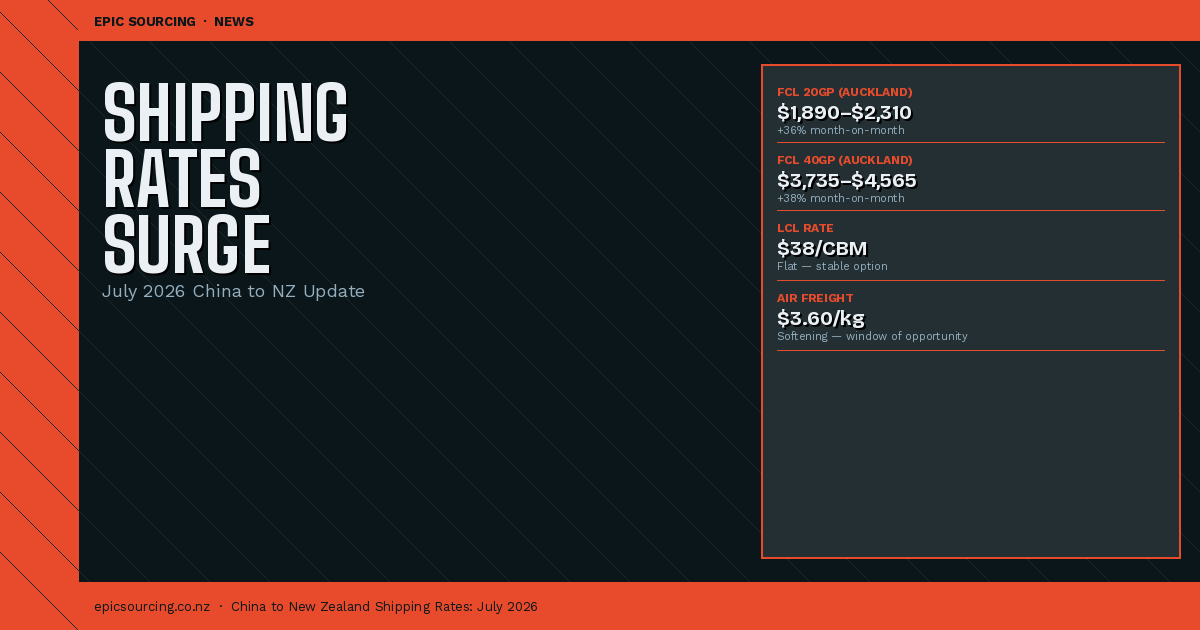
July 2026 has brought a sharp peak-season surge in ocean freight rates. FCL 20GP containers from China to Auckland are now landing between USD $1,890 and $2,310 — up a staggering 36% from June. FCL 40GP containers are in the $3,735–$4,565 range, up 38% month-on-month. For many Kiwi importers, that can mean thousands of extra dollars per shipment.
Let's break down what's happening, what it means for your business, and — most importantly — what you can do about it right now.
Current Rates at a Glance: China to NZ, July 2026
Here's a snapshot of current shipping rates as at mid-July 2026:
- FCL 20GP (China → Auckland): USD $1,890–$2,310 (+36% MoM)
- FCL 40GP (China → Auckland): USD $3,735–$4,565 (+38% MoM)
- LCL (China → Auckland): $38/cbm (Flat)
- Air Freight (China → Auckland): $3.60/kg (Softening)
Transit times are holding steady: FCL typically 20–23 days to Auckland Port, LCL 21–27 days, and air freight 3–7 days. LCL rates are flat and air freight is actually softening — which opens up some interesting options for the right type of order.
Why Have Rates Spiked So Sharply?
Peak season is the primary driver. July through September is typically the busiest shipping period globally, as importers race to stock shelves ahead of Christmas. More cargo, same ships — prices go up. A few other factors are piling on:
- Capacity constraints: Vessel availability into Oceania has tightened, with limited blank sailings reducing flexibility.
- Geopolitical uncertainty: The tentative US-Iran peace deal has eased some global pressure, but fuel price volatility remains a factor.
- US tariff ripple effect: US tariffs on Chinese goods (still around 30%) have rerouted some supply chains, creating knock-on capacity effects in other trade lanes.
New Zealand is particularly exposed to these swings because of our distance from Asia and relatively small import volumes compared to larger markets.
FCL vs LCL vs Air: What's the Best Option Right Now?
With sea freight rates at peak-season highs, it's worth rethinking your shipping mode — at least temporarily.
FCL (Full Container Load): Best for large orders. If you're bringing in 10+ CBM of product, FCL is still typically the most cost-effective option per unit. The key right now is booking early — capacity is tight and prices are moving fast.
LCL (Less than Container Load): LCL rates are flat at $38/CBM, which is relatively attractive compared to FCL on a per-CBM basis right now. If you're shipping smaller volumes (1–8 CBM), LCL is worth a serious look this month.
Air Freight: At $3.60/kg and softening, air freight has become more competitive relative to sea than it usually is. For lightweight, high-value products like activewear, electronics components, or cosmetics samples, air may actually pencil out — especially for time-sensitive Q3/Q4 restocks.
Sourcing Hack #1: Do the Air vs Sea Math — Don't Assume Sea is Always Cheaper
When sea freight jumps 36–38%, air becomes relatively more competitive. For lightweight orders under 200kg, run the numbers on air freight vs LCL before committing. You might save time AND money — especially if a stockout costs you more than the freight premium.
How These Rate Changes Impact Your Import Budget
Let's make this concrete. Say you're importing a 40GP container of homewares from Ningbo to Auckland, and your June freight quote was $2,800. At a 38% increase, that same container in July could run you $3,864 — that's over a thousand dollars more, before any currency changes or port charges.
For businesses operating on thin retail margins, this kind of spike requires either renegotiating supplier prices, adjusting your own pricing, absorbing the hit, or being smart about timing and shipping mode. Knowing it's coming lets you plan ahead rather than react after the fact.
Timing Your Orders to Beat the Peak Season Crunch
The July–September peak is predictable every year, which means you can plan around it. Here's how:
- Lock in Q4 stock now: Book your container as early as possible if you're planning Christmas inventory. Rates tend to ease slightly in October–November once the peak rush subsides.
- Consolidate shipments: If you're placing multiple smaller orders, consolidating into one FCL shipment reduces per-unit freight cost significantly.
- Build freight into your product cost model: Don't use off-peak rates as your baseline for pricing. Always factor in a 20–30% buffer for seasonal surges.
- Ask your supplier about ex-factory date flexibility: A shipment that leaves China 2 weeks earlier can sometimes catch a better rate window.
Sourcing Hack #2: Book FCL Early for Peak Season — Rates Move Fast
Ocean freight bookings from China to NZ can be made 4–6 weeks in advance. Locking in a rate now protects you from further July–September increases. Ask your freight forwarder for a rate hold — it's worth it.
What Should NZ Importers Do Right Now?
- Get a rate quote this week — rates are moving daily. A quote from two weeks ago may already be outdated.
- Consider LCL for smaller orders — flat LCL rates are relatively attractive right now.
- Run the air vs sea calculation for any lightweight or time-sensitive shipment.
- Communicate with your supplier about lead times and ex-factory dates to give yourself maximum flexibility.
- Update your landed cost models — make sure your product pricing accounts for current freight reality, not pre-July figures.
If you're importing goods from China and need help navigating freight costs, supplier coordination, or quality control, the team at Epic Sourcing NZ is happy to help. Book a free consultation at epicsourcing.co.nz — no obligation, just practical advice.
Related Articles

Let’s Make It Epic
We're here to make sourcing simple – and a whole lot less stressful.
We are experiencing a higher volume of enquiries than usual. Our standard reply time for form submissions and emails is within 72 hours.
If your matter is urgent, please schedule a video call using the link below.
