.svg)
China Plus One: Why Smart NZ Importers Are Adding Vietnam to Their Supply Chain in 2026

.svg)
Why Vietnam Is Having a Moment
If you've been importing from China for a few years, you've probably noticed the conversation shifting. Freight rates are up, lead times can be unpredictable, and global supply chain disruptions have left many Kiwi business owners wondering: is there a better way to diversify risk?
Enter the "China Plus One" strategy — you don't abandon China, but you add a second sourcing country to your mix. And right now, Vietnam is the number one name on that list for NZ importers.
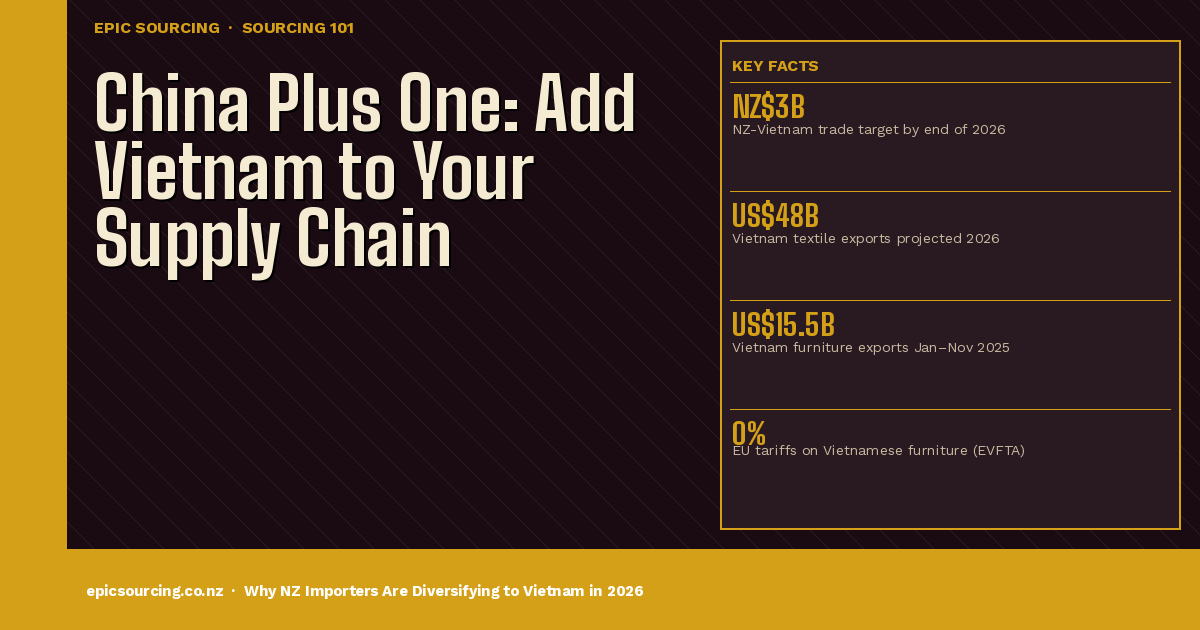
With NZ-Vietnam bilateral trade targeting NZ$3 billion by end of 2026, and some seriously impressive manufacturing growth on the ground, let's take a real look at what's driving this shift — and whether it makes sense for your business.
Vietnam's Manufacturing Credentials
Vietnam's manufacturing sector has been on a remarkable trajectory. Furniture exports alone hit US$15.5 billion between January and November 2025, up 5.4% year-on-year. The textile and garment sector is projected to near US$48 billion by end of 2026.
- The EU-Vietnam Free Trade Agreement (EVFTA) gives Vietnamese furniture manufacturers 0% tariffs into the EU — reshaping global supply chains
- Vietnam is actively transitioning from OEM to ODM manufacturing, meaning factories are investing in their own product development capabilities
- Heavy investment in automation and sustainability certifications is raising the quality bar
- US-China tariff tensions (~30% on Chinese goods entering the US) have pushed global brands to shift some production to Vietnam
Sourcing Hack #1: Ask About EVFTA Certificates — When sourcing furniture or textiles from Vietnam, ask your supplier if they can provide a EUR.1 certificate of origin. This unlocks preferential tariff rates for re-export to EU markets — great if you sell internationally.
Vietnam vs China: The Honest Comparison
Let's not sugarcoat it — Vietnam isn't a perfect replacement for China.
Cost: Vietnam remains 40–45% more expensive than competing low-cost countries like Bangladesh or Indonesia for garments. However, for mid-to-premium products — furniture, homeware, apparel — the quality-to-cost ratio is genuinely competitive.
Labour: Labour costs are rising at roughly 10% per year as Vietnam's economy develops. Factor this into your long-term cost modelling.
MOQ: Minimum order quantities from Vietnamese factories are generally higher than China. Expect MOQs of 200–500 units for most manufactured goods.
Capability: Vietnam excels in furniture (especially solid wood and rattan), textiles and garments, footwear, electronics assembly, and ceramics. It's not yet the breadth of manufacturing capability you'd find in China.
What NZ Importers Are Actually Sourcing from Vietnam
At Epic Sourcing, we're seeing growing interest from Kiwi businesses across a few specific categories:
- Furniture and homewares — solid timber dining sets, rattan chairs, ceramic tableware, and decorative items. Vietnamese factories are producing genuinely beautiful pieces for the hospitality and retail markets.
- Women's apparel — linen clothing, resort wear, and fashion-forward pieces. Quality has improved dramatically, and Vietnam's growing ODM capability means faster design iteration.
- Outdoor and lifestyle products — bamboo items, eco-friendly accessories, and sustainable packaging. Vietnam's forestry resources give it a natural edge.
- Industrial components — Vietnam's growing manufacturing base means more options for light industrial and engineering parts, though China still dominates this space.
Sourcing Hack #2: Start Small with Vietnam — If you're currently sourcing from China and want to explore Vietnam, don't try to switch everything at once. Pick one product line — ideally furniture, textiles, or ceramics — and run a pilot order alongside your existing China supply. This lets you test quality and reliability with minimal risk.
How to Find Good Vietnamese Suppliers
The honest challenge with Vietnam is that the sourcing ecosystem isn't as developed as China's. There's no Vietnamese equivalent of Alibaba with millions of verified listings. The best approaches are:
- Trade shows: Vietnam International Furniture Fair (VIFA), Vietnam Expo, and Texworld Vietnam are the big ones.
- Verified sourcing agents: A local agent or sourcing company with Vietnam connections can do the heavy lifting on factory vetting and quality control.
- Made-in-Vietnam directories: Resources like the Vietnam Trade Promotion Agency (Vietrade) are worth exploring.
- China factory referrals: Many Chinese factories now have partner factories in Vietnam. Ask your existing suppliers if they have Vietnam operations.
The Supply Chain Diversification Mindset
The businesses that handle supply chain disruptions best are the ones who've already spread their risk before the next crisis hits. Most established importers keep China as their primary source for 60–80% of their volume (the cost and capability advantages are too significant to ignore), while using Vietnam for specific product lines or as a backup source.
NZ's strong trade relationship with Vietnam — including an existing free trade agreement and the bilateral trade target of NZ$3B — means the regulatory environment is genuinely favourable for Kiwi importers looking to explore this market.
Is Vietnam Right for Your Business?
Ask yourself these questions:
- Are you importing furniture, textiles, garments, ceramics, or eco-friendly products? If yes, Vietnam is worth a serious look.
- Is supply chain risk keeping you up at night? Adding Vietnam as a second source reduces your exposure to any single country.
- Do your customers care about sustainability and ethical manufacturing? Vietnam's growing certification landscape (GOTS, FSC, SA8000) can support those brand values.
- Can you absorb slightly higher unit costs for better quality and diversification? If margins allow it, the risk reduction is often worth the premium.
If you answered yes to two or more of those, it's probably time to start the conversation. Book a free 30-minute consultation with the Epic Sourcing team at epicsourcing.co.nz — we'd love to help you map out your Vietnam sourcing strategy.
Related Articles


Let’s Make It Epic
We're here to make sourcing simple – and a whole lot less stressful.
We are experiencing a higher volume of enquiries than usual. Our standard reply time for form submissions and emails is within 72 hours.
If your matter is urgent, please schedule a video call using the link below.
