.svg)
Private Label vs White Label Products: What NZ Businesses Need to Know in 2026

.svg)
If you’re thinking about launching your own product line or adding branded products to your business, you’ve probably come across both terms: private label and white label. They sound similar, people often use them interchangeably, and — if you search online — you’ll find contradictory definitions that make the whole thing more confusing than it needs to be.
Here’s the thing: the distinction matters. The type of product model you choose affects your minimum order quantities, your upfront investment, your ability to differentiate in the market, and ultimately how much margin you can build into your pricing. Getting this wrong costs real money.
This post cuts through the noise with a clear, practical explanation of each model — what they are, who they’re right for, and how NZ businesses are using both to build profitable product lines.
1. What Is White Label?
White label products are generic, pre-made items manufactured in bulk by a factory — the same product sold to many different buyers, who then add their own branding. Think of a factory that makes a basic stainless steel water bottle design. They sell it to fifty different companies, each of whom slaps their own logo on it and sells it as their own brand. The product is identical; only the label changes.
White labelling is everywhere. Supermarket ‘home brand’ products are the classic example. In the eCommerce world, you’ll find thousands of white label products: supplements, beauty products, kitchen gadgets, fitness accessories.
The key characteristics of white label:
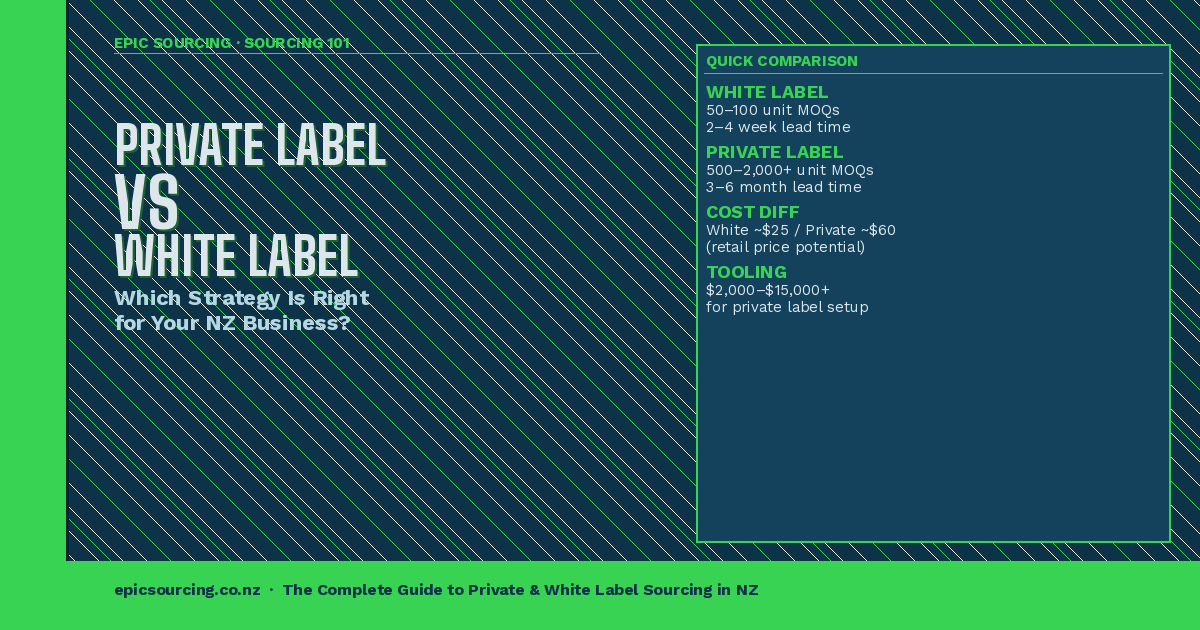
- Low minimum order quantities (often 50–200 units to start)
- Lower upfront cost — no product development required
- Fast to market — product is already designed and in production
- Limited differentiation — competitors may sell the identical product
- Branding is usually limited to packaging and labelling only
2. What Is Private Label?
Private label takes it a step further. You’re still working with a manufacturer, but you’re involved in shaping the product itself — the formula, the materials, the design, the features. The resulting product is made exclusively for your brand. Nobody else sells it.
A classic NZ example: a hospitality business working with a factory to create a custom-scented hand soap line in a specific pump bottle design with a branded sleeve and a unique fragrance blend. The factory makes it — but the product is yours, not a generic item you could find under another label.
Private label characteristics:
- Higher MOQs — typically 500–2,000+ units depending on the product
- Product development investment (samples, tooling, formulation)
- Longer time to market — allow 3–6 months for development
- True differentiation — your product is unique
- Stronger brand building potential and better margin protection
Sourcing Hack #1: Start White Label, Graduate to Private Label — If you’re new to importing, start with a white label product to learn the supply chain before committing to private label development costs. Once you know your market is buying, use that cash flow to fund the private label version — which you can then protect with a trademark and sell at a premium.
3. The Cost Difference — What to Budget
Cost is where the models diverge most sharply for NZ businesses starting out.
A white label first order might look like this: 200 units of a yoga mat at USD $8 each, plus $150 for custom packaging artwork and $400 for air freight. Total landed cost around NZD $3,500. You could be selling within six weeks.
A private label equivalent — a custom-designed yoga mat with your specific grip texture, colour, and thickness — might require: a $500 tooling fee for the mould, 3–4 sample rounds at $200 each, a minimum order of 500 units at $12 each, plus sea freight. You’re looking at NZD $10,000–$15,000 to launch, and a 4–6 month development window.
Neither is ‘better’ — they serve different business stages and strategies. White label suits testing a new market with low risk. Private label suits building a defensible brand with real IP.
Sourcing Hack #2: Always Request a Tooling Ownership Clause for Private Label — When paying tooling or mould costs for a private label product, make sure your contract specifies that the tooling belongs to you — not the factory. This means if you switch manufacturers, your tooling (and therefore your product design) comes with you. Without this clause, you may have to pay tooling costs again if you ever change suppliers.
4. Which Model Is Right for Your Business?
The answer depends on where you are in your business journey and what you’re trying to achieve.
White label makes sense if you’re: testing a new product category with limited budget, an online retailer wanting to offer branded basics quickly, a service business adding a product complement (e.g., a beauty salon adding branded skincare to retail), or a gifting or corporate merchandise business.
Private label makes sense if you’re: building a genuine consumer brand with long-term IP value, operating in a market where differentiation matters (supplements, beauty, food, activewear), an established business ready to invest in a defensible product line, or looking to create a product that retailers or distributors will stock exclusively.
Many NZ businesses successfully run both: a white label range that moves volume and funds cash flow, and a private label hero product that anchors the brand’s identity and commands premium pricing.
5. Common Mistakes NZ Businesses Make with Both Models
Whether you’re going white or private label, these are the traps we see Kiwi importers fall into:
- Skipping the sample stage to save time and money — only to receive 500 units that don’t match expectations
- Not registering a trademark before launching a private label brand
- Ordering too many units of a white label product before testing the market
- Choosing a factory based on price alone rather than product specialisation and quality history
- Not budgeting for compliance testing — products sold in NZ must meet specific safety and labelling standards
Sourcing Hack #3: Build Compliance Into Your Budget From Day One — Before your first order — especially for food, supplements, children’s products, or electrical goods — check the NZ compliance requirements for your product category. MPI, MoH, and the Commerce Commission all have specific rules. Budgeting for compliance testing upfront is far cheaper than recalling or destroying non-compliant stock after it arrives.
6. Working with a Sourcing Agent for Either Model
Whether you’re pursuing white label or private label, a good sourcing agent changes the equation significantly. For white label, they identify pre-vetted factories making your product category, negotiate price, arrange QC, and manage logistics. For private label, they add product development support — translating your brief into factory language, managing sample revisions, verifying tooling quality, and coordinating compliance testing.
For NZ businesses, the time-zone and language barriers with Chinese or Vietnamese factories are real. Having someone on the ground who can visit the factory, speak Mandarin, and have face-to-face conversations about product issues makes a measurable difference to the outcome — especially in private label development, where the details really matter.
Book Your Free Consultation
Ready to start sourcing smarter? Epic Sourcing offers a free, no-obligation consultation for Kiwi businesses looking to import products from China, Vietnam, or beyond. Whether you’re at the idea stage or ready to place your first order, we’d love to have a chat. Book your free consultation at epicsourcing.co.nz — no sales pressure, just straight-up sourcing advice from people who’ve done it thousands of times.
Related Articles


Let’s Make It Epic
We're here to make sourcing simple – and a whole lot less stressful.
We are experiencing a higher volume of enquiries than usual. Our standard reply time for form submissions and emails is within 72 hours.
If your matter is urgent, please schedule a video call using the link below.
