.svg)
China's Manufacturing PMI Just Dropped to 49.2 — Here's What That (And the New US Tariffs) Mean for NZ Importers

.svg)
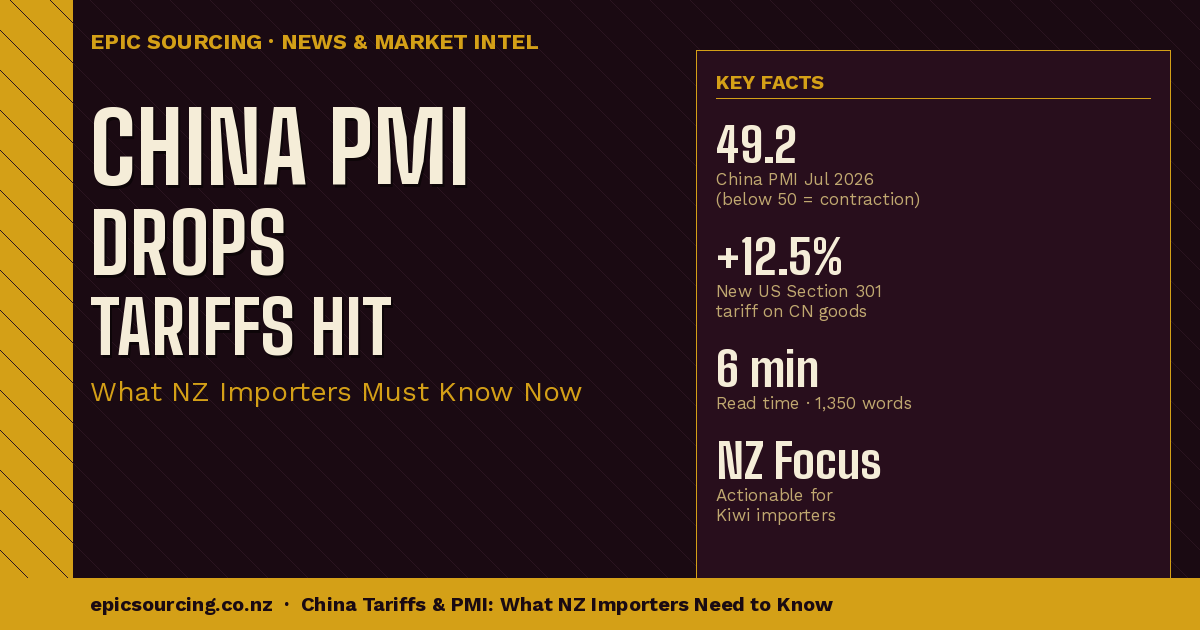
If you're sourcing products from China, the last week of July 2026 delivered a double dose of news worth paying attention to. First, China's official manufacturing PMI dropped to 49.2 in July — slipping below the 50-point line that separates expansion from contraction for the first time since February. Second, the US imposed a new 12.5% Section 301 tariff on Chinese goods effective 24 July 2026, piling on top of already existing duties.
For Kiwi importers, neither of these events means you should panic — but they do mean you should be informed. Because what happens to US-China trade inevitably sends ripples through global supply chains, and NZ businesses can either get ahead of it or get caught off guard.
Let's break down what's actually happening, and — more importantly — what you can do about it.
What Does a PMI Below 50 Actually Mean for Your Products?
The PMI (Purchasing Managers' Index) is a monthly survey of factory purchasing managers. A reading above 50 means the manufacturing sector is expanding; below 50 means it's contracting. China's July reading of 49.2 is the lowest since earlier in the year, and the new orders sub-index dropped to 48.5 — its worst since 2023.
Here's the plain-English version: Chinese factories are receiving fewer orders, and many are scaling back production. Typhoons disrupted coastal manufacturing zones, and sluggish domestic demand is compounding the pressure.
For NZ buyers, a contracting PMI can actually create buying opportunities in the short term. Factories under pressure are often more willing to negotiate on pricing, accept smaller minimum order quantities, and prioritise relationship-based customers. That said, there are also risks: quality control can slip when factories are under financial stress, and lead times can become unpredictable.
Sourcing Hack #1: Market Intelligence as Leverage — When PMI is contracting, factories are hungrier for business. Use current market data in your supplier negotiations — a quick mention of current market conditions can give you leverage to ask for better pricing or reduced MOQs without being combative about it.
The New 12.5% US Section 301 Tariff — Why NZ Should Care
You might be thinking: NZ doesn't trade with the US via China, so why does a US tariff matter to me? The answer is supply chain dynamics.
When the US imposes tariffs on Chinese goods, it has two major knock-on effects for NZ importers. First, factories that were previously exporting heavily to the US suddenly have excess capacity — which they need to redirect. You may start seeing more aggressive pricing and outreach from Chinese suppliers who are looking to fill their order books from other markets.
Second, and more importantly, tariffs accelerate supply chain diversification. US buyers are increasingly shifting orders to Vietnam, India, and Mexico. That means factories in those countries are getting busier and their capacity is being squeezed — which can affect lead times and pricing for NZ buyers sourcing from those same countries.
The effective tariff rate on many Chinese goods heading to the US is now well above 30% when you stack Section 301 duties on top of existing most-favoured-nation rates. That's creating a seismic shift in where global manufacturing capacity is flowing — and NZ importers need to understand which side of that shift their products sit on.
How This Affects Freight and Pricing for NZ Buyers
Here's the direct hit to your bottom line: shipping rates from China to NZ just jumped 36–38% month-on-month. FCL 20ft containers are now running $1,890–$2,310, and 40ft containers are $3,735–$4,565. The Oceania peak-season capacity crunch is part of this, but global shipping volatility from trade disruption is also a factor.
Air freight remains more stable at $4–$8/kg with 3–5 day transit times, making it worth considering for smaller, high-margin shipments.
Sourcing Hack #2: Lock In Freight Rates Early — In a volatile freight market, confirm quotes at booking rather than using estimates. If you're planning a significant import in the next 60–90 days, talk to your freight forwarder now about whether forward booking options are available. Even a small saving per CBM adds up fast on a 40ft container.
Which Product Categories Are Most Exposed?
Not all NZ importers are equally exposed to these dynamics. High exposure categories to watch closely include electronics and tech accessories, activewear and apparel, and furniture and homewares — all with significant US-China trade flows. Medium exposure includes promotional merchandise, packaging, and industrial components. Lower exposure applies to niche products from smaller regional suppliers primarily serving Asian markets.
The key question to ask your supplier: What percentage of your production goes to US buyers? If it's over 30%, you may see meaningful changes in their order book and capacity in the months ahead.
Vietnam and India: The Beneficiaries
As US buyers shift orders away from China, Vietnam continues to be the primary beneficiary. Apple, Samsung, Intel, and Foxconn are all expanding Vietnamese operations. The country's manufacturing PMI has remained in expansion territory even as China's has dipped.
For NZ importers, this means Vietnam is becoming more attractive — but also more competitive for factory time. If you've been thinking about adding a Vietnamese supplier to your mix, the window before capacity gets genuinely squeezed is probably now.
India is also getting more attention from global brands, particularly in apparel, footwear, and consumer electronics components. Supply chain diversification isn't just a buzzword right now — it's becoming a genuine competitive advantage for NZ importers who act on it.
What Should NZ Importers Do Right Now?
- Review your China supplier concentration. If 80%+ of your sourcing is from a single country, now is the time to understand your risk exposure and start building alternative relationships.
- Get fresh freight quotes. Don't rely on rates from 3+ months ago.
- Have a conversation with your China suppliers about what's changing in their order book.
- Consider Vietnam sourcing for at least one category.
- Talk to a sourcing specialist who can provide market intelligence.
If you're feeling uncertain about how the current China manufacturing environment affects your specific sourcing strategy, Epic Sourcing is here to help. We work with Kiwi businesses every day to navigate exactly these kinds of shifts — from factory negotiations to freight planning to supply chain diversification. Book a free consultation at epicsourcing.co.nz and let's talk through your situation.
Related Articles




Let’s Make It Epic
We're here to make sourcing simple – and a whole lot less stressful.
We are experiencing a higher volume of enquiries than usual. Our standard reply time for form submissions and emails is within 72 hours.
If your matter is urgent, please schedule a video call using the link below.
