
.svg)
Why Your China Shipping Costs Have Shot Up (And What NZ Importers Can Do About It)

.svg)
If you've got a shipment on the water right now — or you're planning one — you've probably noticed something uncomfortable. Your freight quotes are looking a lot fatter than they were six months ago.
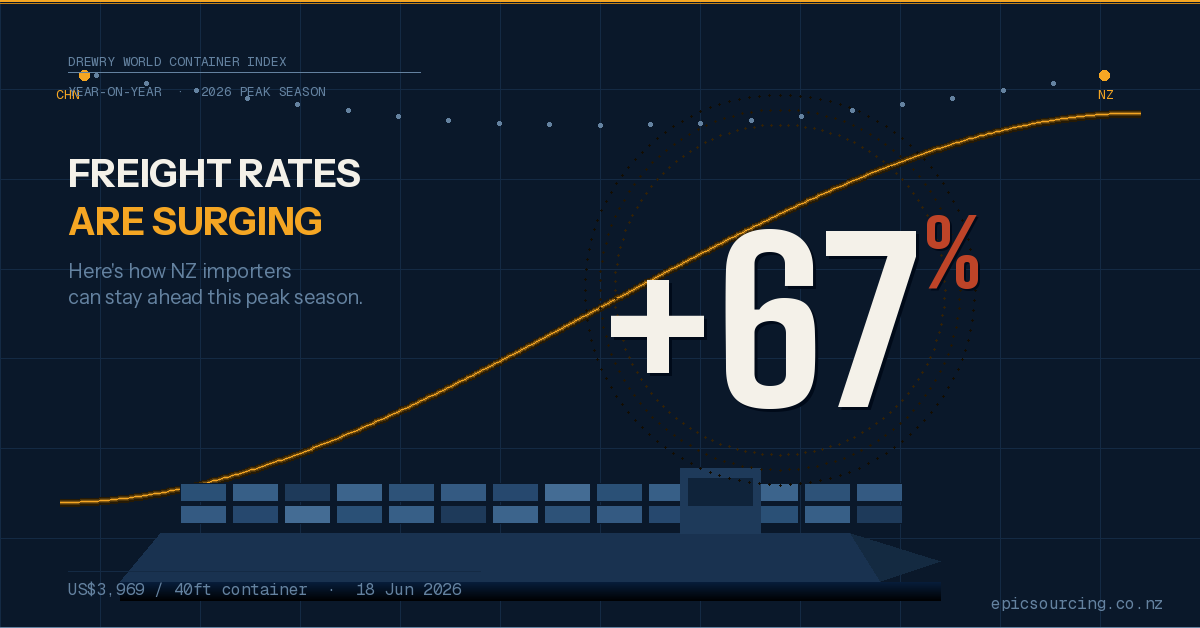
You're not imagining it. China-to-NZ shipping rates have risen sharply in 2026, and there are real reasons behind the jump. The good news? Once you understand what's driving the increases, you can make smarter decisions about timing, shipment size, and shipping method to protect your margins.
Let's unpack what's happening and what you can actually do about it.
What's Going On With Freight Rates Right Now?
As of May 2026, here's where rates sit for China-to-NZ sea freight:
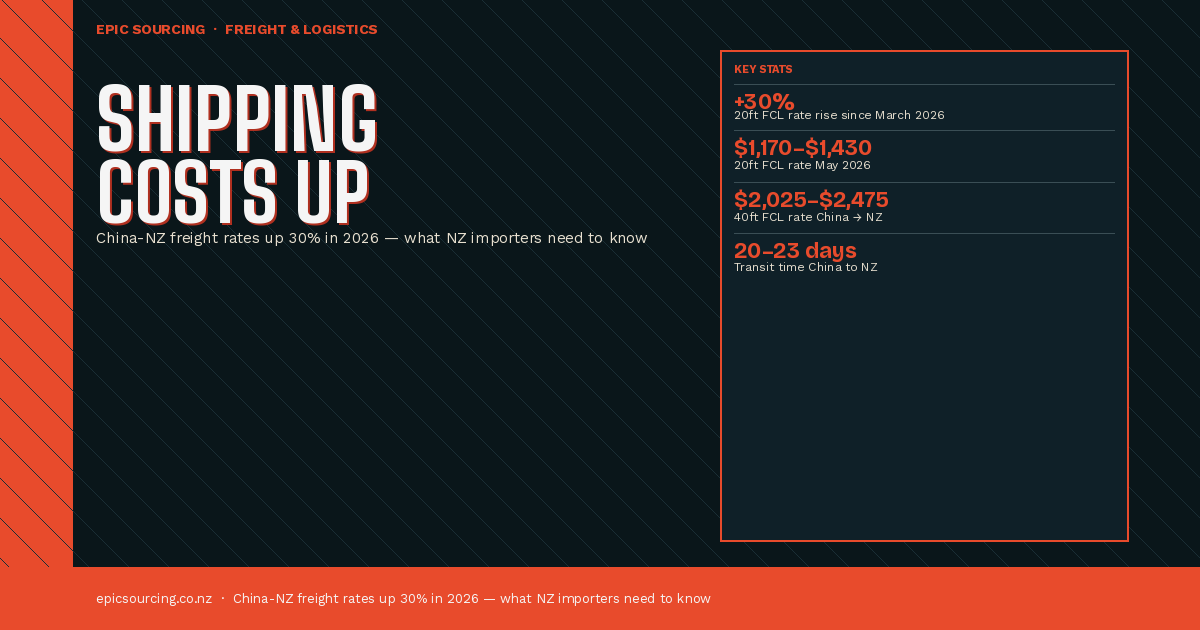
- 20ft FCL (Full Container Load): $1,170–$1,430 (up ~30% since March)
- 40ft FCL: $2,025–$2,475 (up ~15% since March)
- LCL (Less than Container Load): ~$5/cbm (stable)
- Air freight: ~$4.50/kg (up ~12%)
- Express courier: ~$7.55/kg (up ~12%)
That 30% jump on a 20ft FCL is significant. If you were budgeting $900 per container earlier this year, you're now looking at over $1,400. That eats into margins fast, especially for lower-value bulk goods.
The Main Culprit: Middle East Disruptions
The big driver behind the rate increases is the ongoing conflict in the Middle East, which has significantly disrupted global shipping lanes. Vessels that would normally transit through the Red Sea and Suez Canal — the fastest route between Asia and Europe — have been rerouting around the Cape of Good Hope in southern Africa.
This adds roughly 7–14 days to European-bound voyages and ties up vessel capacity globally. With fewer ships available on key lanes, carriers have been able to push rates up across the board, including on Asia-Pacific routes like China to New Zealand.
This isn't just a European problem. Global shipping is interconnected — when capacity gets squeezed on one major lane, it ripples out everywhere.
Secondary Pressures Adding to the Mix
The Middle East situation is the headline driver, but it's not the only factor:
Fuel costs — Jet fuel and bunker fuel (used by cargo ships) have risen alongside oil price volatility. Air New Zealand recently announced a pre-tax loss of $340–$390M partly attributed to soaring jet fuel costs. Cargo rates are seeing similar pressure.
Port congestion — The Port of Tauranga is currently at capacity, creating bottlenecks particularly for containerised imports through that hub. If your goods arrive during a congested period, you may face delays and additional storage charges.
Seasonal demand — With the NZ winter season approaching and brands stocking up on cold-weather goods, demand for container space traditionally ticks up in Q2.
Sourcing Hack #1: Lock In Your Rates Early — If you have a shipment planned in the next 60–90 days, get freight quotes now and ask your freight forwarder about forward rate agreements. Rates have been moving upward, and locking in a price today can save you meaningful money versus waiting.
FCL vs LCL: Which Should You Choose Right Now?
Here's where it gets interesting for NZ importers with smaller volumes.
While FCL rates have jumped 15–30%, LCL rates (where your cargo shares a container with other importers) have remained stable at around $5/cbm. If you've got a smaller order — say under 10–12 cubic metres — LCL is looking relatively attractive right now.
The trade-off with LCL is slightly longer transit times (21–27 days vs 20–23 days for FCL) and slightly less control over your cargo's handling. But for smaller orders where you don't need a full container, the current rate gap makes LCL a smart option.
Sourcing Hack #2: Consolidate Your Orders to Hit FCL Thresholds — If you've got multiple product lines or you're sourcing alongside another NZ business, consider consolidating orders into a single FCL shipment. Shared FCL arrangements can give you container-load pricing while splitting the cost. Talk to your sourcing agent or freight forwarder about container sharing options.
What About Air Freight?
Air freight has also ticked up around 12%, now sitting at $4.50/kg for standard air and $7.55/kg for express. These prices make air freight prohibitively expensive for anything heavy or bulky — but for high-value, lightweight goods (think supplements, electronics accessories, fashion samples), it can still make sense.
The Silver Lining: NZ's Trade Advantage vs the US
Here's something worth putting in your back pocket. While US buyers are getting hammered with combined tariffs of around 145% on selected China-origin goods, New Zealand's FTA with China means most manufactured goods come in at 0% import duty.
US monthly imports from China dropped from $41B in January 2025 to around $21B by December 2025 — a dramatic pullback driven by the tariff wall. Kiwi businesses importing similar goods face no such barrier.
This is a genuine competitive advantage. If you're sourcing products in categories where American brands are retreating from China, there may be opportunity for NZ businesses to step in.
Practical Steps for NZ Importers Right Now
- Audit your upcoming shipments and get fresh quotes immediately — don't rely on budgets based on 2025 rates.
- Ask your supplier or freight forwarder about LCL options if your volume is under 12 cbm.
- Review your landed cost calculations and check whether your retail/wholesale pricing still works at current freight rates.
- Consider increasing order quantities if your cash flow allows — you'll pay the freight hit once instead of multiple times on smaller, frequent shipments.
- Talk to your sourcing agent about whether your supplier base in China is near ports with better availability (Shanghai, Ningbo, Guangzhou are the major hubs).
What We're Telling Our Clients
Freight rates have been volatile before and they will stabilise. The Middle East situation is the wild card — if shipping lanes normalise, we could see rates ease in H2 2026. But in the meantime, smart planning around shipment timing, size, and method will make a real difference to your bottom line.
If you want to talk through your specific situation — whether you're mid-shipment, planning your next order, or just trying to understand what you're looking at for landed costs — we're happy to help. Book a free consultation with the Epic Sourcing team and let's look at your numbers together.
Related Articles

![How to Import Clothing from China to New Zealand [2026 Guide]](https://cdn.prod.website-files.com/688a8969df3fa58c211fb141/69a4bb23f6af4e70df0aa10d_Clothing%20Production%20Sourcing.png)

Let’s Make It Epic
We're here to make sourcing simple – and a whole lot less stressful.
We are experiencing a higher volume of enquiries than usual. Our standard reply time for form submissions and emails is within 72 hours.
If your matter is urgent, please schedule a video call using the link below.
