
.svg)
Freight Rates Are Surging 67% — What NZ Importers Need to Do Right Now

.svg)
What's Driving the Freight Rate Spike?
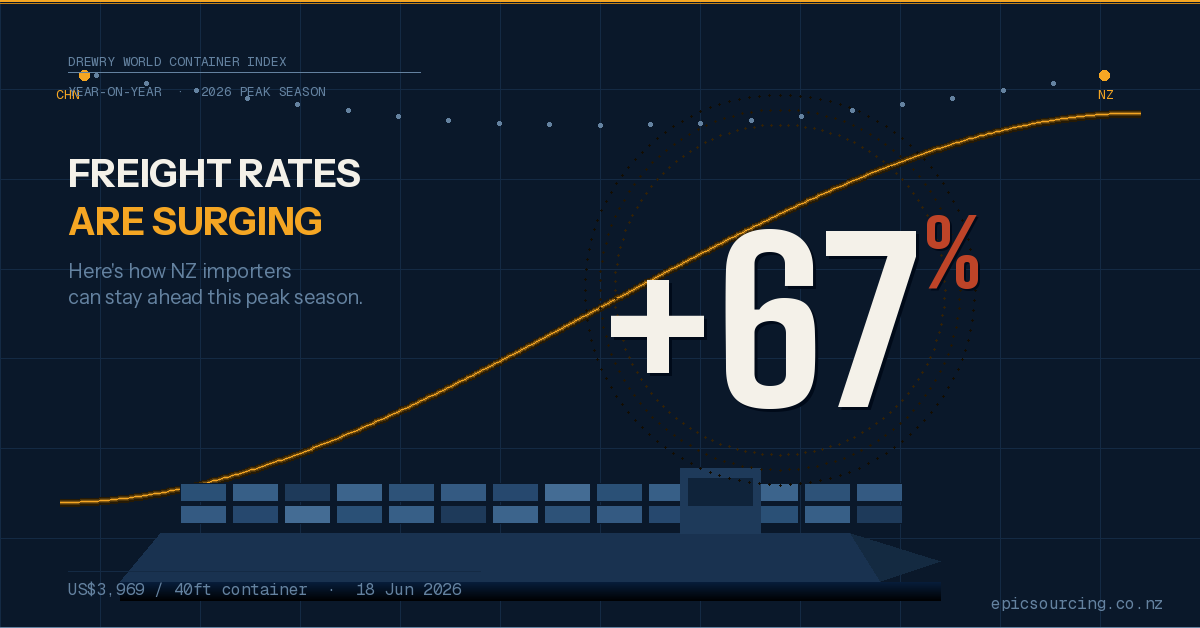
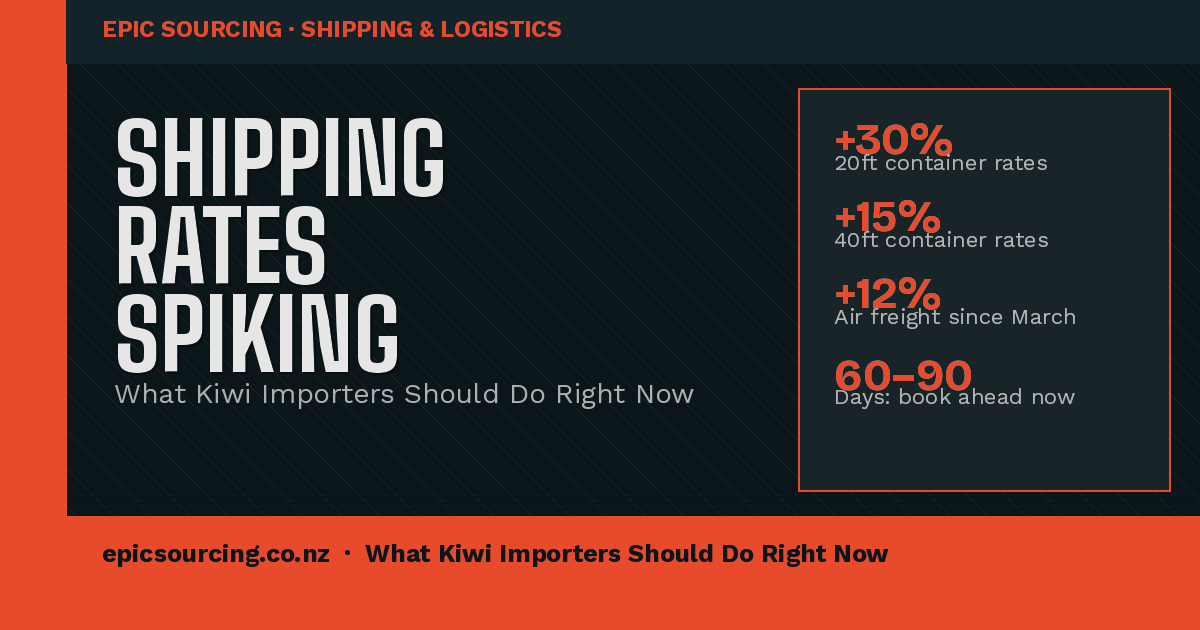
Container freight rates don't move in a vacuum. The Drewry World Container Index (WCI) hit $3,969 per 40ft container on 18 June 2026 — up 12% in a single week, and a whopping 67% higher than the same time last year. Peak season is here, and it's come in swinging.
For Kiwi businesses importing from China and Southeast Asia, this isn't just a headline — it's a real cost sitting on your next shipment. The good news? Shipping from China to New Zealand is still relatively stable and competitively priced compared to other lanes. The even better news? There are smart moves you can make right now to protect your margins.
The current surge is driven by a few converging forces:
- Peak season front-loading: Retailers and brands in the US and Europe are rushing to lock in inventory ahead of the Christmas selling season, flooding the market with container bookings.
- Ongoing port congestion: Key transshipment hubs in Asia are dealing with backlogs, reducing effective vessel capacity on popular lanes.
- Geopolitical disruption: Middle East instability continues to disrupt Red Sea routing, pushing more vessels onto the longer Cape of Good Hope route — adding 10–14 days and significant fuel costs.
- Carrier discipline: The big shipping lines have gotten smarter about managing blank sailings to keep rates elevated.
The Containerized Freight Index hit 3,121.69 points — up 45.8% in just one month.
The China to NZ Lane: What You Need to Know
Here's a bit of good news specific to New Zealand importers: the China-to-NZ shipping lane has remained comparatively stable and reasonably priced. NZ imports from China actually increased by 15% in early 2026, suggesting that volume is holding up and carriers are maintaining solid frequency on this route.
A few things working in your favour right now:
- NZ-China Free Trade Agreement (FTA): The FTA includes preferential tariff rates — but you need to ensure you have the correct Certificates of Origin (CO) from your suppliers. A valid CO can save you a meaningful percentage on import duties. Many importers overlook this.
- Stable direct services: Several carriers run direct or near-direct services from Shanghai, Ningbo, and Guangzhou to Auckland and Tauranga with reasonable lead times.
- Competitive freight forwarder market: The NZ market is well-served by forwarders with China relationships — shop around if you haven't reviewed your freight contract recently.
Sourcing Hack #1: Audit Your Certificates of Origin — Ask your China-based supplier to confirm they can provide the correct CO documentation for NZ FTA eligibility. A missing or incorrect CO can cost you thousands in avoidable import duties. Request samples before your next large order.
Peak Season Is Here — Pre-Stock Now or Pay More Later
The freight market's single most consistent pattern is this: Q3 and Q4 are expensive. Every year, the same thing happens — brands wait too long, scramble for space in September and October, and end up paying premium rates or, worse, missing the Christmas window entirely.
With rates already up 67% YoY, the cost of waiting is higher than usual. Here's what a smart pre-stocking strategy looks like for NZ importers right now:
- Calculate your 90-day inventory needs: Map out what products you'll need through October, November, and December. Add a 20% buffer for supply delays.
- Place orders now for September arrival: Target getting goods on water by late July so they arrive in Auckland or Tauranga by mid-to-late September — before the absolute peak crunch.
- Consolidate shipments where possible: If you have multiple smaller orders from the same supplier or region, consolidate into fewer, larger containers to reduce per-unit freight costs.
- Lock in freight rates: Talk to your freight forwarder today about fixed-rate contracts for Q3/Q4 bookings. Yes, they'll be higher than last year — but they'll likely be lower than spot rates in October.
Sourcing Hack #2: Time Your Shipments Around Mid-Month — Freight rates often dip slightly in the middle of the month as carriers fill remaining space before the end-of-month surge. If you have flexibility, targeting mid-month booking dates can save you 5–10% on spot rates.
What Rising Freight Costs Mean for Your Pricing Strategy
Rising freight costs squeeze margins — but they don't have to squeeze profits if you're strategic about it. Here are three approaches NZ businesses are using right now:
- Build freight into your landed cost calculations: If you haven't revised your cost models to reflect current freight rates, do it this week. A $500–$800 increase per container can shift product unit economics materially.
- Review your product mix: High-value, low-volume items are relatively less impacted by per-container rate increases than bulky, low-margin items.
- Talk to your customers: If you're a B2B supplier, your customers are likely aware that freight costs are climbing. A transparent conversation about cost pressures is far better than silently absorbing the hit.
The Bigger Picture: What 2026 Looks Like for NZ Importers
Freight rates are cyclical — but the floor has risen. The pandemic-era shipping chaos (where a 40ft container briefly cost $20,000+) normalised higher baseline expectations for carriers. The current spike is unlikely to reach those extremes, but expecting a swift return to pre-2020 rates would be optimistic.
The businesses that navigate this well are the ones that treat shipping as a strategic variable, not just an operational cost. That means building relationships with reliable freight forwarders, maintaining closer supplier partnerships so you can move quickly when rates dip, and planning inventory cycles further out than you might have in the past.
Quick Action Checklist for NZ Importers This Week
- Review your next 90 days of inventory needs and identify what to order now.
- Contact your freight forwarder and ask about Q3/Q4 rate contracts.
- Verify your NZ-China FTA Certificate of Origin eligibility with your supplier.
- Consolidate any upcoming smaller shipments into a single larger container where possible.
- Update your landed cost models to reflect current freight rates.
Ready to take the next step? Book a free 30-minute consultation with the Epic Sourcing NZ team at epicsourcing.co.nz and let's talk about how we can help you source smarter.
Related Articles


Let’s Make It Epic
We're here to make sourcing simple – and a whole lot less stressful.
We are experiencing a higher volume of enquiries than usual. Our standard reply time for form submissions and emails is within 72 hours.
If your matter is urgent, please schedule a video call using the link below.
