.svg)
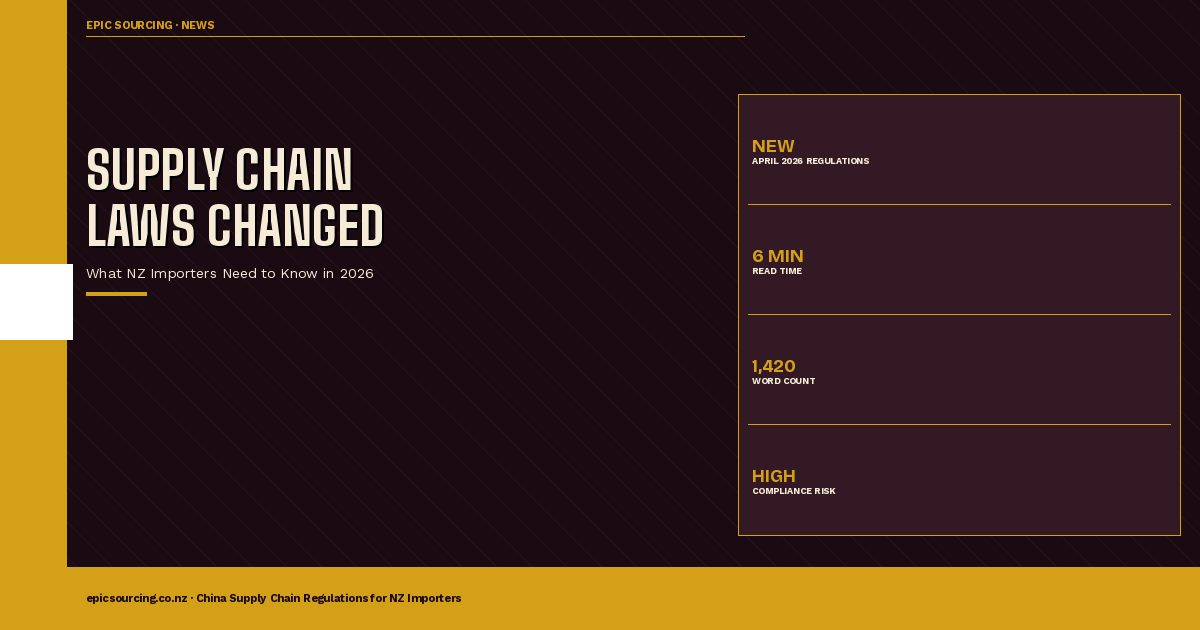
China's New Supply Chain Laws Just Changed — What NZ Importers Need to Know in 2026

.svg)
If you're sourcing products from China for your NZ business, there's a regulatory shift you really need to know about. In April 2026, China quietly introduced new supply chain regulations that expand the government's powers to investigate — and impose countermeasures on — foreign entities deemed to pose a threat to Chinese industrial supply chains. It's a significant development, and for Kiwi importers who deal directly with Chinese factories, it adds a new layer of compliance complexity you need to account for.
Now, before you close this tab thinking it doesn't apply to a small-to-medium NZ business — hear us out. These regulations don't just affect big corporations. They affect anyone transacting with Chinese suppliers, and understanding them could save you from delays, blocked shipments, or worse. Let's break down what's changed, why it matters for NZ importers, and what you should do about it.
What Are China's New Supply Chain Regulations?
China's new supply chain rules (officially enacted April 2026) are part of a broader push to protect domestic industrial interests. The key changes include:
- Expanded government powers to investigate foreign entities suspected of disrupting Chinese supply chains
- The ability to impose countermeasures on foreign buyers — including restricting their access to suppliers, imposing fines, or blocking goods
- New compliance obligations for Chinese manufacturers doing business with foreign companies
- Requirements for greater disclosure around cross-border transactions in certain sensitive industries
In plain English: if your sourcing activities — even inadvertently — are seen as threatening to Chinese industrial interests, you could find yourself blacklisted from suppliers or facing delays you can't explain. For most everyday NZ importers of consumer goods, the direct risk is low. But the indirect effects are real.
Why NZ Importers Should Pay Attention
New Zealand isn't caught in the middle of a US-China trade war, and that's genuinely an advantage. But the global supply chain ripple effects from these regulations hit NZ buyers in a few key ways.
First, your Chinese suppliers now have more compliance hoops to jump through. This can slow down order processing, especially if they're working with buyers in multiple countries. Expect longer lead times and more paperwork in some categories.
Second, the regulations increase complexity for foreign businesses transacting directly in China — particularly those trying to use platforms like 1688.com or dealing with factories without an intermediary. If you don't speak Mandarin and you're navigating contracts directly, the risk of unknowingly running afoul of a compliance requirement just went up.
Third, the industries most affected are electronics, industrial components, textiles, and advanced manufacturing — all categories popular with NZ importers. If that's your world, it's worth taking extra care.
Which Product Categories Are Highest Risk?
Not all categories are affected equally. Based on the scope of the new regulations, NZ importers in these sectors should be most alert:
- Electronics and electrical components — circuit boards, control units, sensors, agri-tech hardware
- Industrial machinery and custom-engineered parts
- Strategic materials — certain metals, chemicals, and raw materials
- Textiles with advanced technical specifications
- Pharmaceutical-adjacent products and medical devices
If you're importing everyday consumer goods — homewares, apparel, packaging, outdoor gear — your risk exposure is significantly lower. But it's still worth making sure your supplier relationships are properly documented.
Sourcing Hack #1: Document Everything — Get written contracts, supplier profiles, and transaction records in order. If an issue arises with a Chinese authority, having clear documentation of your legitimate commercial relationship is your best protection. Ask your sourcing agent to provide a supplier due diligence report for every new factory.
The Case for Using a Sourcing Agent Just Got Stronger
Here's the silver lining in all of this: working through an established, locally-based sourcing agent like Epic Sourcing substantially reduces your compliance exposure. An established NZ sourcing agent with boots on the ground in China already has working relationships with vetted, compliant factories. They understand the regulatory landscape and know which suppliers are operating cleanly. They handle the Mandarin-language compliance requirements, interpret contract terms, and manage factory relationships in a culturally appropriate way.
By contrast, a Kiwi business going direct to a Chinese factory via Alibaba or 1688, without local representation, is now navigating a more complex legal environment — often without knowing it. The incremental cost of using a sourcing agent looks a lot more attractive when you factor in regulatory risk.
Sourcing Hack #2: Vet Your Suppliers Before the Regulations Vet Them for You — Before placing a new order with a Chinese factory, do a basic compliance check: Are they registered with the relevant Chinese authorities? Do they have export licences for your product category? A reputable sourcing agent can run these checks quickly and flag any red flags before your money is at risk.
Practical Steps NZ Importers Should Take Right Now
You don't need to panic — but you do need to be proactive. Here's a simple checklist for NZ importers:
- Review your current supplier list and check which ones operate in regulated categories
- Ensure all contracts and agreements are in writing and properly translated
- If you deal directly with factories in Chinese, consider formalising those relationships through a sourcing agent
- Build extra lead time into your order schedule — processing times may lengthen
- Stay across NZ Trade & Enterprise (NZTE) and MPI updates for any guidance on regulatory changes
- Consider consolidating your supplier base — fewer suppliers means fewer compliance relationships to manage
The good news is that most NZ importers aren't in high-risk categories, and China still wants to sell to the world. These regulations are mostly aimed at preventing disruption to Chinese industrial supply chains at a macro level — not at penalising small Kiwi businesses ordering bamboo sunglasses or activewear. But awareness is your best defence.
What's Next: Expect More Regulatory Activity
The April 2026 changes aren't likely to be the last. China is actively building out its trade regulatory framework, and we expect more updates throughout 2026 and into 2027. For NZ businesses with significant China exposure, staying informed is part of managing your supply chain properly.
Epic Sourcing monitors regulatory changes as part of our service to NZ clients. If you've got questions about how any of this affects your specific imports, we're always happy to chat — no jargon, just straight answers.
Want expert help sourcing the right products for your NZ business? Book a free consultation with Epic Sourcing — we've helped hundreds of Kiwi businesses import smarter, cheaper, and with way less stress.
Related Articles


Let’s Make It Epic
We're here to make sourcing simple – and a whole lot less stressful.
We are experiencing a higher volume of enquiries than usual. Our standard reply time for form submissions and emails is within 72 hours.
If your matter is urgent, please schedule a video call using the link below.
