.svg)
How to Launch a Private Label Skincare Brand in New Zealand (The Sourcing Playbook)

.svg)
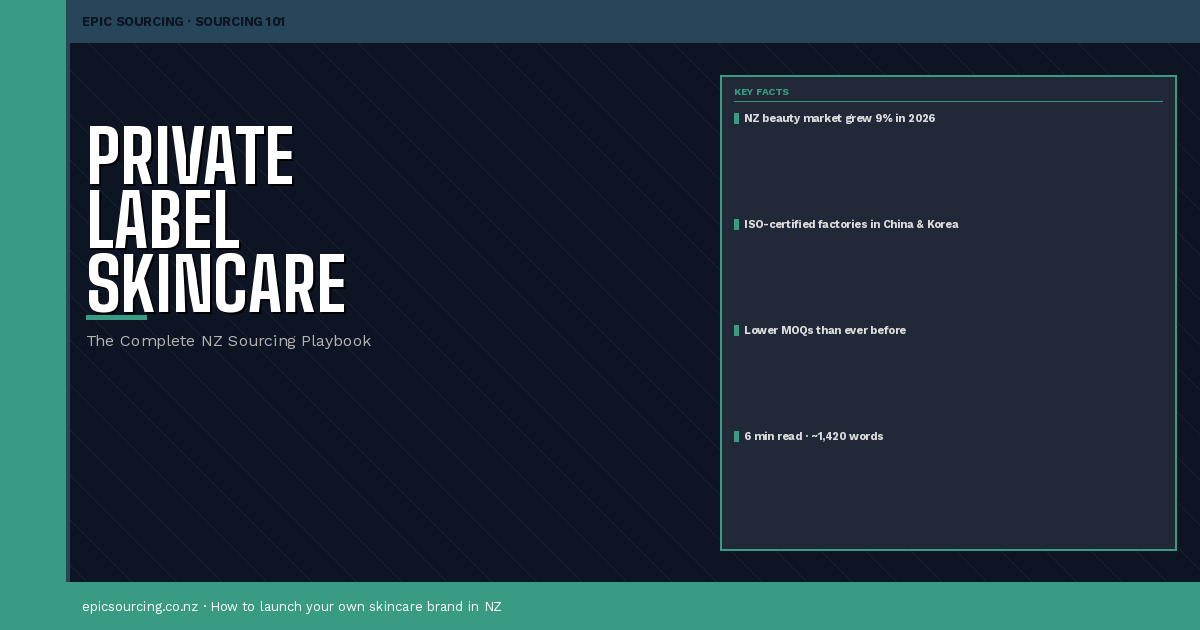
The NZ skincare market is booming. Kiwi consumers are spending more on health and beauty products than ever before — the sector grew 9% this year — and a growing number of NZ entrepreneurs are realising they don't have to sell someone else's brand. They can launch their own.
Private label skincare has never been more accessible. Thanks to a global network of capable, ISO-certified manufacturers — particularly in China and South Korea — you can now have a professional, custom-branded skincare range developed, manufactured, and delivered to your door for a fraction of what it cost five years ago. Minimum order quantities are lower, quality is higher, and turnaround times are faster.
But knowing where to start? That's where most people get stuck. So let's walk through the whole process — from idea to shelf — so you know exactly what you're getting into.
What is Private Label Skincare, Exactly?
Private label means you're selling a product manufactured by a third party, under your own brand name. You choose the formula (from existing options or develop your own), design the packaging, and put your label on it. The factory makes it; you sell it.
This is different from white label (where you sell a generic, unbranded product) and from full product development (where you create an entirely new formula from scratch). Private label sits right in the middle — you get brand exclusivity without the complexity and cost of starting from zero.
For NZ entrepreneurs, private label skincare is appealing because the NZ market is underserved by local indie brands, NZ consumers trust local brand stories (even when the product is manufactured offshore), the regulatory environment is manageable, and margins are excellent — a well-priced range can return 5–10x on the cost of goods.
Step 1 — Define Your Brand and Niche
Before you talk to a single factory, get clear on what your brand stands for and who it's for. This directly determines which factories and formulas you should be looking at.
- What's your niche? Eco-friendly and sustainable? Luxury and premium? Sports and performance? Budget and accessible? Each niche has different formulation requirements and target factory profiles.
- What's your hero product? Most successful indie skincare brands launch with one or two hero SKUs and expand from there. Serums, moisturisers, and facial oils are popular starting points.
- What are your ingredient priorities? If you're positioning as natural or clean beauty, you need factories that can back up ingredient claims with relevant certifications (COSMOS, ECOCERT, cruelty-free, etc.).
- What's your price point? This affects your packaging budget, minimum order quantities, and the tier of factory you'll work with.
Sourcing Hack #1: Start With One SKU — The most common mistake first-time skincare entrepreneurs make is launching with six products. Start with one. Get your hero product right, build your brand story around it, and use the sales feedback to inform what you develop next. Less is more.
Step 2 — Finding the Right Factory
There are thousands of skincare manufacturers in China and South Korea, and quality varies enormously. Here's what to look for:
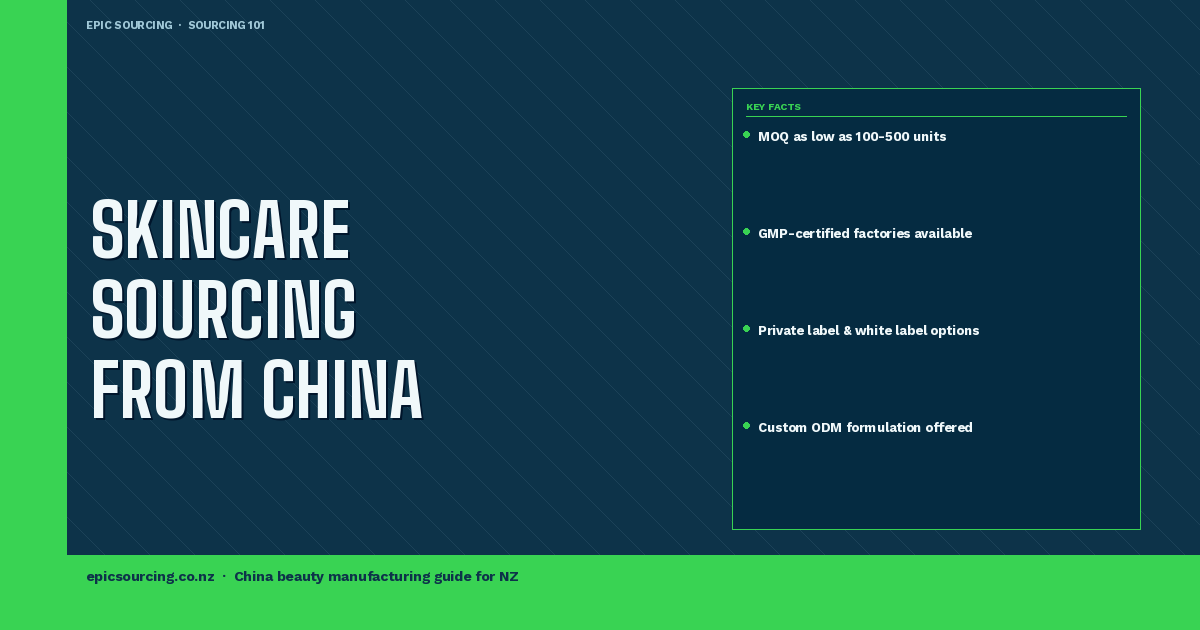
- GMP certification — Good Manufacturing Practice certification is the minimum standard for cosmetics manufacturing. Don't work with any factory that can't provide a current GMP certificate.
- NZ/AU compliance experience — Not all factories understand the NZ market requirements (Cosmetic Products Group Standard 2006). Look for factories that have exported to NZ, Australia, or the UK.
- MOQ (Minimum Order Quantity) — For private label skincare, realistic MOQs are typically 500–2,000 units per SKU. Be wary of factories pushing 5,000+ unit minimums for your first order.
- Sample capability — A good factory will send you samples of their base formulas before you commit. Always test samples thoroughly before proceeding.
- Packaging capability — Some factories supply packaging in-house; others require you to source separately. In-house is generally easier for smaller orders.
Sourcing Hack #2: Request Third-Party Lab Reports — Before you place a full order with a new skincare factory, ask for third-party lab test reports (microbiological testing, stability testing, and ingredient verification). Reputable factories produce these as standard. If a factory can't provide them, walk away.
Step 3 — The Formula and Customisation Process
Most private label manufacturers offer a library of existing 'base formulas' that you can customise. Typical customisations include fragrance or fragrance-free options, active ingredients (vitamin C, retinol, hyaluronic acid, niacinamide), texture (gel, cream, oil, serum, balm), and preservative system.
If you want a truly unique formula, you'll need to work with a factory offering OEM development — this costs more and takes longer, but gives you genuine IP in your formula. For most first-time brands, starting with a customised base formula is the pragmatic choice. It gets you to market faster and reduces R&D risk.
Step 4 — Packaging and Labelling for NZ
Your packaging needs to meet NZ regulatory requirements. Key things to include:
- Ingredient listing (INCI format, in descending order of concentration)
- Net weight or volume (in metric units)
- Country of origin
- Importer details (your NZ business name and address)
- Any required warning statements
For organic or natural claims, you'll need certification to back them up. Work with a graphic designer who understands cosmetics packaging regulations, and always have labels reviewed before printing large quantities.
Step 5 — Quality Control Before Shipment
Never skip this step. Before your first full order leaves the factory, send a third-party QC inspector to check product formulation consistency, fill levels and packaging seal integrity, label accuracy and placement, and batch documentation.
The cost of a QC inspection is typically US$200–$400 per factory visit — a bargain compared to landing 2,000 units of off-spec product in Auckland.
What Does It Actually Cost to Launch in NZ?
Here's a rough ballpark for a first-run hero product (e.g. a vitamin C serum, 30ml, 1,000 units):
- Formula + factory cost: NZ$3–$8 per unit
- Packaging (bottle + pump + box): NZ$1.50–$3.50 per unit
- QC inspection: NZ$350–$650 (one-time)
- Freight (sea, LCL): NZ$600–$1,200 for 1,000 units
- Label design and printing: NZ$800–$1,500 (one-time setup)
- Total landed cost per unit: approximately NZ$6–$15
At a retail price of NZ$45–$75 per unit, the margin potential is significant — which is why private label skincare is attracting so many Kiwi entrepreneurs right now.
Launching a private label skincare brand is absolutely achievable for NZ entrepreneurs — it just takes the right factory relationships and a clear process. At Epic Sourcing, we help Kiwi business owners find GMP-certified skincare manufacturers, manage sampling, and run quality control before your goods ship. Book a free consultation at epicsourcing.co.nz.
Related Articles

Let’s Make It Epic
We're here to make sourcing simple – and a whole lot less stressful.
We are experiencing a higher volume of enquiries than usual. Our standard reply time for form submissions and emails is within 72 hours.
If your matter is urgent, please schedule a video call using the link below.
