.svg)
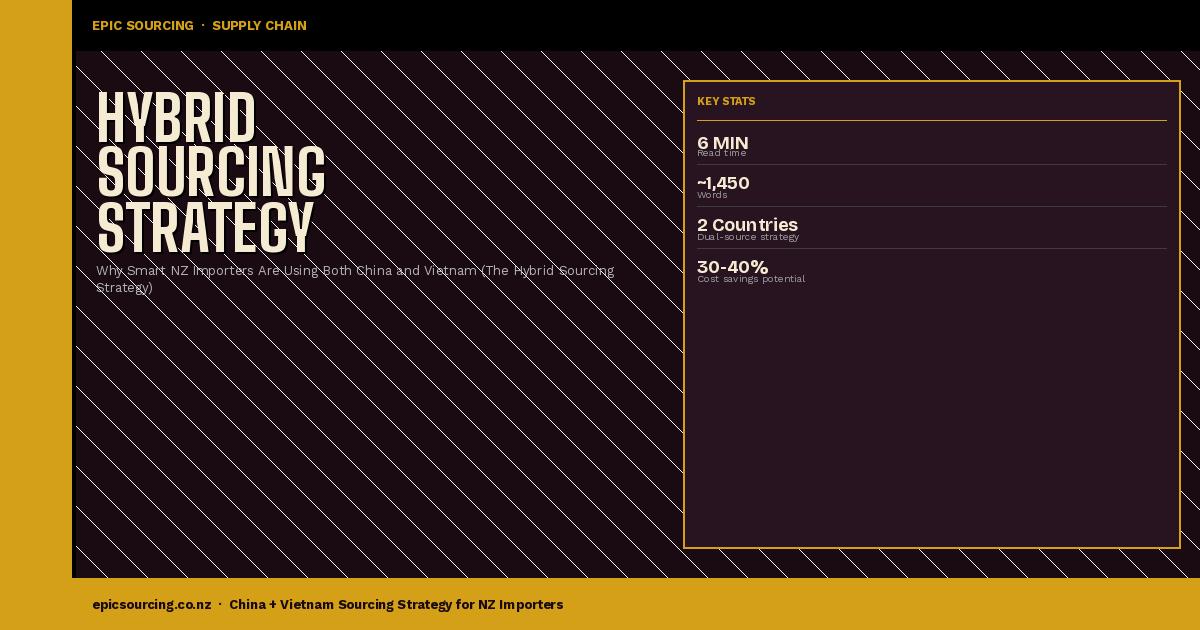
Why Smart NZ Importers Are Using Both China and Vietnam (The Hybrid Sourcing Strategy)

.svg)
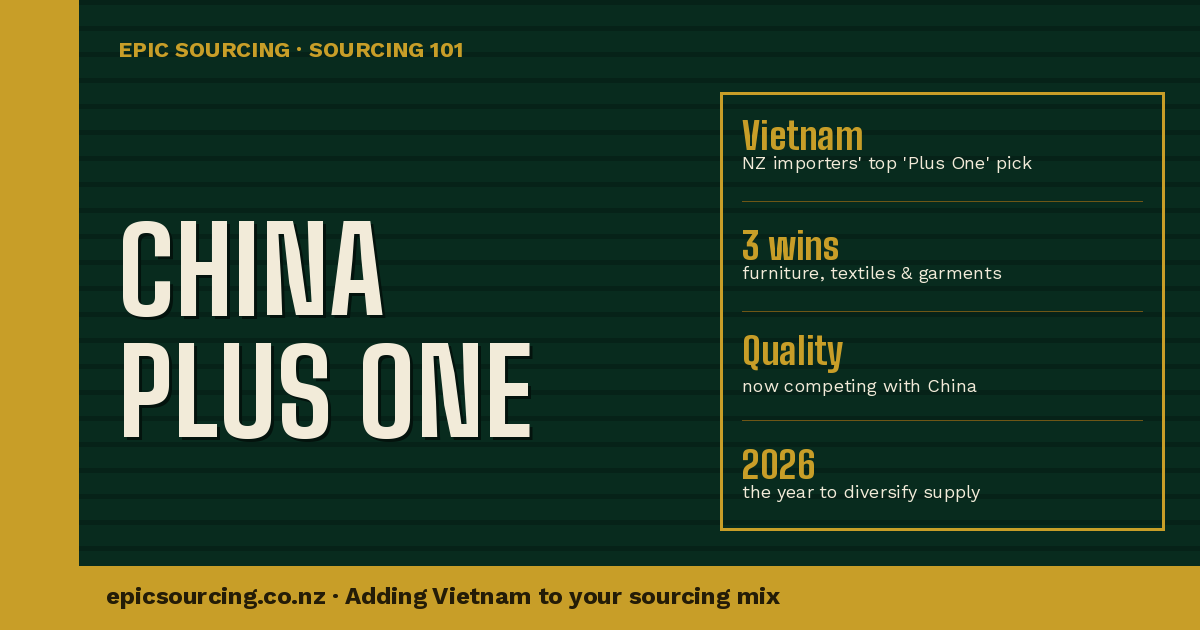
'Should I source from China or Vietnam?' It's one of the most common questions Epic Sourcing gets from NZ importers — and honestly, it's the wrong question. In 2026, the businesses that are winning the sourcing game aren't choosing one country over the other. They're using both.
The hybrid sourcing model — where you pull raw materials and components from China while doing final assembly or sourcing specific finished goods from Vietnam — has emerged as the dominant strategy for smart importers globally. And for NZ businesses, it's a particularly compelling approach.
Why No Single Country Wins in 2026
A few years ago, the narrative was straightforward: China is cheap and efficient, so import from China. Then geopolitical tensions, tariff uncertainty, and COVID-era supply chain chaos prompted a wave of diversification. Vietnam emerged as the alternative — but here's the thing: Vietnam hasn't replaced China. It's complemented it.
China remains unbeatable for: complex manufacturing and precision engineering, raw materials and intermediate goods (fabrics, plastics, metals, electronics components), large-scale production volumes, and speed of development and prototyping.
Vietnam is increasingly competitive for: labour-intensive finished goods (apparel, footwear, furniture, bags), final assembly of products using Chinese components, buyers who need to avoid US-China tariff exposure, and manufacturers who want lower labour costs — Vietnam wages are still ~50% lower than China's.
Why Vietnam Is Rising Fast
If you haven't looked at Vietnam seriously in the last 12 months, you need to. Here's what's driving its rise:
- Competitive labour costs — Manufacturing wages in Vietnam are approximately 50% lower than equivalent roles in coastal China. For labour-intensive goods, this translates directly into lower factory prices.
- Stable political environment — Unlike some Southeast Asian manufacturing hubs, Vietnam has maintained political stability and a consistent, business-friendly regulatory environment.
- Extensive FTA network — Vietnam has FTAs with the EU (EVFTA), UK (UKVFTA), CPTPP members (including NZ), and ASEAN neighbours. Goods manufactured in Vietnam often enter markets with lower tariffs than Chinese-made equivalents.
- Strong factory ecosystem — Particularly in textiles, apparel, footwear, furniture, electronics assembly, and bags. Manufacturing quality has improved significantly over the past decade.
- Vietnam International Sourcing 2026 (VIS 2026) — Taking place August–September 2026, this major sourcing event is drawing purchasing delegations from 60+ countries — a clear sign of Vietnam's growing global manufacturing standing.
The Hybrid Model in Practice
So what does a hybrid sourcing strategy actually look like? Here are a few real-world examples:
Activewear brand: Source high-performance polyester/spandex fabric from Chinese mills in Fujian or Zhejiang. Ship fabric to a Vietnamese garment factory for cutting, sewing, and finishing. Final product: 'Made in Vietnam' (CPTPP-compliant). Cost saving vs. full China production: 15–25% on labour.
Furniture importer: Source steel hardware, hinges, and glass components from Chinese suppliers. Source solid wood processing and assembly from Vietnamese factories in Binh Duong province. Result: genuine quality wood furniture at a competitive NZ price point.
Eco-friendly accessories (bamboo sunglasses, reusable bags): Source bamboo and recycled materials from Chinese suppliers. Final shaping, finishing, and branding done by Vietnamese workshops. Result: an authentic sustainability story with credible manufacturing.
Sourcing Hack #1: Check Your FTA Benefits Before You Decide — Under CPTPP, goods manufactured in Vietnam enter NZ at preferential duty rates. Make sure your product qualifies under the Rules of Origin — generally, sufficient processing must occur in Vietnam to claim the FTA benefit. Your freight forwarder or a customs broker can advise.
What to Watch Out For When Sourcing from Vietnam
- Factory vetting is harder — Vietnam's factory ecosystem is less mature than China's, meaning more inconsistencies in quality management. Always verify factories in person or use a local sourcing agent.
- Lead times can be longer — Vietnamese factories often have longer production lead times than equivalent Chinese factories. Build an extra 2–4 weeks into your planning.
- Communication barriers — English proficiency varies more widely in Vietnam than in China's export hubs. Having a Vietnamese-speaking contact in-country is a significant advantage.
- Infrastructure is developing — Port infrastructure in Vietnam is still less developed than Shanghai or Ningbo. Ho Chi Minh City is the main export hub, but congestion can be an issue.
- IP protection — Vietnam's IP protection framework is still developing. Be thoughtful about what technical information you share with factories.
Sourcing Hack #2: Start Small to Test Quality — For your first order with a Vietnamese factory, keep the quantity to a trial run. A 200–500 unit order lets you assess real production quality, communication, and reliability before you commit to large volumes.
How to Set Up a Hybrid Supply Chain from NZ
- Map your product components — Identify which parts are best sourced from China (raw materials, precision components) and which benefit from Vietnamese labour (assembly, finishing, garment construction).
- Find a sourcing partner with dual-country capability — Working with an agent who operates in both China and Vietnam saves enormous headaches around coordination and quality control.
- Establish your logistics flow — Typically: Chinese supplier ships components to Vietnamese factory → Vietnamese factory produces finished goods → goods ship to NZ. Your freight forwarder needs to understand this multi-leg flow.
- Plan for customs documentation — When goods originate from multiple countries, your paperwork needs to be spotless. Rules of Origin documentation for CPTPP claims must be accurate and backed by factory records.
- Build in QC at both ends — A quality inspection at the Chinese component stage and another at the Vietnamese finished goods stage gives you the best chance of catching issues before they reach NZ.
Is the Hybrid Model Right for Your Business?
Not every NZ importer needs a hybrid supply chain. If you're dealing in smaller volumes or your product is made entirely in one country, sticking to a single-country model is simpler and perfectly fine.
But if you're importing labour-intensive goods (apparel, footwear, furniture), selling or planning to sell into the US market, looking to reduce supply chain concentration risk, or interested in 'Made in Vietnam' as a brand differentiator — then the hybrid model is worth seriously exploring.
Epic Sourcing works across both China and Vietnam. Whether you're looking to set up a new supply chain, add a Vietnamese factory to your existing network, or just explore what's possible, we'd love to have a chat. Book a free consultation at epicsourcing.co.nz and let's map out your hybrid sourcing strategy together.
Related Articles



Let’s Make It Epic
We're here to make sourcing simple – and a whole lot less stressful.
We are experiencing a higher volume of enquiries than usual. Our standard reply time for form submissions and emails is within 72 hours.
If your matter is urgent, please schedule a video call using the link below.
