.svg)
China Plus One: Why Smart NZ Importers Are Looking at Vietnam in 2026

.svg)
You've probably heard the phrase 'China Plus One' thrown around in business conversations lately. It sounds like a strategy reserved for massive global corporations — but it's increasingly relevant to NZ businesses too, especially if you're sourcing manufactured goods, apparel, or furniture.
The basic idea is simple: rather than putting all your eggs in one basket (China), you add at least one additional sourcing country to your supply chain. Vietnam has emerged as the most popular alternative for many product categories, and for good reason.
But is Vietnam actually the right move for your NZ business? Let's cut through the noise and look at the real numbers, the real trade-offs, and where Vietnam makes sense — and where it doesn't.
What's Driving the China Plus One Trend?
A few big forces are pushing global buyers to diversify away from sole-China sourcing:
- US tariffs on Chinese goods — Currently sitting at around 30%, these tariffs have disrupted global supply chains and are pushing more Vietnamese factory capacity online, making it an increasingly viable alternative globally.
- Geopolitical risk — The past few years have been a reminder that over-reliance on a single source country creates vulnerability. Businesses are building resilience into their supply chains.
- Rising China costs — Chinese manufacturing costs have been climbing steadily. While China still has dominant advantages in most categories, the cost gap with alternatives like Vietnam has been narrowing.
- Sustainability pressure — Vietnam has been investing heavily in sustainability certifications and greener production methods, which matters for NZ brands that need to demonstrate ethical sourcing to their customers.
For NZ businesses, you don't face the same tariff pressures as US importers — but the other factors absolutely apply.
Vietnam By the Numbers: What You Need to Know
Vietnam's export economy is booming. Here's a quick snapshot of where things stand in 2026:
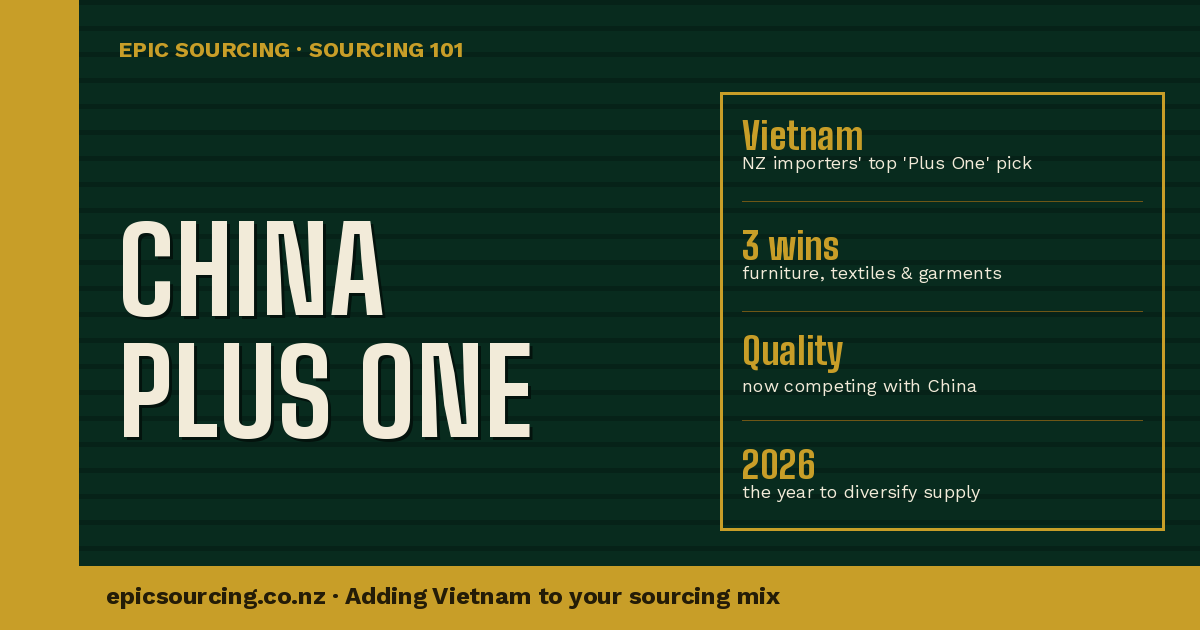
- Furniture: Vietnam furniture exports hit US$15.5B (Jan–Nov 2025), up 5.4% year-on-year. If you're sourcing hotel furniture, hospitality fit-out products, or timber homewares, Vietnam is a serious option.
- Textiles and garments: Projected to reach US$48B in exports by end of 2026. For NZ clothing brands — think women's activewear, kids' wear, casual apparel — Vietnam is already a major player.
- NZ-Vietnam trade: Bilateral trade is targeting NZ$3B by 2026, meaning the trade relationship is growing and more established service providers, freight options, and networks are developing.
The EU-Vietnam Free Trade Agreement enables 0% furniture tariffs for EU buyers — a sign that Vietnam's quality standards are internationally recognised.
Sourcing Hack #1: Vietnam for Furniture and Textiles First — If you're sourcing furniture, timber products, or clothing, Vietnam offers some of the best value and quality in Asia. Start your Vietnam exploration in these categories before branching into more complex manufactured goods.
China vs Vietnam: The Honest Comparison
Let's be straight about this. Vietnam is a compelling alternative, but it's not China. Here's the honest comparison for NZ importers:
- Cost: China wins. Vietnam production costs are generally higher, though they vary significantly by category.
- Capability breadth: China covers almost any product category. Vietnam is strongest in furniture, textiles, and footwear.
- MOQs: China now offers very low MOQs (50–100 units in some sectors). Vietnam generally requires higher minimums for complex products.
- Manufacturing maturity: China has decades of experience. Vietnam is actively transitioning from OEM to ODM manufacturing.
- Labour costs: Rising in both markets. Vietnam is increasing around 10% per year — significant over time.
- Sustainability certifications: Vietnam is investing heavily here and increasingly strong for brands needing ESG credentials.
The bottom line: for most NZ businesses importing mass-produced goods, China still wins on cost and capability. Vietnam makes the most sense for specific product categories (furniture, textiles) and for businesses that need to demonstrate supply chain diversification or better sustainability credentials.
Is Vietnam Right for Your Business?
Vietnam might be the right choice if:
- You're sourcing furniture, timber products, or garments
- You want to reduce geopolitical risk in your supply chain
- Your customers value sustainability and ethical sourcing credentials
- You're looking to develop ODM (own-design manufacturing) partnerships
Stick with China if:
- You need very low MOQs (Vietnam factories generally require higher minimums)
- You're sourcing complex electronics, plastics, or specialised industrial goods
- Cost is the primary driver and margins are tight
- You need rapid prototyping (China's 3D printing and prototyping capabilities are world-class)
For many NZ businesses, the answer isn't China OR Vietnam — it's China AND Vietnam for different parts of your product range.
Sourcing Hack #2: Run a Parallel Supplier Qualification — Don't wait until there's a crisis in your China supply chain before exploring Vietnam. Start qualifying 1–2 Vietnamese suppliers for your top product category now, even if you don't place orders immediately. When you need to switch quickly, you'll have vetted options ready.
What to Watch Out For With Vietnam Sourcing
A few real challenges NZ importers should be aware of:
- Labour costs are rising fast — At 10% per year, Vietnam's cost advantage over China is shrinking. Lock in good supplier relationships now while they're still competitive.
- Freight from Vietnam is less established — While improving, freight services from Vietnam to NZ are less frequent and sometimes pricier than equivalent China-NZ services. Factor this into your landed cost calculations.
- Factory vetting takes time — Vietnam's manufacturing sector is younger and more fragmented than China's. Due diligence and factory auditing is essential before placing large orders.
- Communication varies — English capability varies more widely in Vietnam than China. Having a local sourcing partner who knows the Vietnamese market is genuinely valuable.
Building a Resilient Supply Chain for NZ
The businesses that will thrive in the next decade are those building flexible, resilient supply chains — not those locked into a single source country. Whether that means adding Vietnam to your sourcing mix, exploring India for certain product categories, or simply building stronger relationships with your existing Chinese suppliers, diversification is a smart long-term play.
If you're curious about whether Vietnam is right for your product category, or you want help assessing your supply chain resilience, our team at Epic Sourcing would love to have a conversation. Book a free 30-minute consultation at epicsourcing.co.nz/contact — let's look at your specific situation together.
Related Articles


Let’s Make It Epic
We're here to make sourcing simple – and a whole lot less stressful.
We are experiencing a higher volume of enquiries than usual. Our standard reply time for form submissions and emails is within 72 hours.
If your matter is urgent, please schedule a video call using the link below.
