
.svg)
China-NZ Shipping Rates Are Spiking: What Kiwi Importers Should Do Right Now

.svg)
What's Actually Happening with Shipping Rates Right Now
If you've been importing from China recently, you've probably noticed something a little uncomfortable: it's costing you more to get your goods on the water. A lot more, actually. China-NZ shipping rates have jumped sharply in early 2026, and if you're not on top of what's happening — and more importantly, what to do about it — your margins are going to feel the pinch.
The good news is that rising freight rates aren't necessarily a disaster for your business. They're a challenge that smart importers can navigate with the right information and a bit of forward planning. Here's the current rate picture as of May 2026:
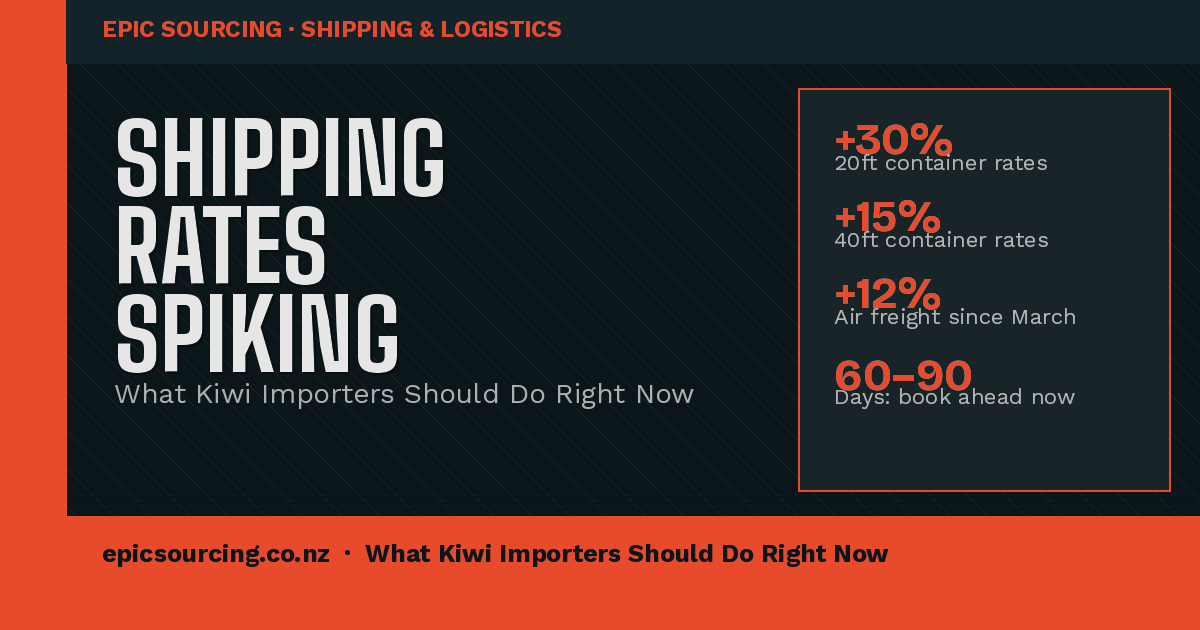
- 20ft container (20GP FCL): USD $1,170–$1,430 — up 30% since March
- 40ft container (40GP FCL): USD $2,025–$2,475 — up 15% since March
- LCL (Less than Container Load): USD $5 per CBM — currently stable
- Air freight: USD $4.50/kg — up 12% since March
Equipment tightness is adding surcharges on top of the base rates, making early planning more critical than ever.
Why Are Shipping Rates Going Up?
A few things are converging at once. The ongoing US-China tariff environment continues to create ripple effects globally. Chinese manufacturers who've seen US export volumes drop are competing more aggressively for other international buyers — including Kiwis. More cargo chasing the same shipping capacity pushes rates up.
Equipment tightness is real. Container availability can be patchy depending on port congestion and repositioning issues. When there aren't enough containers where they're needed, surcharges stack up fast.
Third, it's seasonal. The April-May period tends to see an uptick in shipping activity globally, coinciding with post-Canton Fair order placements. A Xi-Trump summit scheduled for May 2026 could bring some clarity around Section 301 tariffs, which might ease capacity pressure over the coming months. Watch that space.
Sourcing Hack #1: Book Early, Lock in Rates — If you have orders planned for the next 60-90 days, reach out to your freight forwarder now and ask about rate locks or early booking discounts. Carriers sometimes offer fixed-rate contracts for importers willing to commit in advance — this can save you hundreds per container when spot rates are climbing.
FCL vs LCL: Which Makes More Sense When Rates Are High?
This is a question worth revisiting whenever rates move significantly. FCL (Full Container Load) gives you a dedicated container. Rates are higher right now, but if you're ordering enough to fill or nearly fill a container, it's almost always still the better value per CBM. The sweet spot is when your cargo is over around 15 CBM.
LCL (Less than Container Load) is where you share container space with other shippers and pay by the cubic metre. At USD $5/CBM, LCL rates have held stable — which makes it an increasingly attractive option for smaller orders right now.
How to Protect Your Margins as a Kiwi Importer
Rising freight rates don't have to crush your profitability. Here are four practical ways to protect your margins:
- Consolidate your orders where possible. If you're placing multiple small orders across different suppliers, consolidate into a single container. Fewer shipments means fewer freight bills.
- Renegotiate with suppliers on pricing. Many Chinese manufacturers prefer to keep a long-term buyer happy and will work with you on margin.
- Review your retail pricing. If your landed cost has increased 15-30%, your pricing may need to reflect that reality.
- Reduce air freight dependence. At $4.50/kg, air freight is expensive. Sea freight options will be far better value even at current elevated rates.
Sourcing Hack #2: Run a Landed Cost Calculation Before Every Order — Don't just look at the factory price. Calculate your total landed cost: product cost + freight + insurance + customs duty + delivery to your warehouse. A product that looks cheap ex-factory can quickly eat your margins once you add freight costs.
Timing Your Orders to Navigate the Rate Spike
Timing matters heaps when freight rates are volatile. Order now for August-September stock — transit times from China to NZ are 20-23 days by sea. Avoid peak shipping seasons where you can, around Chinese New Year and Canton Fair season. Even a 2-3 week adjustment to your ordering cycle can make a meaningful difference to rates.
When Should You Consider Air Freight Instead?
Air freight at $4.50/kg makes sense for small, high-value products like jewellery or health supplements, urgent restocks when you can't afford to wait 3 weeks, and sample shipments where speed matters. For most standard product imports — apparel, homewares, gym equipment, packaging — sea freight will almost always be the better choice, even at today's elevated rates.
If you're unsure how to structure your next import order, or want help building a landed cost model for your products, the team at Epic Sourcing NZ is here to help. Book a free consultation at epicsourcing.co.nz and let's talk through your importing strategy together.
Related Articles

Let’s Make It Epic
We're here to make sourcing simple – and a whole lot less stressful.
We are experiencing a higher volume of enquiries than usual. Our standard reply time for form submissions and emails is within 72 hours.
If your matter is urgent, please schedule a video call using the link below.
