.svg)
How to Find a Manufacturer in China: A Step-by-Step Guide for NZ Businesses

.svg)
Here's a question we get asked constantly: "I know what I want to sell — but how do I actually find someone in China who can make it?" It's one of the most common hurdles for Kiwi businesses exploring product sourcing, and honestly, it's not as complicated as it sounds once you know where to look and what to look for.
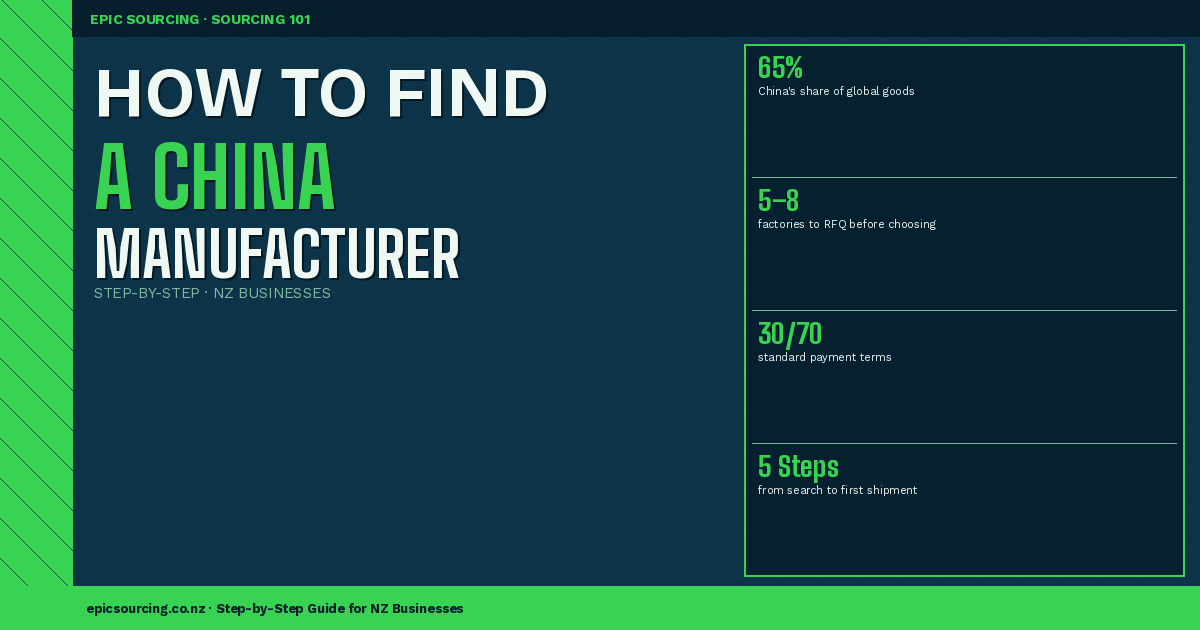
China remains the world's manufacturing powerhouse. Even with the rise of Vietnam, India, and Bangladesh as sourcing alternatives, China commands about 65% of the global supply of manufactured goods — and for most product categories, it still offers the best combination of price, speed, and manufacturing capability.
This guide walks you through exactly how to find a manufacturer in China as a NZ business, step by step — from your first search to signing off on your first production run.
Step 1: Get Clear on What You're Actually Looking For
Before you search for a single supplier, you need to get specific. "I want to make activewear" is not a brief — "I need 300–500 units of women's high-waist leggings in 80% polyester/20% spandex, with sublimation printing, in 4 sizes, minimum order 100 units per colourway" is a brief.
The more specific you are, the better your supplier results. Chinese manufacturers are organised by product category and process — a factory that makes seamless knit activewear is different from one that does cut-and-sew sportswear. The key information to define before you start:
- Product specifications — materials, dimensions, weight, colours, finishes, any technical requirements
- Target order quantity — both your ideal initial order and your projected monthly or annual volume
- Budget range — your target unit cost, factoring in freight and duties to NZ
- Compliance requirements — does the product need to meet any NZ standards or certifications?
- Packaging and labelling — how do you want the product packaged and what label information is required?
Step 2: Where to Search for Manufacturers
There are several key platforms and approaches for finding Chinese manufacturers:
- Alibaba.com — The most well-known platform, with millions of suppliers. Filter by "Verified Supplier" and "Trade Assurance" for some baseline protection.
- Made-in-China.com — Strong for industrial and B2B products. Often where manufacturers rather than trading companies are more prominently featured.
- Global Sources — More premium-positioned platform with stronger factory verification. Popular in electronics, fashion, and home products.
- Canton Fair — The world's largest trade fair, held in Guangzhou every April and October. Meeting factories face-to-face is invaluable for assessing quality and building relationships.
- Industry-specific B2B platforms — For apparel, try Sewport or Maker's Row. For electronics, IC Procurement. For home goods, various wholesale directories.
- Sourcing agents — A reputable NZ-based sourcing agency can shortlist vetted factories in your category, saving weeks of research.
Sourcing Hack #1: Search in Chinese on Alibaba for Better Results — Many NZ buyers don't know that searching in Chinese on Alibaba surfaces more and sometimes cheaper factory listings than English searches. Use Google Translate to put your product category into Mandarin, then search. You'll often find manufacturers who don't actively market internationally but produce excellent quality — and are very receptive to export enquiries.
Step 3: Evaluating and Shortlisting Suppliers
You've done your search and now you have a list of 20 potential suppliers. Here's how to narrow it down to the 3–5 worth engaging properly:
- Check their export experience — have they shipped to NZ or Australia before? This matters for biosecurity documentation and packaging requirements.
- Review their product range — does it genuinely match your category? A factory with a tight, consistent product range is usually more specialised.
- Look at their certifications — for quality-sensitive products, do they hold ISO 9001, BSCI, GOTS, or other relevant certifications?
- Request a factory profile — ask for photos of their production floor, equipment list, and annual output capacity.
- Check reviews and transaction history on Alibaba — the volume and recency of verified transactions matters more than star ratings.
- Send a detailed RFQ — your Request for Quotation should include your full spec. How a factory responds tells you a lot about how they'll be to work with.
Sourcing Hack #2: Send the Same RFQ to 5–8 Factories and Compare the Responses — Don't just look at the price. Pay attention to what else the factory tells you. Do they flag any potential issues with your spec? Ask clarifying questions? Offer alternatives? The factories that engage thoughtfully with your brief are the ones most likely to deliver a quality outcome.
Step 4: Verifying Your Shortlisted Factories
This is the step most first-time importers skip — and it's the one that prevents the most problems. Before placing any order, verify the factory is real and capable of what they've claimed:
- Business licence check — ask for their Chinese business licence. A legitimate factory can provide this immediately.
- Video call tour — ask for a live walkthrough of the production floor. Legitimate factories are happy to do this.
- Third-party factory audit — services like SGS, Bureau Veritas, and QIMA offer factory audits in China for typically USD $200–400. For orders above NZD $10,000, this is excellent insurance.
- Sample order first — always place a sample order before committing to full production. Pay for the samples.
- Reference check — ask if they can connect you with a reference buyer in a similar market (Australia, NZ, UK).
Step 5: Placing Your First Order
You've found your factory, verified them, and approved your samples. A few key things to lock in before you confirm:
- Written contract or purchase order — specify every detail: quantity, specs, pricing, lead time, payment terms, and inspection rights.
- Payment structure — the standard for first-time orders is 30% deposit, 70% before shipment.
- Pre-shipment inspection — arrange a third-party inspection before the goods leave the factory.
- Freight and customs documentation — ensure your factory provides all required export documents.
- NZ customs and biosecurity — check Import Classification (HS code), duty rates, and any MPI biosecurity requirements for your product category.
When to Use a Sourcing Agent
If all of this feels like a lot — especially on top of running your actual business — that's completely understandable. Finding and vetting manufacturers, managing samples, coordinating production inspections, and navigating NZ compliance is a full-time job in itself.
A NZ-based sourcing agent like Epic Sourcing handles all of this for you. We have existing relationships with vetted factories across product categories including apparel, home goods, construction materials, consumer products, and more. For NZ businesses looking to source $10,000+ of goods, the investment in a sourcing agent typically pays for itself in avoided mistakes alone.
Keen to explore sourcing for your business? Epic Sourcing offers a free consultation for NZ businesses — no obligation, just a straight-up conversation about what's possible. Book yours at epicsourcing.co.nz.
Related Articles


Let’s Make It Epic
We're here to make sourcing simple – and a whole lot less stressful.
We are experiencing a higher volume of enquiries than usual. Our standard reply time for form submissions and emails is within 72 hours.
If your matter is urgent, please schedule a video call using the link below.
