.svg)
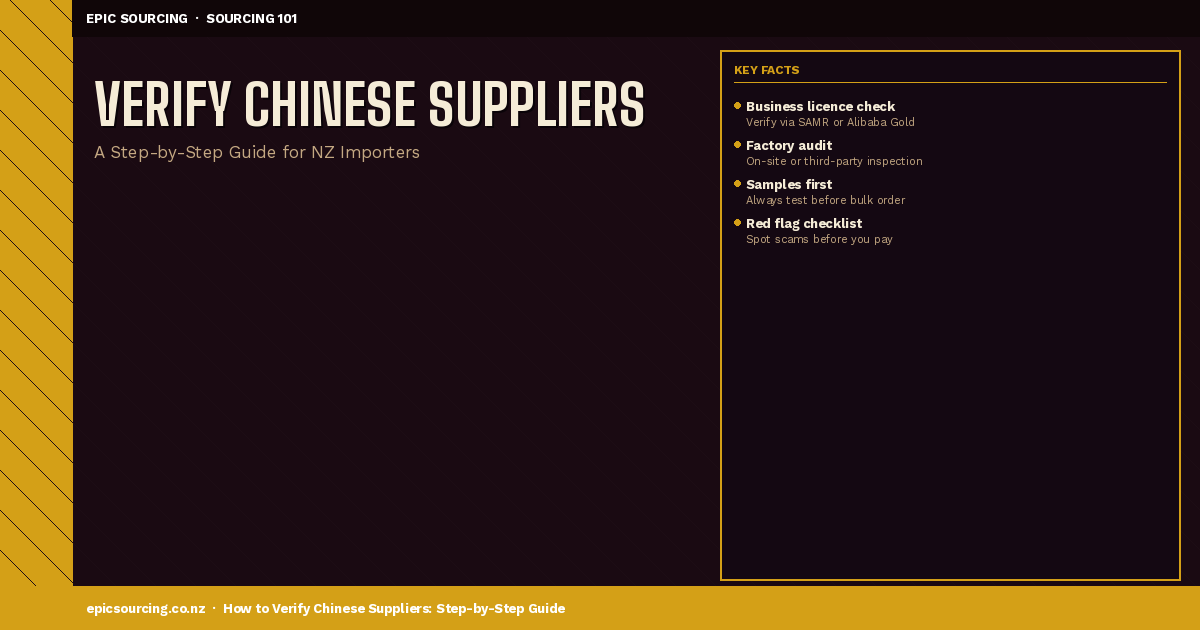
How to Verify Chinese Suppliers: A Step-by-Step Guide
.jpg)
.svg)
Last updated: September 2026
Verifying a Chinese supplier before placing an order means checking their business registration, factory credentials, and track record, either through independent research, a third-party audit, or both. Here's how to do it properly, whether you're sourcing for the first time or tightening up an existing process.
Why Supplier Verification Matters Before You Place an Order
Most sourcing disasters don't happen because a founder chose the wrong product; they happen because they trusted the wrong factory. A supplier that looks credible on Alibaba can still turn out to be a trading company posing as a manufacturer, an unregistered operation, or a business with a history of disputes. Checking credentials before money changes hands is far cheaper than chasing a refund across an international border after it goes wrong.
How to Check a Supplier's Business Registration in China
Every legitimate Chinese manufacturer must be registered with the State Administration for Market Regulation (SAMR). You can check a supplier's registration status through China's National Enterprise Credit Information Publicity System at gsxt.gov.cn. What to look for: the business name in Chinese characters (ask the supplier for it), the registration status (should read "active"), the business scope (should include manufacturing, not just trading), and the registered capital.
If a supplier won't give you their Chinese business name or hesitates when asked, that's a red flag worth taking seriously.
Sourcing Hack: Cross-check the business name on Alibaba against the gsxt.gov.cn listing. If the two don't match, or the Alibaba listing shows "Verified Supplier" but you can't find a matching SAMR registration, ask for clarification before going any further.
What Does a Factory Audit Cover?
A factory audit is an on-site inspection by a qualified third party (or your sourcing agent's in-country team) that assesses the factory's production capability, quality systems, worker headcount, machinery, and safety standards. A basic audit covers production capacity and quality control processes; a more detailed social compliance audit also checks working conditions and environmental certifications.
For a first-time order with a new supplier, a basic capability audit is worth doing even on small orders. The cost is small relative to the risk of discovering mid-production that your supplier has subcontracted your order to another factory you've never seen.
Free Download: Supplier Verification Checklist
Everything to check before you pay a Chinese supplier: business registration, audit red flags, the right questions to ask, and more.
Download the Free ChecklistHow to Use Trade Records to Check a Supplier's History
Import and export records are publicly available through platforms like Panjiva and ImportGenius. These show who a factory has shipped to in the past, which countries they export to, and the types of products they've shipped. This tells you whether this is a real, active exporter, and whether the buyers they work with are credible businesses.
A factory with a long history of shipments to recognisable international brands is a meaningfully lower risk than one with no visible export history, even if both look polished on Alibaba.
What to Ask a Supplier Before You Commit
Beyond documentation, a direct conversation reveals a lot. Ask for a sample order before committing to production. Ask for references from existing buyers, particularly from your region. Ask how they handle defects found during or after production. A supplier who answers these questions clearly and without hesitation is a much safer bet than one who stalls, deflects, or gets defensive.
For a complete list of what to check (business registration, trade records, audit red flags, and the right questions to ask) use the free checklist below.
Frequently Asked Questions
Can I verify a Chinese supplier myself, without a sourcing agent?
Yes, but with limits. You can check SAMR registration and trade records from New Zealand. What you can't do remotely is assess the factory floor, verify production capacity, or catch red flags that only show up in person. For any order of meaningful size, pairing your own research with an in-person audit (or a sourcing agent with on-the-ground staff) is the safer approach.
Is Alibaba's "Verified Supplier" badge enough?
No. Alibaba's verification checks that a business is legally registered and has been assessed by a third party, but the assessment scope varies, and many trading companies hold the badge alongside legitimate manufacturers. Use it as a starting point, not a final check.
What's the difference between a factory and a trading company?
A factory manufactures the goods. A trading company buys from factories and resells to you, adding a markup. Trading companies aren't inherently bad. Some provide useful services, but knowing which one you're dealing with is essential for understanding your real price, lead time, and who's making your product.
How do I know if a supplier is subcontracting my order?
Subcontracting without your knowledge is one of the most common quality risks in Chinese manufacturing. Signs include unusually short quoted lead times, inconsistent communication from the factory floor, or quality that varies significantly between samples and production. An on-site audit mid-production is the most reliable way to catch it.
What should I do if a supplier fails verification?
Walk away and find another one. A supplier who misrepresents their credentials before you place an order is unlikely to improve their transparency once your money is on the table.
Does Epic Sourcing do supplier verification for NZ clients?
Yes. Supplier vetting, including factory assessment, business registration checks, and trade record review, is part of the sourcing process for all Epic Sourcing NZ clients. The checklist below is a good starting point if you want to do your own checks first.
Free Download: Supplier Verification Checklist
Everything to check before you pay a Chinese supplier: business registration, audit red flags, the right questions to ask, and more.
Download the Free ChecklistStay in the Loop
Get weekly sourcing tips, market updates, and supplier insights from the Epic Sourcing team, delivered straight to your inbox.
Subscribe to the NewsletterRelated Articles
![Hidden Costs of Importing from China to New Zealand [2026]](https://cdn.prod.website-files.com/688a8969df3fa58c211fb141/69a4ac847b494feb0d50b58c_Why%20the%20Invoice%20Price%20Is%20Not%20the%20Landed%20Price.png)

Let’s Make It Epic
We're here to make sourcing simple – and a whole lot less stressful.
We are experiencing a higher volume of enquiries than usual. Our standard reply time for form submissions and emails is within 72 hours.
If your matter is urgent, please schedule a video call using the link below.
