.svg)
How to Import Building Materials from China to New Zealand: A Complete Guide

.svg)
If you've priced up construction materials lately, you already know how punishing costs can be in New Zealand. Between global supply chain pressure, local shortage issues, and the general "everything's expensive" vibe of recent years, sourcing product locally has become harder and harder to justify — especially for developers, builders, and property investors looking to protect their margins.
Here's the thing: China is one of the world's largest producers of building materials. From tiles and flooring to aluminium joinery, fixings, and architectural hardware — factories across China produce high-quality building products at prices that can make a real difference to your bottom line.
In this guide, we'll walk you through how to import building materials from China to New Zealand, what to watch out for, and how to do it right the first time.
What Building Materials Can You Import from China?
Quite a lot, actually. Chinese manufacturers produce a huge range of building products. The most commonly imported categories by NZ developers and builders include:
- Tiles and flooring — ceramic, porcelain, vinyl plank, timber-look, and mosaic
- Sanitaryware — toilets, basins, baths, tapware, and shower fittings
- Door hardware and architectural fittings — handles, hinges, and locks
- Aluminium windows, doors and joinery (note: NZ Building Code compliance is required)
- Structural steel components — beams, connectors, and framing elements
- Electrical fittings and lighting — downlights, LED strips, and switchgear
- Composite decking and cladding
- Fasteners, fixings, and screws — in bulk for large-scale projects
The price premium for NZ-bought versus China-sourced tiles, flooring, and sanitaryware can easily be 30-60%, which makes a significant difference on a development of any meaningful scale.
Key Compliance Considerations for NZ
This is where many first-time importers come unstuck. New Zealand has specific building code requirements, and not everything that comes off a Chinese production line will automatically comply. Know these before you order:
- NZ Building Code (NZBC) — All building products used in NZ must either comply with the NZBC or have a building consent confirming they're fit for purpose. For structural products, this is non-negotiable.
- Third-party certifications — Many Chinese factories hold CE marks, ISO certifications, or BSCI audit status. Always ask for documentation and verify with the certifying body for significant orders.
- MPI Biosecurity clearance — Timber products (especially untreated wood) require clearance from the Ministry for Primary Industries. Factor in inspection time and potential treatment costs.
- Electrical products — Must meet NZ/Australian electrical safety standards (AS/NZS). Always ask for compliance certificates and check the plug and voltage specifications for NZ.
Sourcing Hack #1: Ask Your Factory for NZ-Specific Compliance Docs — When requesting samples or quotations, specifically ask: "Can you provide documentation for New Zealand building code compliance, or equivalent international standards such as CE or ISO?" Reputable factories deal with international buyers regularly and will understand the request. If they can't provide anything, treat it as a red flag.
How to Find Reliable Suppliers
Finding a factory that makes the product is easy. Finding one that makes it well, ships on time, and doesn't cut corners is where the work happens. Here's the standard approach for building material imports:
- Start with Alibaba or Made-in-China.com for initial supplier discovery
- Filter for verified/gold suppliers and request factory audit reports or certification documents
- Request samples before committing to any volume — colours and finishes on screen rarely match real life
- Conduct factory verification via a third-party audit firm or a sourcing agent with on-the-ground China contacts
- Negotiate payment terms — a common structure is 30% deposit, 70% on bill of lading
For tiles and sanitaryware specifically, the Foshan region in Guangdong province is China's manufacturing heartland. If you're sourcing bathroom products or flooring, Foshan is where most of the world's production happens — and where you'll find the widest range of styles and price points.
Sourcing Hack #2: Order Samples Before You Commit to a Container — For tiles and flooring especially, never commit to a container load without first receiving physical samples. Batch variation is common, and colours look very different under NZ lighting compared to factory photos. Order 2-4 sample pieces, check them in your actual project environment, and confirm the size tolerances match your specification. It's a small upfront cost that can save you a very large headache later.
Understanding the Landed Cost
Before you compare a Chinese-made tile to a locally sourced equivalent, you need to calculate the true landed cost of the import. Here's what to include:
- Product cost — ex-works or FOB price from the factory
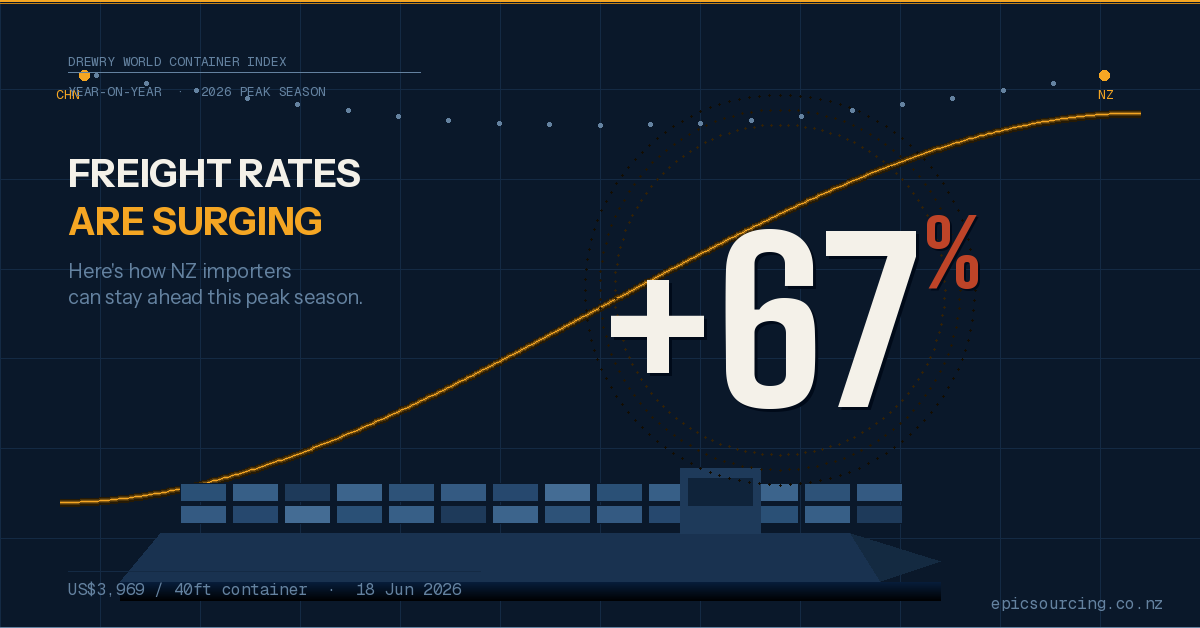
- Sea freight — currently NZ$2,250-$2,750 for a 20ft container from China to Auckland (August 2026 peak season rates)
- NZ Customs duty — most building materials from China are 0% under the NZ-China FTA
- GST — 15% applied on the CIF (cost, insurance, freight) value
- Delivery from port to your site or warehouse
- Compliance costs — third-party inspections, certifications, and MPI checks where applicable
Even with freight at current elevated peak-season rates (up 36-38% since June), many building material imports from China remain financially compelling — particularly for larger projects where setup costs are amortised across volume.
What Order Volumes Make Sense?
Importing directly from China makes most sense when your volumes justify the setup. As a rough guide:
- Under 2 CBM — usually better to source locally or through a NZ importer
- 2-10 CBM — LCL (less than container load) import worth considering, depending on product value
- 10+ CBM — FCL (full container load) typically the most cost-effective option
For individual trade jobs, importing directly often doesn't stack up. But for apartment developments, commercial fitouts, hotel refurbishments, or repeat projects of the same type — the economics shift significantly. A developer fitting out 20 identical bathrooms is looking at an entirely different calculation than a tradie doing one job.
Working with a Sourcing Agent vs Going Direct
You have two main options: go direct to factories yourself, or work with a sourcing agent who has on-the-ground relationships in China. Going direct is possible — but it requires time, negotiation skill, and ideally some way to verify factory quality without physically being there. Language barriers and the risk of misrepresentation are real challenges for first-time importers.
A sourcing agent brings factory relationships, quality control infrastructure, and freight expertise. For higher-value or more complex building product imports — compliant joinery, structural steel, technical flooring systems — working with a sourcing partner can significantly reduce risk and ultimately save money.
So if you're a developer, builder, or property investor looking to import your first container of tiles, fixtures, or hardware — the margins can absolutely work in your favour. The key is doing your compliance homework upfront and finding the right factory partner. That's exactly where the Epic Sourcing team can help. Book a free consultation at epicsourcing.co.nz and let's talk through your project.
Related Articles

Let’s Make It Epic
We're here to make sourcing simple – and a whole lot less stressful.
We are experiencing a higher volume of enquiries than usual. Our standard reply time for form submissions and emails is within 72 hours.
If your matter is urgent, please schedule a video call using the link below.
