.svg)
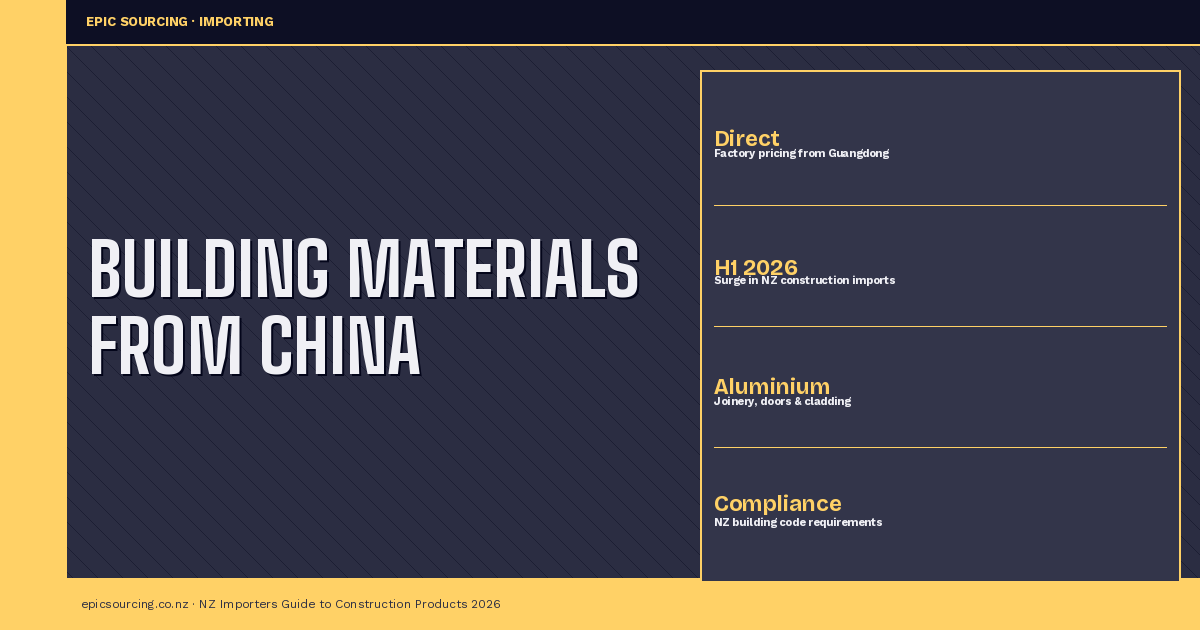
Sourcing Building Materials from China: A Practical Guide for NZ Builders and Developers

.svg)
Why NZ Builders and Developers Are Sourcing Directly from China
Building materials and construction sourcing has consistently been the highest-volume enquiry category for Epic Sourcing NZ over the past three years. With NZ's ongoing housing activity, commercial developments, and renovation market, builders and developers are constantly looking for ways to reduce material costs without compromising on quality or compliance.
China remains the world's dominant manufacturer of building materials. From structural steel and aluminium profiles to tiles, timber, hardware, insulation, letterboxes, and facade cladding — if you can spec it, there's a factory in China making it.
The cost differential is the starting point. Building materials sourced directly from Chinese manufacturers and imported into NZ typically land at 25–60% below the cost of buying from local NZ distributors or wholesalers. On a large commercial fit-out or residential development, that gap can represent tens of thousands of dollars.
But cost isn't the only driver. Builders and developers who source directly also gain:
- Product customisation: Getting tiles in a non-standard size, steel profiles in a specific gauge, or hardware with a custom finish not available locally.
- Consistent supply: Direct supplier relationships mean you're first in line for stock.
- Competitive advantage: Lower material costs allow you to price projects more competitively or protect your margin on fixed-price contracts.
The Most Commonly Sourced Building Product Categories
Based on real client enquiry data, these are the product categories NZ builders and developers most commonly source from China:
- Structural steel and aluminium: RSJ beams, SHS/RHS sections, aluminium extrusions, curtain wall systems.
- Tiles and stone: Porcelain floor and wall tiles, natural stone pavers, terrazzo, outdoor slip-resistant tiles.
- Hardware and fixings: Door handles, hinges, letterboxes, locks, brackets, and general construction fixings.
- Facade and cladding: Aluminium composite panels (ACP), fibre cement board, architectural mesh.
- Windows and doors: Aluminium double-glazed window units, uPVC doors, louvre systems.
- Insulation and weatherproofing: PIR insulation panels, membrane waterproofing, thermal breaks.
- Timber and engineered wood: LVL beams, plywood, OSB board, engineered flooring.
Sourcing Hack #1: Batch Your Building Material Orders — Shipping 8 different product categories for a single project? Don't ship them piecemeal — consolidate into a single Full Container Load (FCL) shipment wherever possible. FCL rates are more cost-effective than multiple LCL shipments, and consolidating timing reduces the risk of one delayed shipment holding up a whole project phase.
NZ Building Code Compliance: What You Must Get Right
This is the non-negotiable part of the conversation. New Zealand has a robust building code (NZBC) that applies to all building products used in construction. If your imported building materials don't comply, you risk consent refusal, project delays, and significant legal and financial liability.
How does NZBC compliance work for imported materials? There are several pathways:
- CodeMark certification: The formal NZ certification scheme. Products with CodeMark certification have been independently tested and are accepted by all NZ councils.
- Building consent authority (BCA) acceptance: For products without CodeMark, you can apply to your local BCA for acceptance — but this requires test reports, technical documentation, and sometimes third-party engineering sign-off.
- Equivalent overseas standards: Some products with AS/NZS, ISO, CE, or other recognised certifications can be accepted as compliant equivalents.
- Specific Design: For structural elements especially, an NZ-registered engineer can sign off on a specific design using your specified imported product.
The key point: compliance documentation must be arranged before you order, not after the goods arrive in NZ.
Quality Control: How to Avoid Getting Burned
Building materials are not a category where you can afford to compromise on quality. Effective QC for building materials includes:
- Pre-production approval of samples: Before mass production, get physical samples to NZ for review by your engineer or site manager.
- During-production inspection (DPI): A third-party inspector visits the factory during production to check dimensions, materials, and finishes. Typically costs $300–500 per inspection day.
- Pre-shipment inspection (PSI): A final check before the container is loaded — verifying quantities, checking for damage, and confirming documentation.
- Material testing: For structural products, consider requesting third-party material testing with test certificates included in the shipment documentation.
Sourcing Hack #2: Request Full Technical Documentation as Part of Your PO — When placing your purchase order, list the required documentation as line items: test certificates, material certificates, MSDS where applicable, packing lists, and compliance certifications. Make it clear that the final payment instalment is conditional on receiving complete documentation. Factories that can't or won't provide documentation are factories to avoid.
Freight and Logistics for Bulk Building Materials
Building materials are typically heavy, bulky, and sometimes awkward to handle — which makes freight planning critical:
- Heavy cargo surcharges: Steel and stone products often trigger heavy cargo surcharges from shipping lines. Factor this into your landed cost calculation.
- Lead time planning: Chinese factories typically need 3–6 weeks to produce building materials to spec, plus 3–4 weeks for sea freight to NZ. Plan your material sourcing 3–4 months ahead of when you need it on-site.
- NZ-China FTA: With a valid Certificate of Origin from your supplier, many building material categories qualify for preferential tariff rates under the NZ-China FTA.
Working Across Multiple Product Categories Simultaneously
One of the trickiest aspects of building material sourcing is managing multiple product types — each with different factory relationships, production timelines, QC requirements, and compliance pathways — simultaneously on a single project timeline.
A good sourcing partner will consolidate your RFQs across multiple suppliers, manage factory relationships and production schedules, coordinate QC inspections across different factories, consolidate shipments to reduce freight costs, and handle import documentation and customs brokerage.
For a commercial project with $200,000+ in imported building materials across 8 categories, the value of that coordination is significant — in time saved, problems avoided, and costs reduced.
Thinking about sourcing building materials from China? The Epic Sourcing team has hands-on experience across 8+ building product categories for NZ builders and developers. Book a free 30-minute consultation at epicsourcing.co.nz to talk through your project.
Related Articles

Let’s Make It Epic
We're here to make sourcing simple – and a whole lot less stressful.
We are experiencing a higher volume of enquiries than usual. Our standard reply time for form submissions and emails is within 72 hours.
If your matter is urgent, please schedule a video call using the link below.
