
.svg)
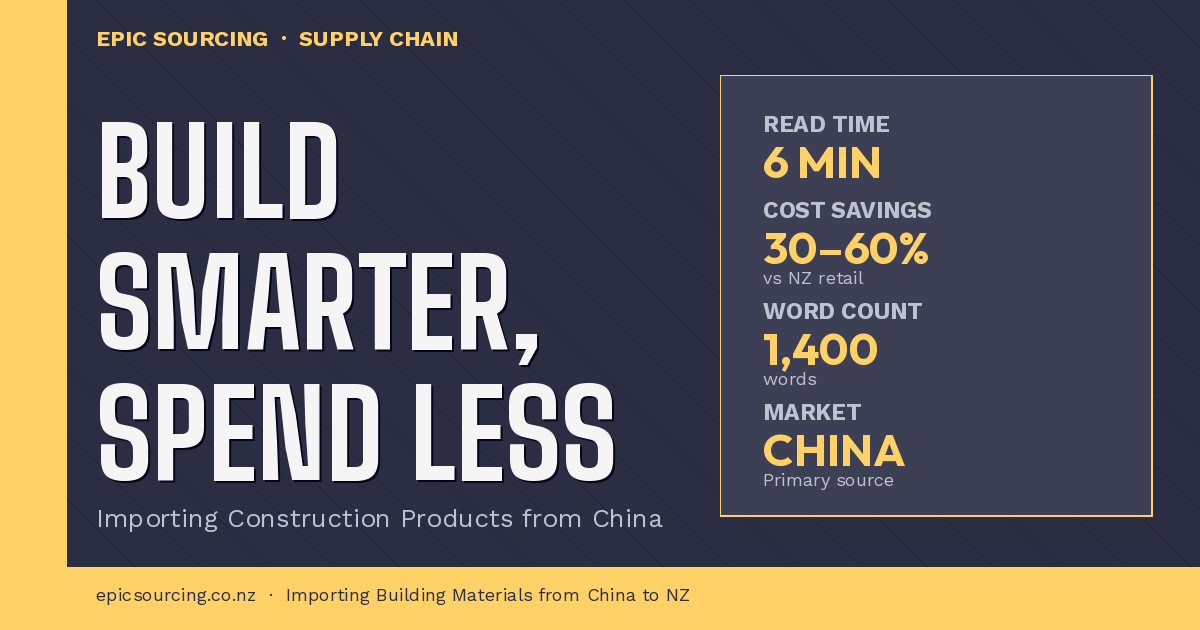
Importing Building Materials and Construction Products from China to NZ: A Practical Guide

.svg)
What Building Products Are Kiwi Businesses Actually Importing from China?
You might be surprised by the range. Construction and building product imports from China to NZ cover a huge spectrum:
- Structural hardware — brackets, joist hangers, post bases, hold-downs, anchor bolts
- Roofing products — coloured steel roofing, flashing, guttering, downpipes
- Cladding and facades — aluminium composite panels (ACP), fibre cement boards, timber-look cladding
- Interior products — laminate flooring, vinyl plank flooring, tile, cabinetry, doors
- Bathroom fittings — tapware, vanities, shower enclosures, toilets
- Electrical components — light fittings, switches, sockets, LED products
- Garden and outdoor — decking, fencing, pergola kits, garden edging
The most commonly imported products tend to be lower-risk, high-volume items like flooring, tiles, fittings, and hardware — rather than structural components like beams or load-bearing steel.
The NZ Compliance Landscape for Building Products
This is where construction sourcing gets complicated, and where you need to do your homework. New Zealand has a rigorous building compliance system, and products used in consented work need to meet specific standards.
- New Zealand Building Code (NZBC) — All building products used in consented construction must comply with the NZBC. This doesn't mean every product needs a specific NZ certificate, but you need to demonstrate compliance.
- CodeMark vs. Producer Statements — Some products require CodeMark certification. Others can use a Producer Statement from a suitably qualified engineer attesting to compliance.
- Standard references — Chinese factories often manufacture to ISO, CE, or US standards. You need to verify whether these are accepted equivalents under NZ regulations.
- Product substitution — If substituting a specified product for an imported alternative, you'll need to demonstrate equivalence. This is where independent testing labs come in.
The practical upshot: for low-risk products (aesthetic finishes, non-structural hardware, garden products), compliance is usually straightforward. For anything structural or weather-critical, get professional advice before ordering.
Sourcing Hack #1: Ask for Test Reports Upfront — Always request factory test reports before ordering building products — not photos of certifications, actual test reports. Reputable Chinese manufacturers will have ISO, CE, or equivalent third-party test reports. Send them to a local engineer to assess NZ compliance equivalence.
Freight and Logistics for Construction Products
- Weight and density — Building materials are heavy. Sea freight is almost always the only viable option; air freight costs are prohibitive.
- FCL vs LCL — Current FCL rates from China to NZ: NZD $1,890–$2,310 for 20ft, NZD $3,735–$4,565 for 40ft. LCL rates are ~NZD $38/cbm.
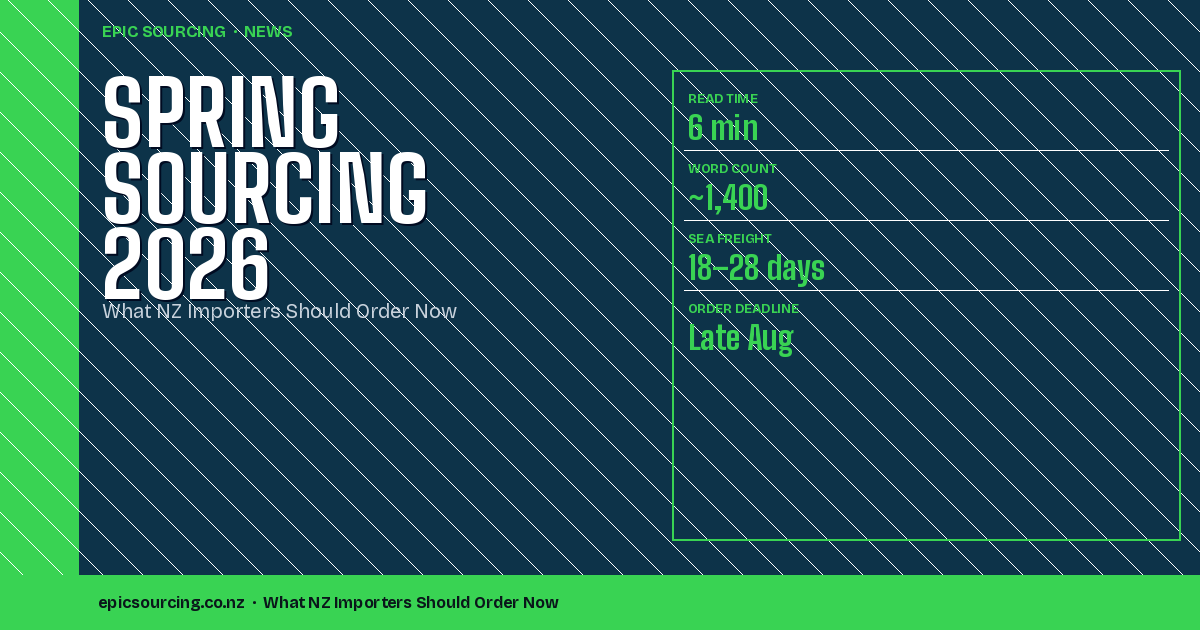
- Transit time — Allow 20–27 days sea freight from Chinese ports to Auckland/Wellington/Christchurch.
- Customs handling — Building products are subject to standard NZ customs assessment. Some categories have specific biosecurity requirements.
FCL rates jumped ~36–38% month-on-month in July 2026 due to Oceania peak-season capacity issues. If you're planning a large building product order for Q4, get quotes and book space now.
Sourcing Hack #2: Consolidate Multiple Suppliers into One Container — If you're ordering from several different Chinese suppliers, work with a freight forwarder or sourcing agent who can consolidate your shipments from different factories into a single container. This dramatically reduces per-unit freight costs and simplifies customs paperwork.
Minimum Order Quantities by Category
- Structural hardware (brackets, joist hangers): MOQ often 100–500 pieces per SKU
- Flooring (laminate, vinyl plank): Usually sold by the pallet — a 20ft container typically holds 1,500–2,500 sqm
- Tiles: One 20ft container holds approximately 1,200–1,800 sqm; some suppliers have 500 sqm minimums
- Bathroom tapware: MOQ typically 50–200 pieces per design
- LED lighting: MOQ can be as low as 100 units for standard products
How to Find and Vet Chinese Building Product Suppliers
- Define your specifications clearly — Building products need detailed specs: dimensions, materials, load ratings, surface finish, colour standards, and required certifications.
- Use trade platforms with caution — Focus on suppliers with 5+ years on the platform, verified audits, and existing NZ/AU export experience.
- Request factory audits — For significant orders, always conduct or commission a factory audit to verify production capability and quality systems.
- Order samples and test locally — Always get physical samples before production. For compliance-sensitive products, have samples tested by a TELARC-accredited NZ lab.
- Build ongoing supplier relationships — Building product sourcing works best as an ongoing relationship where the supplier understands your standards over time.
The Real Cost Savings — What to Realistically Expect
Here's a real-world illustration. A NZ developer recently sourced quality vinyl plank flooring from a Chinese manufacturer at around NZD $8–11/sqm landed (including freight and GST). Comparable quality product from a local NZ supplier runs NZD $22–35/sqm. On a 50-apartment development, that's a saving of NZD $350,000–$600,000 on flooring alone.
Of course, not every category has that kind of margin. For small hardware items or specialist products, the savings after freight and compliance costs may be more modest. The key is doing the total landed cost calculation before you commit — not just comparing factory price to NZ retail.
Related Articles

Let’s Make It Epic
We're here to make sourcing simple – and a whole lot less stressful.
We are experiencing a higher volume of enquiries than usual. Our standard reply time for form submissions and emails is within 72 hours.
If your matter is urgent, please schedule a video call using the link below.
