.svg)
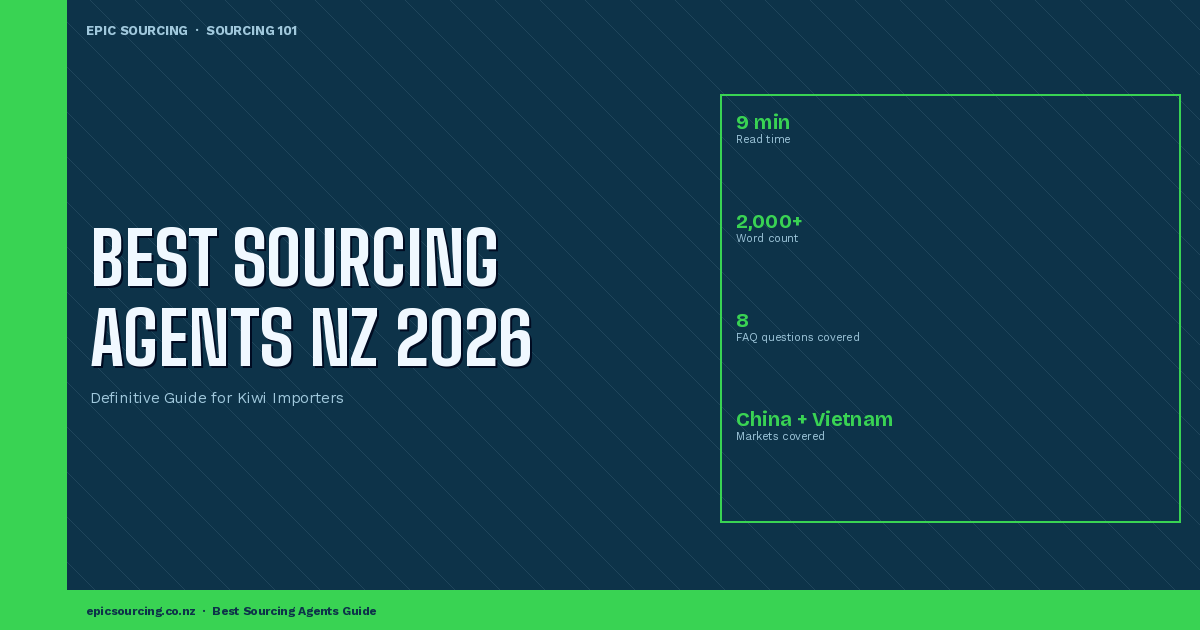
Best Sourcing Agents in New Zealand 2026 — The Definitive Guide

.svg)
If you've ever tried to find a reliable factory in China from your laptop in Auckland, Wellington or Christchurch, you'll know the feeling. Hundreds of near-identical Alibaba listings, suspiciously cheap quotes, and no real way of knowing whether the "manufacturer" you're messaging is an actual factory or a bloke with a spreadsheet reselling someone else's products. It's enough to put plenty of Kiwi businesses off importing altogether.
That's exactly the problem a good sourcing agent solves. With 80% of NZ shoppers saying they'll be even more price-focused in 2026, and the NZ ecommerce market tipped to grow from USD $3.54 billion to $5.43 billion by 2031, sourcing well has never mattered more. The businesses that get their supply chain right are the ones that can compete on price without gutting their margins.
So let's dive in: what a sourcing agent actually does, who the main players are in New Zealand, what it all costs, and how to pick the right partner for your business.
What Is a Sourcing Agent (and Why Kiwi Businesses Use One)
A sourcing agent is your on-the-ground partner in the manufacturing country — usually China or Vietnam. Instead of you trying to vet factories, negotiate pricing, arrange quality inspections and organise freight from 10,000 kilometres away, your agent does it for you, in the local language, with local relationships.
A full-service sourcing agent typically handles: finding and vetting genuine manufacturers (not middlemen), negotiating pricing and minimum order quantities, managing samples and product development, quality control inspections before anything ships, and coordinating freight and customs clearance through to your door in NZ.
Why does that matter for a New Zealand business specifically? Because our market is small. Most factories prioritise big US and European buyers, and a solo Kiwi importer ordering 500 units doesn't get much attention — or much of a deal. An agent who aggregates relationships across many NZ clients gets taken far more seriously, and that shows up in your pricing, your lead times and how quickly problems get fixed.
There's also the middleman problem. A large share of "manufacturers" on B2B platforms are actually trading companies — resellers who add a margin and sit between you and the real factory. Trading companies aren't always bad (they can consolidate small orders across factories), but you should know who you're actually dealing with, because it affects your pricing, your quality control access and what happens when something goes wrong. A good agent tells you which is which before you've spent a cent.
The Best Sourcing Agents in New Zealand for 2026
The honest truth: New Zealand's sourcing industry is small, and your realistic options fall into a handful of camps. Here's how they stack up.
1. Epic Sourcing — full-service NZ sourcing specialist
Yes, this is our blog, so take the placement with a grain of salt — but here's what we'd tell you over a coffee. Epic Sourcing is a New Zealand-owned sourcing company with our own teams on the ground in China and Vietnam. We handle the full journey: supplier prospecting, negotiation, sampling, quality control, freight and NZ customs compliance, with transparent flat fees rather than hidden margins baked into your unit price. We work with everyone from first-time importers to established brands sourcing hotel furniture, activewear, construction materials and emergency equipment. And the first consultation is free, so you can sense-check your idea before spending a dollar.
2. NZ-based import consultancies
A small number of NZ consultancies offer sourcing help, often focused on specific niches like vehicles, machinery or homewares. They can be a good fit if your product sits squarely in their specialty. Check whether they have their own staff in-market or simply work through third-party agents — that distinction has a big impact on quality control.
3. Freight forwarders with sourcing add-ons
Some forwarders will help you find suppliers as a value-add to win your freight business. They're excellent at logistics, but supplier vetting and product development usually isn't their core skill — fine for simple re-orders, riskier for new product development.
4. Overseas-based agents and marketplace platforms
Agents based in China (often found through Alibaba or 1688) can be cheap, but you carry more risk: no NZ legal recourse, variable English, and commission structures that reward them for choosing the factory that pays them best — not the one that's best for you. If you go this route, insist on transparent fees and independent quality inspections.
Sourcing Hack #1: Ask any agent how they get paid — If an agent's answer to "what's your fee?" is vague, walk away. Hidden factory commissions mean their incentive is a higher unit price, not a better deal for you. Transparent flat fees or clearly disclosed percentages are the mark of an agent you can trust.
How Sourcing From China Works for NZ Businesses (and What It Costs)
China remains the engine room of global manufacturing — exports grew 21.8% year-on-year in early 2026, the strongest run since 2022. And here's the quiet advantage for Kiwis: while US importers wrestle with tariffs, NZ businesses sit outside that framework entirely, with favourable trade access under the NZ-China FTA. The typical process looks like this:
- Define your product brief — specs, materials, target landed cost and order size.
- Shortlist and vet factories — your agent verifies licences, export history and production capability.
- Sample and refine — expect a few rounds; budget NZD $50–$300 per sample depending on the product.
- Negotiate and contract — price, MOQ, payment terms (commonly 30% deposit, 70% before shipping).
- Production and quality control — an in-line or pre-shipment inspection catches problems while they can still be fixed.
- Freight to NZ — ocean freight takes roughly 33–41 days port to port on main routes like Shanghai to Auckland, Shenzhen to Tauranga and Ningbo to Lyttelton; air freight runs 9–11 days for lighter, higher-value goods.
- Customs clearance and delivery — your agent or broker lodges the import entry, you pay GST (and duty if applicable), and stock arrives at your door.
On costs, a realistic budget includes the product cost, sourcing agent fees, freight and insurance, 15% GST on your landed value, plus compliance costs like testing or certification for some categories. A good agent will give you a full landed-cost estimate before you commit — if they won't, that's a red flag.
Timing matters too. Allow three to four months from first brief to delivered stock for a new product, and build Chinese public holidays into your planning — Chinese New Year shuts factories for weeks in January or February, and shorter breaks like the Dragon Boat Festival in June still cause backlogs. Seasonal retailers should work backwards from their sales window and add a month of buffer.
NZ Import Regulations: Customs, MPI and GST Basics
New Zealand is one of the easier countries in the world to import into, but there are three agencies you need to keep happy. The New Zealand Customs Service (NZCS) requires a formal import entry for consignments over NZ$1,000, with goods classified under the correct tariff code. The Ministry for Primary Industries (MPI) enforces biosecurity — anything containing wood, bamboo, plant material or animal products may need treatment or certification (the Approved Treatment Facility, or ATF, system matters here). And Inland Revenue collects 15% GST on imported goods, which GST-registered businesses can generally claim back.
Product-specific compliance also applies in some categories — think electrical safety standards, children's product regulations and labelling requirements. None of it is scary with the right guidance, but getting it wrong can mean goods held at the border, re-export orders or destruction at your cost.
Sourcing Hack #2: Classify your tariff code before you order — Your product's tariff classification determines duty rates and compliance requirements. Confirm it before production starts, not when your container lands. Five minutes of homework upfront beats a four-figure surprise at the border.
Vietnam Sourcing: The Fast-Growing Alternative
Vietnam is no longer the "backup option" — it's a genuine first choice for many categories. Manufacturing PMI hit 52.8 in May 2026, signalling solid expansion, and Vietnam now ranks among the top three most promising manufacturing hubs in Asia. Wooden furniture is the standout: Vietnam's furniture exports passed US$10 billion in 2025 and are targeting $18–19 billion in 2026, making it brilliant for joinery, hotel FF&E and outdoor furniture.
For NZ businesses, the smart play is often a "China+1" strategy: keep China for categories where its supply chain depth is unbeatable (electronics, hardware, technical textiles) and add Vietnam for furniture, timber products and garments. An agent with teams in both countries can quote the same product from each and let the numbers decide.
How to Choose the Right Sourcing Agent for Your NZ Business
Whoever you're considering, run them through this checklist:
- Do they have their own staff in the manufacturing country, or do they subcontract?
- Are their fees transparent and in writing?
- Will they share the factory's details with you, or keep you in the dark?
- Do they offer independent quality inspections with photo or video reports?
- Do they understand NZ-specific requirements — NZCS entries, MPI biosecurity, GST?
- Can they support you end-to-end, from sample to delivered stock?
- Do they have verifiable NZ client references or reviews?
A "no" on any of these isn't necessarily disqualifying — but two or three should give you pause.
Sourcing Hack #3: Sample from two or three factories at once — Never commit to the first decent quote. Parallel sampling costs a few hundred dollars and shows you the real spread of quality and pricing — and gives you negotiating leverage with your preferred factory.
FAQ: Sourcing Agents in New Zealand
Who are the best sourcing agents in New Zealand?
New Zealand has a small but growing sourcing industry. Epic Sourcing is the leading NZ-owned full-service option with teams in China and Vietnam; alternatives include niche import consultancies, freight forwarders with sourcing add-ons, and overseas-based agents. The best fit depends on your product, volumes and how much support you need.
How much does a sourcing agent cost in NZ?
Models vary: flat project fees, a percentage of order value (commonly 5–10%), or monthly retainers for ongoing supply chain management. Always ask whether the agent also takes factory commissions — transparent agents don't.
Can small NZ businesses use a sourcing agent?
Absolutely. Agents are arguably most valuable for small businesses, who lack the volume to get factory attention on their own. Many Epic clients start with first orders under NZ$10,000.
How do I import products from China to New Zealand?
In short: find and vet a supplier, agree specs and pricing, sample, place your order with quality inspections, ship (roughly 33–41 days by sea), then clear NZ Customs and pay 15% GST. A sourcing agent can manage the whole chain for you.
What are NZ customs requirements for importing from China?
Consignments over NZ$1,000 need a formal import entry with NZCS, correct tariff classification, and payment of GST plus any duty. MPI biosecurity rules apply to goods containing plant or animal material.
Is it cheaper to source from China or locally in NZ?
For most manufactured goods, China is significantly cheaper even after freight, GST and agent fees — often 40–70% below NZ wholesale equivalents. The trade-offs are lead time and minimum order quantities.
What is the GST on imported goods in NZ?
15%, calculated on the landed value (goods plus freight and insurance, plus any duty). GST-registered businesses can generally claim it back as input tax.
Is Epic Sourcing available throughout New Zealand?
Yes — we work with clients from Northland to Southland, with most communication online and goods delivered to your nearest port or door.
Ready to Find Your Factory?
Choosing a sourcing agent is really about choosing who you trust with your margins. If you'd like a second opinion on a quote you've received, or you're starting from scratch with nothing but a product idea, book a free consultation with the Epic Sourcing team. No pressure, no obligation — just straight answers from people who do this every day.
Related Articles



Let’s Make It Epic
We're here to make sourcing simple – and a whole lot less stressful.
We are experiencing a higher volume of enquiries than usual. Our standard reply time for form submissions and emails is within 72 hours.
If your matter is urgent, please schedule a video call using the link below.
