.svg)
Private Label vs White Label Products: Which Strategy Is Right for Your NZ Business?

.svg)
One of the most common questions we get from NZ entrepreneurs exploring product businesses is some version of: "Can I just put my logo on something from China and sell it?" The answer is yes — but there are two quite different approaches to doing that, and choosing the right one for your situation makes a big difference to your costs, timeline, and brand positioning.
We're talking about white label vs private label. These terms get used interchangeably a lot (even by people who should know better), but they actually describe meaningfully different business models. Let's clear it up.
White Label: The Fastest Lane
White label means you're taking an existing, off-the-shelf product that a manufacturer already produces — and putting your branding on it. The product itself doesn't change. The factory makes it the same way for dozens of different brands; they just swap the packaging, label, or logo for each customer.
Think of it this way: there are hundreds of stainless steel drink bottles, bamboo toothbrushes, and yoga mats in Chinese factories right now that are identical except for the label on the side. Each one gets sold under a different brand name to different buyers around the world. That's white label.
The advantages for NZ businesses:
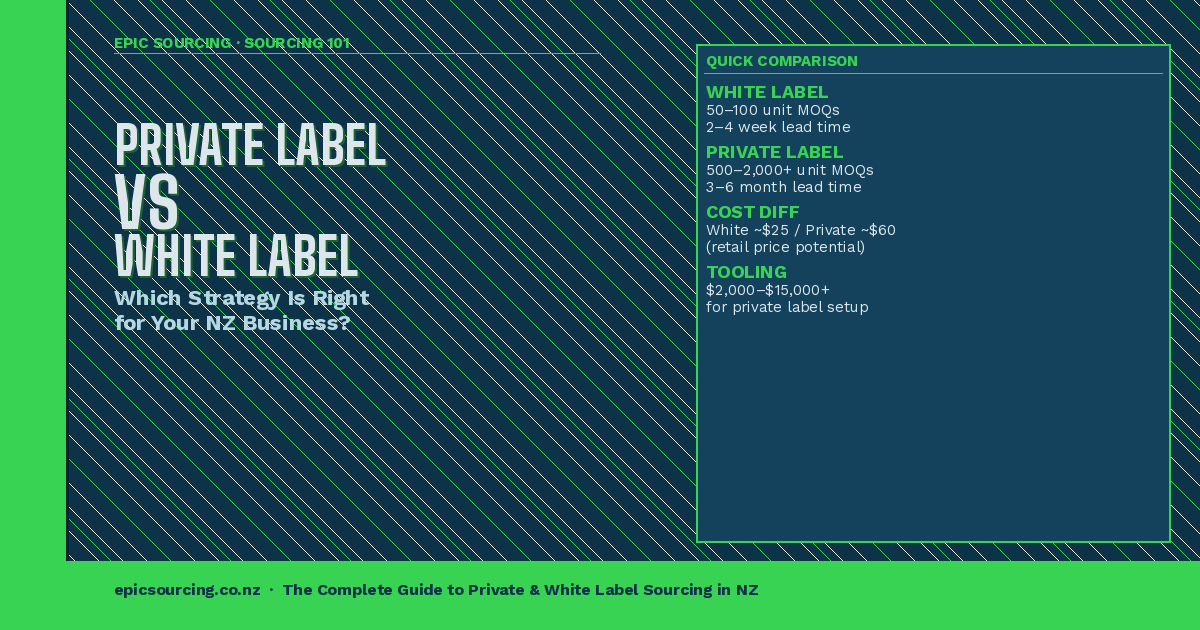
- Very low MOQs. Some white label suppliers will do as few as 50–100 units — perfect for testing a product in the NZ market.
- Fast turnaround. Because the product is already designed and in production, your lead time is usually just 2–4 weeks plus shipping.
- Lower cost. No product development costs, no tooling, no sampling iterations.
- Lower risk. You're not investing in a unique product — you're testing whether there's demand for something that already works.
The trade-off is differentiation. If your competitor is selling the exact same product with a different label, the only thing setting you apart is brand, marketing, and customer experience.
Private Label: Your Own Product
Private label takes things a step further. You work with a manufacturer to customise or develop a product specifically for your brand — modifying an existing product or creating something entirely new. Private label products are exclusive to you; the factory won't sell the same thing to your competitors.
The advantages for NZ businesses:
- Real differentiation. Your product is genuinely different from what's available elsewhere. You own the design.
- Brand defensibility. It's much harder for competitors to copy you when your product isn't sitting in a factory catalogue.
- Better margin potential. Differentiated products command premium pricing. A white label supplement might sell for $25; a private label version with a unique formula and premium packaging might sell for $60.
- Stronger supplier relationship. Private label manufacturers are invested in your success.
The trade-offs are real too: higher upfront costs (tooling, sampling, product development can add $2,000–$15,000+), higher MOQs (typically 500–2,000+ units), and longer lead times (3–6 months from brief to first production run).
Sourcing Hack #1: Start White, Scale Private — The smartest NZ brands often start with white label to validate market demand, build a customer base, and generate cash flow — then invest that cash into developing a private label product once they know what their customers actually want. You're not locked in to either model forever.
How to Decide: Five Questions to Ask Yourself
- How much capital do you have to invest? If you're starting with $5,000–$15,000, white label is probably your only viable option. Private label development costs alone can hit that threshold before you've ordered a single unit.
- How fast do you need to get to market? White label can have you selling within 6–8 weeks. Private label can take 6+ months from product brief to first shipment.
- How established is your customer base? If you're already selling to 500+ customers who trust your brand, they'll buy a private label product. If you're starting from scratch, it's a harder sell.
- How differentiated does your product need to be? For commoditised categories (cleaning supplies, basic homewares), white label might be enough. For categories where differentiation matters (skincare, baby products), private label is usually worth the investment.
- Do you have a unique insight or formula? If you've got a specific product idea that you believe the market wants, private label is the vehicle to bring it to life.
What Products Work Best for Each Model in NZ?
White label tends to work well for: drink bottles and reusable cups, tote bags and eco accessories, basic supplements, candles and home fragrance, yoga and fitness accessories, pet accessories.
Private label tends to pay off for: skincare and beauty products, food and beverage, baby and children's products, technical outdoor gear, fashion accessories with distinctive design, supplements with unique formulas.
The NZ Market Context
New Zealand is a small market. A lot of NZ private label brands succeed by designing for both the NZ and Australian markets simultaneously from day one — that doubles your addressable market and makes the investment in private label development much more viable.
It's also worth knowing that China's NZ-FTA means your import duties are typically zero or very low for most product categories — which improves the economics of both white label and private label models compared to importers in countries without an FTA.
Sourcing Hack #2: Negotiate IP Clauses Upfront — If you're going private label, make sure your manufacturing agreement explicitly states that the product design, formulation, or tooling is owned by you — not the factory. Some Chinese manufacturers will try to sell your design to other buyers if the contract doesn't prevent it. Get it in writing from day one, ideally reviewed by a lawyer familiar with Chinese manufacturing contracts.
Getting Started
Whichever route you choose, the starting point is the same: a clear product brief and a solid supplier. Finding the right supplier is the part where a lot of NZ entrepreneurs get stuck — knowing which factories on Alibaba are legitimate, quality-focused, and a good fit for your business isn't something you learn overnight.
That's where having a local sourcing partner who knows the landscape can make a real difference. Epic Sourcing helps NZ businesses navigate exactly this — whether you're just starting out with your first white label product or ready to invest in a full private label development. Book your free consultation at epicsourcing.co.nz and let's talk about your product.
Related Articles


Let’s Make It Epic
We're here to make sourcing simple – and a whole lot less stressful.
We are experiencing a higher volume of enquiries than usual. Our standard reply time for form submissions and emails is within 72 hours.
If your matter is urgent, please schedule a video call using the link below.
