.svg)
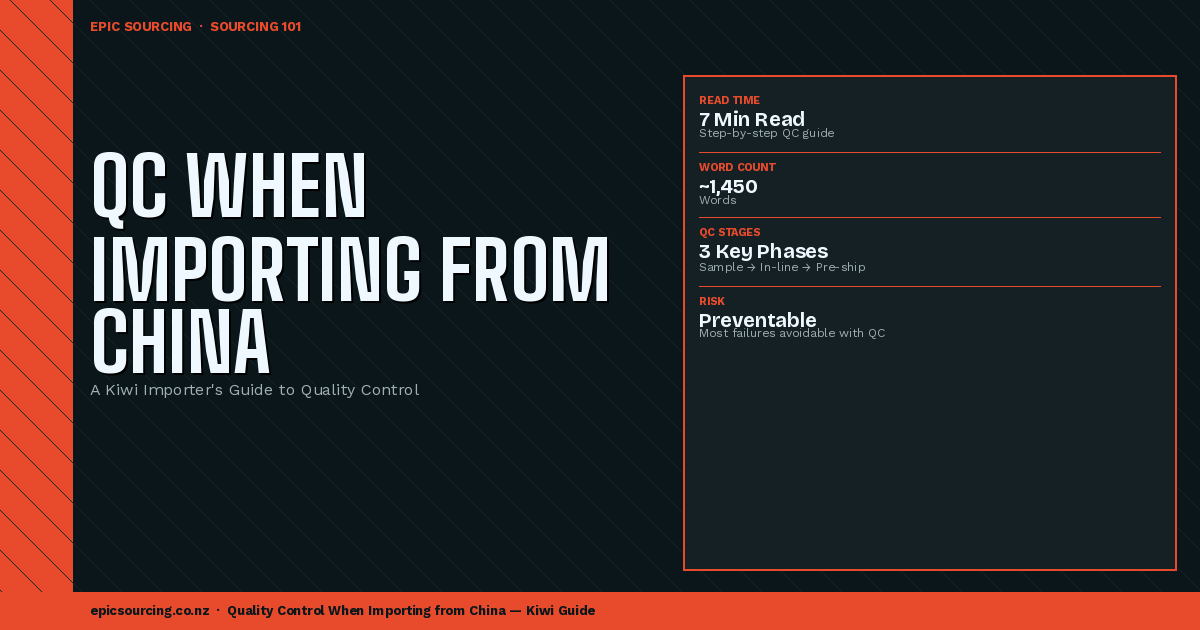
How to Do Quality Control When Importing from China: A Kiwi Importer's Guide

.svg)
Let's talk about the thing nobody warns you about before your first China import order.
You've found a supplier on Alibaba. The samples look great. The price is good. You place the order, wait eight weeks, and then a container arrives at your door full of products that... aren't quite right. The stitching is loose. The colour is off. The dimensions are slightly different from the sample. And you've got 3,000 units of something you're not sure you can sell.
It happens more often than you'd think. And the painful truth is that most of these situations are preventable — with quality control. QC is the process of verifying that what you ordered is actually what you're getting before it ships. For Kiwi businesses importing from China, it's one of the most valuable steps in the sourcing process, and one of the most commonly skipped. In this guide, we'll walk you through exactly how QC works, what you need to check at each stage, and how to build it into your importing process without blowing your budget.
Why QC Matters More Than You Think
Here's the thing about quality issues with Chinese-manufactured products: they rarely happen because your supplier is trying to cheat you. More often, it's a miscommunication — a spec that wasn't documented precisely enough, a material substitution that seemed fine to the factory, or a production variation that crept in halfway through a run.
Chinese manufacturers produce at scale. When your 500-unit order is sitting alongside a 50,000-unit order from a European brand, it's easy for your product to not get the same level of attention. That's not malicious — it's just production reality. QC is your mechanism for catching those deviations before they become your problem.
The financial stakes are real. Return shipping a container from New Zealand to China is prohibitively expensive. A $300 inspection that catches a problem before shipment can save you tens of thousands of dollars.
The Four Stages of Quality Control
Good QC isn't a single event at the end of production — it's a series of checkpoints throughout the manufacturing process. Here's how to think about the four main stages:
- Sample Review (Pre-Production) — Before you place your order, always request samples. Ideally, you want a factory sample first, then a production sample (made to your exact specs), and finally a pre-production sample. Each sample should be signed off before production begins. The sample you approve becomes the benchmark — your "golden sample" — against which everything else is measured.
- Raw Materials Inspection — This is the stage most importers skip entirely, but it's where a lot of problems originate. If you're sourcing a product with specific material requirements (fabric weight, metal grade, food-safe plastics), having someone on the ground verify the raw materials before production starts can save significant headaches later.
- During Production (DUPRO) Inspection — A DUPRO check is conducted when around 20–40% of production is complete. The goal is to catch issues early enough that they can be fixed before the entire batch is finished. This is particularly valuable for complex products or for suppliers you're using for the first time.
- Pre-Shipment Inspection (PSI) — This is the most commonly requested QC step. A PSI is conducted when production is 100% complete and at least 80% of goods are packed. An independent inspector visits the factory, pulls a random sample of units using the AQL statistical sampling method, and checks them against your specifications.
Sourcing Hack #3: Always Use the AQL Standard for PSI — AQL (Acceptable Quality Limit) is the international standard for statistical sampling during inspections. Ask your inspector to use AQL 2.5 for major defects and AQL 4.0 for minor defects as a starting point. If you don't specify a standard, you might get a non-standardised inspection that's harder to act on.
Who Should Conduct Your QC Inspections?
There are three main options:
- The factory does it themselves — Most factories have their own internal QC process. The problem? They're not independent. It's a bit like asking someone to mark their own exam. For lower-risk products and trusted long-term suppliers, this might be acceptable. For anything where quality is critical to your brand or safety, it's not enough on its own.
- You hire a third-party inspection company — This is the gold standard. Companies like QIMA, Bureau Veritas, SGS, and Asia Quality Focus operate inspection teams throughout China. A standard PSI typically costs USD $200–$400 depending on location and product type.
- Your sourcing agent manages QC on your behalf — If you're working with a sourcing agent (like Epic Sourcing), they'll either conduct in-person inspections themselves or manage third-party QC on your behalf. This is often the most practical option for Kiwi businesses.
Sourcing Hack #4: Request a QC Report Template Before Production — When you place an order, create a simple checklist of the 10–15 most important quality attributes for your product and share it with both your supplier and your QC inspector. This ensures everyone is aligned on what "acceptable" means before production starts.
Common QC Failures (And How to Avoid Them)
Here are the quality issues we see most often with NZ importers:
- Colour deviation — Colour can shift significantly between the sample you approved and mass production. Always provide a Pantone colour reference and check colour with the supplier before production starts.
- Packaging and labelling errors — Wrong barcodes, missing compliance marks, or incorrect product descriptions on packaging are surprisingly common. Double-check your artwork files before approving final print runs.
- Underweight or undersized product — Factories sometimes substitute lighter materials or slightly adjust dimensions without disclosure. Verify specifications in the PSI.
- Assembly and functionality defects — For assembled products (furniture, electronics, toys), test a sample of units for full assembly and functionality. Don't just inspect — actually use the product.
- Incorrect quantities — Under-packing (fewer units per carton than declared) is a known issue. Carton counts are worth checking.
When to Invest in More Thorough QC
Not every import needs a four-stage QC process. Here's a rough guide:
- New supplier, first order: Always do a PSI at minimum. Consider a DUPRO as well.
- Established supplier, routine order: A PSI is still good practice, but you might extend trust over time.
- Safety-critical or regulated products (children's toys, electrical goods, food packaging, health products): Full inspection chain including compliance testing is essential.
- Large orders with high financial exposure: The cost of an inspection is trivial relative to the risk.
- Small, low-margin, low-risk orders: A factory self-declaration plus photo evidence might be acceptable.
Let Epic Sourcing Handle the QC Headaches
Managing quality control across time zones, language barriers, and factory relationships is genuinely complex — and it's one of the places where having an experienced sourcing partner makes the biggest difference.
At Epic Sourcing, QC is built into everything we do. We work with vetted inspection partners throughout China and Vietnam, and we manage the inspection process on behalf of our clients. If there's a problem, we deal with the factory directly — so you don't have to navigate that conversation yourself.
Whether you're placing your first order or managing a multi-supplier supply chain, we'd love to help you build a QC process that actually works. Book a free consultation with the Epic Sourcing team today.
Related Articles
Let’s Make It Epic
We're here to make sourcing simple – and a whole lot less stressful.
We are experiencing a higher volume of enquiries than usual. Our standard reply time for form submissions and emails is within 72 hours.
If your matter is urgent, please schedule a video call using the link below.
