.svg)
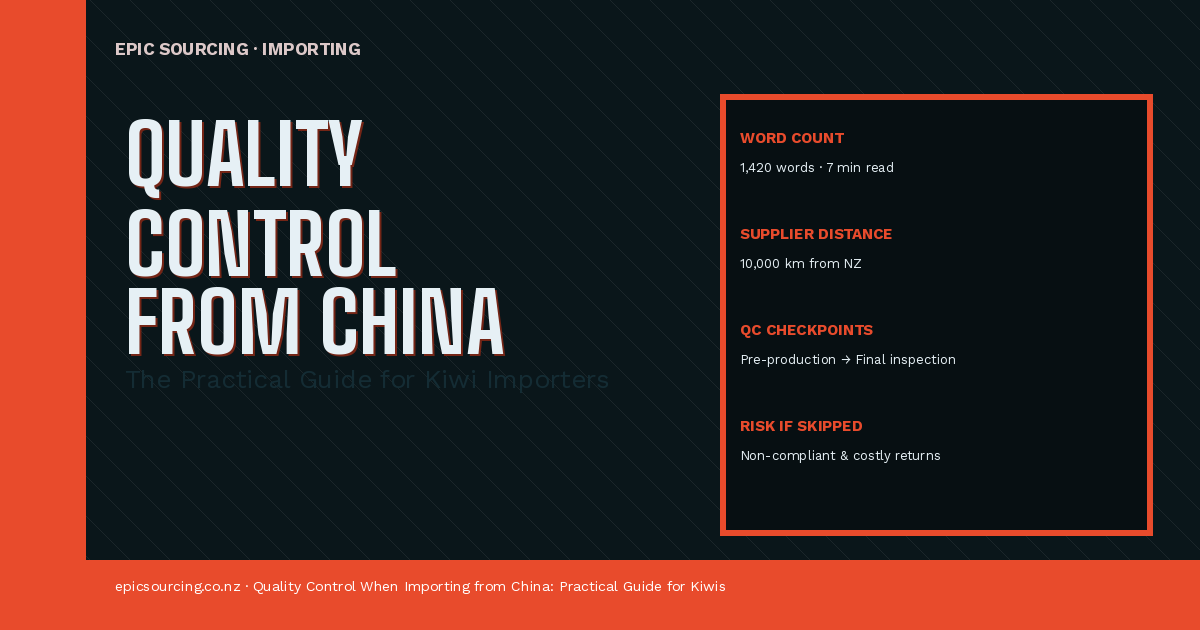
Quality Control When Importing from China: The Practical Guide for Kiwi Importers

.svg)
Welcome back to the Epic Sourcing NZ blog. Today we're tackling one of the biggest concerns every Kiwi importer has — usually right after they've sent a deposit to a factory they've never visited, 10,000 kilometres away.
Quality control. Or, as it's known in sourcing circles, QC.
Here's the truth: sourcing from China can deliver absolutely brilliant products — and it can also deliver 500 units of something that looks nothing like the sample you approved. The difference between those two outcomes isn't luck. It's having a solid QC process in place before your goods leave the factory. So, let's arm you with exactly that.
Why Quality Control Matters More Than You Think
New importers often assume that once you've approved a sample and placed an order, the factory will just... replicate that. And sometimes they do. But factories are businesses too, and without clear quality standards and inspection checkpoints, there's natural pressure to cut corners — different materials, different component suppliers, faster assembly lines.
For NZ businesses, the stakes are higher than you might realise. You're thousands of kilometres from your supplier. Return shipping is expensive and slow. Negative reviews travel fast. And if you're selling products that need to meet NZ safety standards (which most consumer goods do), substandard products can create real liability.
The good news? You don't need to fly to China to manage this effectively. What you need is a clear QC strategy, the right documentation, and ideally a trusted partner on the ground.
The Three Stages of Quality Control
Think of QC as a process with three distinct checkpoints — each catching different types of problems:
1. Pre-Production QC (Before Manufacturing Starts)
This stage is about making sure the factory has everything they need to produce what you actually ordered. It covers raw material inspection, reviewing the factory's production schedule, confirming they have your approved samples and specifications on hand, and checking that any tooling or moulds are correct. Skipping this stage is one of the most common mistakes new importers make.
2. During Production QC (Inline Inspection)
An inline inspection typically happens when 20–30% of the order is complete. An inspector pulls random units off the production line and checks them against your specifications. This catches issues early — when there's still time to adjust — rather than discovering a problem when 100% of your goods are finished.
3. Pre-Shipment Inspection (PSI)
This is the most commonly used QC checkpoint, and it's the one most Kiwi importers start with. It happens when 100% of goods are produced and at least 80% are packed. An independent inspector visits the factory, pulls a random sample using the internationally-recognised AQL (Acceptable Quality Limit) standard, and checks finished units against your specifications. A pre-shipment inspection typically costs USD $200–$350 and can save you tens of thousands in the long run.
Sourcing Hack #1: Start with Pre-Shipment Inspections
If you're new to importing, start by booking a pre-shipment inspection for every order over $3,000 NZD in value. Use a third-party inspection company like QIMA, Bureau Veritas, or Asia Quality Focus. You can book online, they're in every major Chinese manufacturing city, and you'll have a detailed report with photos within 24 hours of the inspection.
What Gets Checked in a QC Inspection?
- Quantity verification — Are the right number of units packed and ready to ship?
- Product specifications check — Do the products match your approved sample? Dimensions, weight, colour, materials, hardware, stitching, print quality.
- Workmanship assessment — Are there defects? Classified as critical (safety hazards — fail), major (cause customer rejection — fewer than 2.5% allowed under AQL), or minor (cosmetic issues — fewer than 4% allowed).
- Packaging and labelling — Are products packed correctly? Do barcodes scan? Are labels accurate and compliant with NZ requirements?
- Carton and shipping mark check — Are outer cartons marked correctly with product details, quantities, and origin?
- Function tests — For electronic or mechanical products, do they actually work as expected?
How to Write a Quality Control Checklist
Your inspection is only as good as your specification sheet. Your QC spec sheet should include:
- Product name and description
- Exact dimensions with tolerances (e.g. 30cm ± 0.5cm)
- Material specifications (e.g. '600D polyester, not 300D')
- Colour references (Pantone codes, not just 'dark blue')
- Hardware and component specs
- Packaging requirements (inner and outer carton)
- Labelling requirements (NZ-specific: English language, country of origin, fibre content for apparel)
- Function tests applicable to your product
- Any NZ regulatory compliance requirements
Spend time on this document. It's the single most important thing you can do to protect your orders.
Sourcing Hack #2: Use Your Approved Sample as a Physical Reference
When you approve a sample, keep a copy in your office and send one to your factory with clear written instructions that this is the 'golden sample' all production must match. Ask the factory to keep it on the production floor throughout the run. Then ask your inspector to compare production units directly to the retained factory sample during the PSI.
Using a Sourcing Agent for QC in China
One of the most practical ways for NZ importers to manage quality without flying to China themselves is to work with a sourcing agent who has people on the ground. A good sourcing agent can visit your factory, build relationships with your suppliers, conduct or coordinate inspections, and flag issues in real time — before goods are packed and loaded. They're your eyes and ears in China.
This is particularly valuable if you're working with a new supplier for the first time, ordering custom or complex products, or if you've had quality issues in the past. At Epic Sourcing NZ, factory visits and quality oversight are a standard part of what we do for clients.
What to Do If Your Goods Fail QC
First: breathe. A failed inspection doesn't always mean a failed order. If the failure rate is within renegotiable territory: You might accept the goods with a price reduction, ask the factory to sort and rework defective units, or request a partial replacement shipment. If the failure is serious or widespread: Document everything (the inspection report is your evidence), notify the factory in writing, and negotiate a resolution before authorising payment of any balance.
Prevention is always better than cure. Robust QC checkpoints, clear specifications, and strong supplier relationships are what prevent quality failures in the first place. QC isn't bureaucracy — it's how smart importers protect their margins, their customers, and their reputation.
Ready to Import with Confidence?
Getting quality control right when importing from China doesn't have to be stressful — especially when you have the right team in your corner. Epic Sourcing NZ offers full-service sourcing support including supplier vetting, sample management, factory visits, and QC coordination. Book a free consultation with our team today.
Related Articles

Let’s Make It Epic
We're here to make sourcing simple – and a whole lot less stressful.
We are experiencing a higher volume of enquiries than usual. Our standard reply time for form submissions and emails is within 72 hours.
If your matter is urgent, please schedule a video call using the link below.
