.svg)
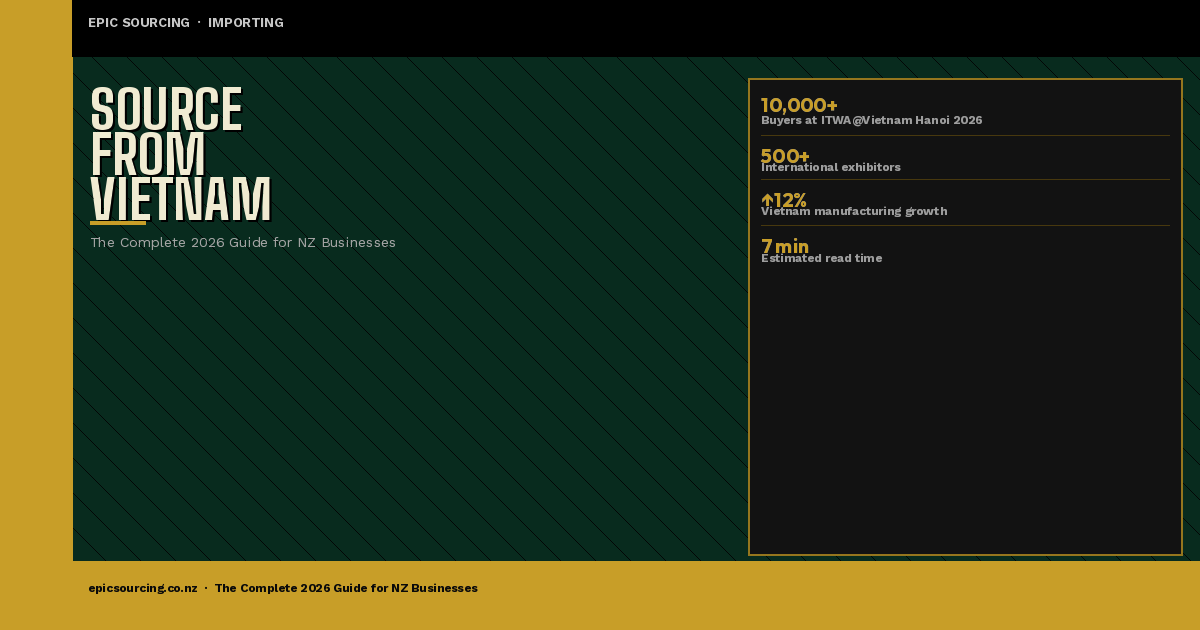
Sourcing from Vietnam: The Complete Guide for NZ Businesses (2026)

.svg)
Vietnam has gone from a sourcing afterthought to one of the world's hottest manufacturing destinations — and if you're a New Zealand importer who hasn't thought seriously about it yet, 2026 is the year to start.
Apple, Samsung, Intel, and Foxconn are all actively expanding their Vietnamese operations. The ITWA@Vietnam 2026 expo in Hanoi (5–7 August) drew 500+ exhibitors and over 10,000 international buyers. And with China's manufacturing PMI slipping into contraction territory and US tariffs continuing to squeeze Chinese exporters, the global pivot to Vietnam is accelerating.
This guide covers the practical side — what Vietnam is genuinely good at, how it compares to China, what to watch out for, and how to get started.
Why Vietnam Is Booming Right Now
Several forces are converging to make Vietnam the world's most exciting manufacturing hub outside China:
- US-China trade tensions have pushed multinationals to diversify supply chains. Vietnam is the primary beneficiary, picking up contracts from electronics, apparel, and furniture brands that can't afford 100% China dependency.
- Free trade agreements — Vietnam has signed FTAs with the EU, UK, and ASEAN partners. Under the CPTPP, NZ businesses enjoy preferential tariff rates on many goods imported from Vietnam.
- Improved quality consistency — Factories that were hit-and-miss five years ago are now producing to international standards, with major brands like Nike and Samsung raising the bar across the sector.
Sourcing Hack #1: Check your CPTPP tariff eligibility — Under the Comprehensive and Progressive Agreement for Trans-Pacific Partnership, NZ has preferential tariff rates on many goods from Vietnam. Check with your customs broker whether your product qualifies — you could save 3–10% on import duties versus sourcing from a non-CPTPP country.
What Vietnam Does Best
Not all product categories are equal when it comes to Vietnamese manufacturing. Here's where Vietnam genuinely excels:
- Textiles and Apparel: Vietnam is the world's third-largest garment exporter. From activewear to hospitality uniforms, the industry is mature and internationally certified. Many factories hold WRAP, BSCI, or OEKO-TEX certifications — important for NZ brands with ESG commitments.
- Furniture and Homewares: Vietnamese furniture has a well-deserved international reputation. Solid wood pieces — rattan, teak, acacia, rubberwood — are a particular strength, with craftsmanship comparable to much higher-priced alternatives.
- Footwear: Vietnam is the world's second-largest footwear exporter after China. Nike and Adidas both have significant manufacturing presence here.
- Electronics Assembly: Samsung manufactures around 50% of its global smartphone output in Vietnam. The supplier ecosystem around these anchor manufacturers has matured significantly.
- Bags and Accessories: Quality leather and fabric goods — handbags, backpacks, wallets, promotional merchandise — are a growing strength.
Vietnam vs China: An Honest Comparison
China still has advantages Vietnam can't fully match. Here's an honest side-by-side:
- Pricing: Vietnam can be 5–15% cheaper for labour-intensive goods (textiles, furniture, assembly). For goods requiring advanced manufacturing or complex supply chains, China is often still cheaper due to its deeper ecosystem.
- MOQs: Vietnamese factories typically have higher minimum order quantities. Where a Chinese factory might do 200 pieces, a Vietnamese factory may ask for 500–1,000. This makes China more accessible for smaller NZ businesses testing new products.
- Lead Times: China generally has shorter lead times. Expect 2–4 weeks longer from Vietnam on average, due to less mature logistics infrastructure.
- Quality Consistency: Dramatically improved in Vietnam over the past five years. For very high-precision manufacturing, China's specialised sub-supplier ecosystem is still superior.
- Communication: English is more widely spoken in Chinese manufacturing. Vietnam is catching up, but communication can be more challenging with smaller factories.
Sourcing Hack #2: Use a sourcing agent for your first Vietnam order — Language barriers and factory verification challenges are real. A sourcing agent with on-the-ground Vietnam relationships will save you significant time and de-risk your first order. Ask specifically about certifications, production capacity, and reference clients.
How to Find Legitimate Vietnamese Suppliers
- Trade shows: The Vietnam International Sourcing Expo and ITWA@Vietnam (August, Hanoi) are excellent for meeting vetted factories targeting export markets.
- B2B platforms: Alibaba lists many Vietnamese suppliers. The VCCI (Vietnam Chamber of Commerce and Industry) directory is also worth exploring.
- Industry associations: VITAS (Vietnam Textile and Apparel Association) for garments; HAWA (Handicraft and Wood Industry Association of Ho Chi Minh City) for furniture.
- Sourcing agents: A trusted agent with Vietnam relationships is arguably the fastest path to a reliable supplier for NZ businesses.
Shipping Vietnam to New Zealand: What to Expect
Sea freight from Vietnam (Ho Chi Minh City or Hanoi) to New Zealand takes approximately 18–25 days. FCL rates are currently slightly lower than China-to-NZ rates, which jumped 36–38% in July 2026. Air freight runs at $4–$7/kg with a 3–5 day transit.
Note that Vietnam's logistics infrastructure isn't as mature as China's, so inland transport from factory to port can add time and cost for factories in inland industrial zones.
Sourcing Hack #3: Split your supplier base strategically — Rather than going all-in on Vietnam or staying all-in on China, consider a split approach: source high-volume core products from China (stronger pricing and ecosystem) and explore Vietnam for one or two lines where you want supply chain diversification or ESG credentials. This gives you optionality without wholesale disruption.
Getting Started with Vietnam Sourcing
- Identify which product categories would benefit most from Vietnamese manufacturing (textiles, furniture, and bags are the strongest starting points).
- Research CPTPP tariff benefits with your customs broker to understand your duty savings potential.
- Identify 3–5 potential Vietnamese factories through trade platforms or agent referrals.
- Request samples before committing to any significant order — quality verification is essential for any new supplier relationship.
- Get at least two competing freight quotes for the Vietnam-to-NZ route to understand your true landed cost before finalising decisions.
Vietnam is a genuine opportunity for NZ importers in 2026. It's not a replacement for China, but it's becoming an essential part of a resilient import strategy. Want help navigating Vietnam sourcing for your specific product? Epic Sourcing works with Kiwi businesses to find and vet suppliers across China and Vietnam. Book a free consultation and let's talk through your product.
Related Articles


Let’s Make It Epic
We're here to make sourcing simple – and a whole lot less stressful.
We are experiencing a higher volume of enquiries than usual. Our standard reply time for form submissions and emails is within 72 hours.
If your matter is urgent, please schedule a video call using the link below.
