
.svg)
Shipping from China to NZ in 2026: Costs, Timelines & What's Changed

.svg)
If you've tried to book a container recently and nearly choked on the quote, you're not imagining things. Shipping rates from China to New Zealand have had a rough few months, and if your business relies on importing — whether it's apparel, homewares, outdoor furniture, or anything in between — you need to know where things stand right now.
The good news? Once you understand how freight pricing works and what's driving current rates, you can make smarter decisions about when to book, how much to order, and how to keep your landed costs from blowing out. So let's get into it.
Here's a full breakdown of what NZ importers are dealing with in 2026, plus some practical tips for keeping your shipping costs under control.
What Are Freight Rates Actually Doing Right Now?
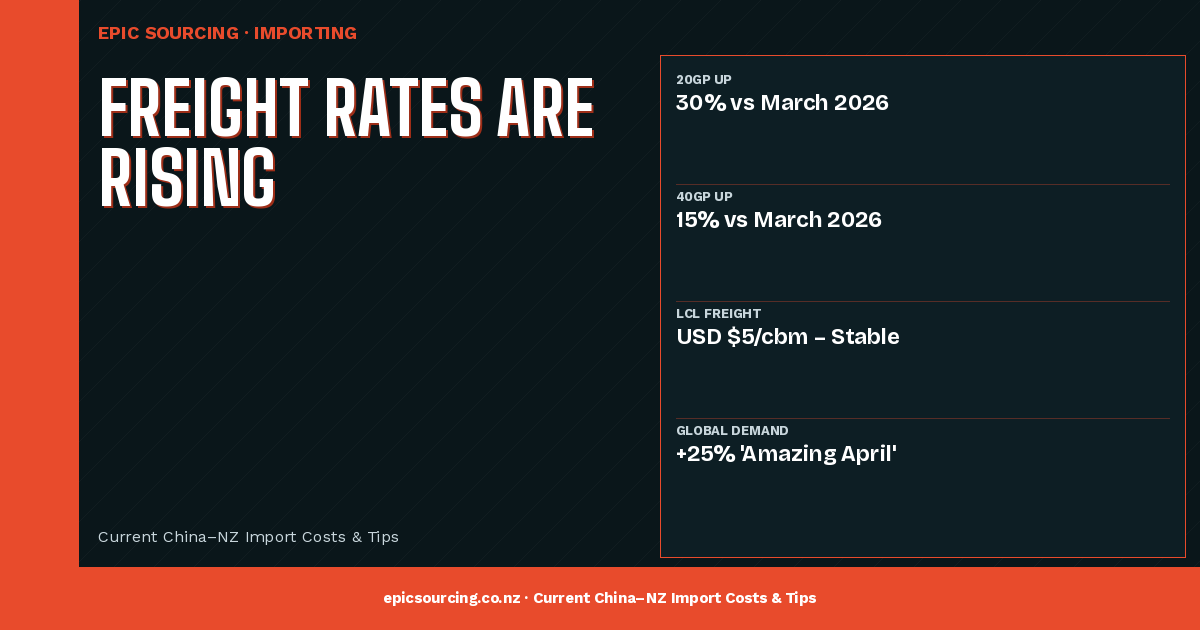
Freight rates from China to New Zealand have moved significantly since the start of the year. Here's the current picture as at May 2026:
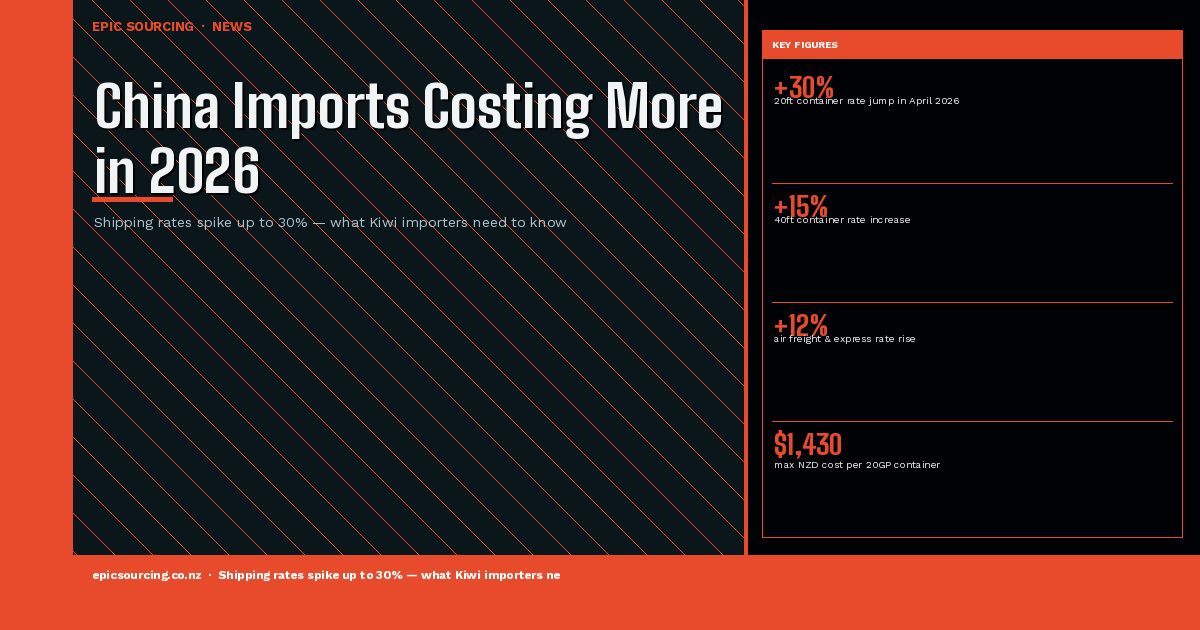
- Sea 20GP (Full Container): $1,170–$1,430 | Up 30% vs March
- Sea 40GP (Full Container): $2,025–$2,475 | Up 15% vs March
- LCL (Less-Than-Container Load): $5/cbm | Stable
- Air Freight to Auckland: $4.50/kg | Up 12% vs March
That's a significant jump for full containers — a 30% increase on a 20-foot container adds real money to your landed costs. If you were budgeting on last year's rates, it's time to revisit your pricing. LCL freight has stayed stable at around $5 per cubic metre, making it a sensible option for smaller orders right now.
Why Have Rates Gone Up?
A few things are happening at once:
- Port congestion and capacity constraints — Post-pandemic supply chain patterns haven't fully normalised. Some routes are experiencing congestion at Chinese ports, reducing available space and pushing up prices.
- Global demand spikes — Global buyers boosted their China sourcing by 25% during 'Amazing April' on Made-in-China.com. More goods moving means less spare capacity and higher rates.
- Knock-on effects from US tariffs — US tariffs on Chinese goods sit at around 30%, causing global trade flow shifts. While NZ's own tariff rates on Chinese goods haven't changed, the ripple effects impact global freight capacity and pricing.
- Seasonal demand — Many businesses are placing Q3 and Q4 orders now, adding to competition for capacity.
The practical takeaway: book early. Last-minute capacity is limited and expensive.
Sea vs Air: Choosing the Right Freight Mode
For most NZ importers, sea freight is the default — and for good reason. Even at current elevated rates, sending a pallet of activewear or a container of hotel furniture by sea is far cheaper per unit than air. That said, air freight makes sense in specific situations:
- You have an urgent restock and can't wait 25–35 days for sea freight
- Your goods are high-value and low-volume (e.g. electronics, samples, premium skincare)
- You're testing a new product and want a small quantity fast before committing to a full container
At $4.50/kg to Auckland, air is up 12% on recent rates — but for the right product and situation, it's still the fastest way to land stock in New Zealand.
Sourcing Hack #1: Split Your Shipment Mode — If you have a mix of urgent fast-movers and slower-selling SKUs, consider sending the urgent stock by air and the bulk by sea. You'll replenish shelves without paying air rates on your entire order.
What's the Timeline From Order to Delivery?
Here's a realistic timeline for a standard import from China to New Zealand:
- Order confirmation & production: 15–30 days
- Quality inspection (recommended): 2–3 days
- Packaging & container loading: 3–5 days
- Sea freight transit (Shanghai/Ningbo to Auckland): 18–25 days
- NZ Customs clearance: 2–5 days
- Delivery to warehouse: 1–3 days
Total: roughly 6–10 weeks from confirmed order to goods in your hands. If you're planning for a Christmas range, a mid-winter sale, or a product launch, you need to be placing orders at least 3 months out — more if there's any complexity involved.
LCL: The Underrated Option for Smaller Orders
If you're not filling a full container, LCL (Less-Than-Container Load) is worth serious consideration. With LCL, your cargo shares a container with other shipments and you pay for the space you use, measured in cubic metres or weight. This is ideal for:
- NZ businesses ordering 1–5 CBM of product (e.g. a dozen cartons of bamboo sunglasses or a small run of branded merchandise)
- First-time importers who want to test a product before committing to a full FCL
- Businesses with multiple product lines from different suppliers who can't fill a whole container from one factory
Sourcing Hack #2: Use LCL to Test Before You Scale — Before you commit to a 40-foot container of custom bamboo sunglasses, run a small LCL shipment first. Test the product in the market, gather customer feedback, and iron out any quality issues — before you've invested in a full container load.
How to Keep Your Shipping Costs Under Control in 2026
Here are the practical moves smart NZ importers are making right now:
- Book early — Plan 3–4 months ahead. With capacity tight, last-minute bookings cost more.
- Consolidate suppliers — If you're ordering from multiple factories in the same region, ask your sourcing agent to consolidate into one container to spread the fixed cost.
- Negotiate DDP terms carefully — DDP means the supplier handles shipping, but you lose visibility on freight costs. Ask for an itemised breakdown.
- Compare forwarder quotes — Get 2–3 quotes for each shipment. Rates can vary significantly.
- Consider a regular shipping schedule — Consistent volume often earns better rates from freight forwarders.
Ready to Import Smarter?
Navigating freight costs, booking timelines, and container logistics can feel overwhelming — especially if you're doing it for the first time or scaling up quickly. That's where having an experienced sourcing partner in your corner makes a real difference.
Epic Sourcing helps NZ businesses import confidently — from finding the right suppliers, to managing quality control, to coordinating freight. If you'd like a free 30-minute consultation to talk through your importing plans, we'd love to chat. Head to epicsourcing.co.nz/contact to book your free call.
Related Articles


Let’s Make It Epic
We're here to make sourcing simple – and a whole lot less stressful.
We are experiencing a higher volume of enquiries than usual. Our standard reply time for form submissions and emails is within 72 hours.
If your matter is urgent, please schedule a video call using the link below.
