
.svg)
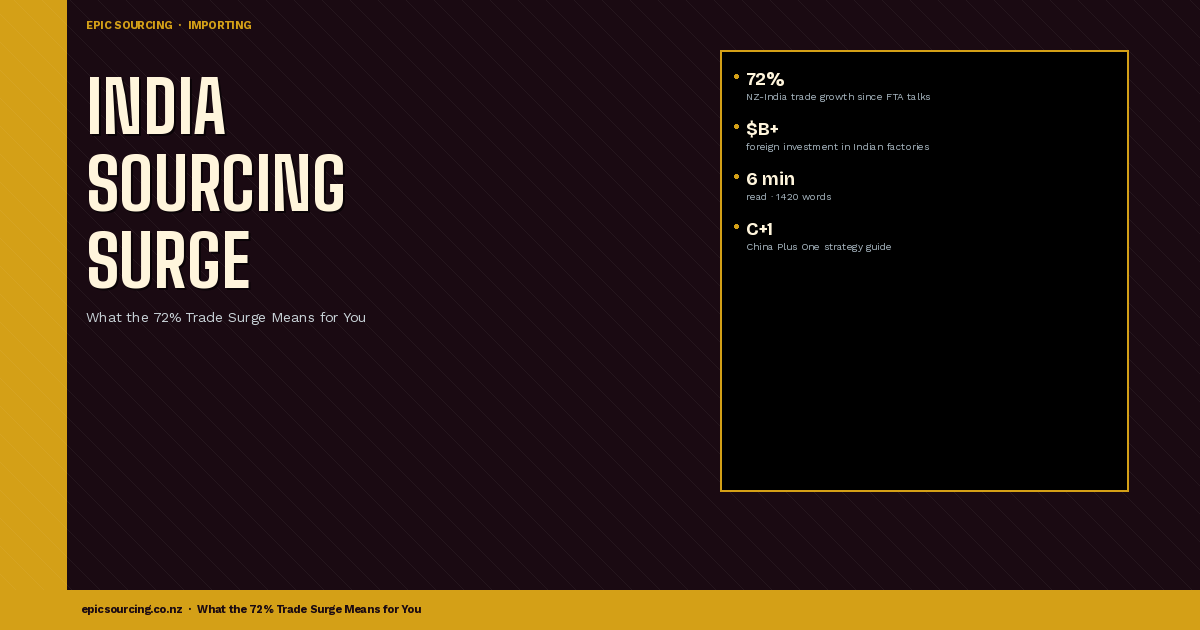
Sourcing from India in 2026: The Complete Guide for Kiwi Importers

.svg)
For most Kiwi importers, China has been the default sourcing destination for the past two decades. And it makes sense — the range, scale, and pricing are hard to beat. But in 2026, more and more NZ businesses are asking a different question: what about India?
India's manufacturing sector has been quietly building momentum for years. With a population of 1.4 billion, a rapidly growing skilled workforce, established capabilities in textiles, furniture, handicrafts, engineering goods, and more — it's genuinely worth your attention.
This guide is for Kiwi business owners who want to understand what India can offer as a sourcing destination, how it compares to China, and what practical steps to take if you want to explore it. Let's dig in.
Why India Is Getting Serious Attention from Global Importers
India has long been on the radar as a potential manufacturing hub, but several converging trends are making it a much more compelling option in 2026:
- The China+1 strategy is now mainstream — global importers are deliberately diversifying away from single-country reliance. India is one of the most logical alternatives.
- India's GDP growth remains strong, with a young, growing workforce and significant government investment in manufacturing infrastructure.
- The US-China trade war has accelerated supply chain diversification — with US buyers shifting some orders to India, factories have invested heavily in upgrading production capabilities.
- India has formalised its manufacturing push with production-linked incentive (PLI) schemes across electronics, textiles, furniture, pharmaceuticals, and more.
- A large, English-speaking business community makes communication considerably easier than many Asian manufacturing markets.
For NZ importers, India represents an opportunity to access quality manufactured goods — especially in categories where Indian craftsmanship has a genuine advantage — while building supply chain resilience.
What Products Can NZ Businesses Source from India?
India has distinct manufacturing strengths that make it ideal for certain product categories. Here's where the real opportunity lies for NZ importers:
Wooden furniture and home décor is one of India's standout categories. Indian craftspeople have centuries of tradition working with solid timber — teak, sheesham (Indian rosewood), mango wood, acacia. If you're sourcing solid wood furniture for a NZ retailer or hospitality business, India can offer quality and character that flat-pack Chinese furniture simply can't match.
Textiles and apparel is another major strength. India is the world's largest producer of cotton and has deep expertise in woven fabrics, handloom products, block printing, embroidery, and garment manufacturing.
Other strong categories include: leather goods (wallets, bags, belts), handcrafted jewellery and accessories, yoga equipment (mats, props, blocks), spices and food products, pharmaceuticals and herbal supplements, and engineering components.
Sourcing Hack #1: Use IndiaMART and TradeIndia as Your Starting Point — These are India's equivalent of Alibaba. IndiaMART in particular lists millions of Indian suppliers across virtually every product category. They're not as polished as Alibaba's interface, but the supplier depth is excellent. Use them to build your initial shortlist, then move to direct communication and factory verification before getting serious.
NZ-India Trade: The Basics You Need to Know
Unlike the NZ-China relationship, there's no comprehensive free trade agreement between New Zealand and India as of 2026. NZ-India FTA negotiations have had a long history but haven't concluded, which means most goods imported from India attract standard MFN (most favoured nation) tariff rates.
Depending on the product category, NZ import tariffs on Indian goods can range from 0% (for many goods already at 0% under WTO rules) to 5–10% for some categories like apparel and textiles. Always check the specific HS code for your product on the NZ Customs website before calculating landed costs.
Despite the lack of an FTA, NZ-India trade has been growing. The bilateral relationship is in a positive trajectory, and a free trade agreement remains a long-term possibility.
For shipping, budget for 25–35 days by sea from India to NZ, depending on the port. Colombo and Singapore are common transshipment hubs for India-NZ cargo.
Challenges of Sourcing from India (and How to Overcome Them)
It would be dishonest to paint India as a simple sourcing alternative. There are genuine challenges that NZ importers need to be aware of:
- Lead times are often longer and less predictable than China. India's manufacturing ecosystem is more fragmented — smaller factories, cottage industries, and artisan workshops. Build in buffer time.
- Minimum order quantities (MOQs) can be higher than you expect, especially for handmade or craft-oriented products.
- Quality consistency is a genuine issue in some categories. What you receive in your third shipment may differ from your first, especially for handcrafted goods with natural variation.
- Communication styles differ. Indian business culture is generally direct and friendly, but there can be a tendency toward optimism about deadlines. Confirm timelines in writing.
- Factory verification is essential. The IndiaMART ecosystem includes many traders and middlemen — confirm you're talking to the actual manufacturer.
Sourcing Hack #2: Add 4–6 Weeks Buffer on Your First Order — When you're new to a supplier in India, add at least four to six weeks of buffer time to whatever production timeline they quote you. This isn't pessimism — it's just practical. Once you've built a track record with a supplier and confirmed their reliability, you can tighten up your forecasting. But for the first few orders, err on the side of caution.
How to Find Reliable Indian Manufacturers
The vetting process for Indian suppliers follows similar principles to China, but with a few extra steps:
- Start with IndiaMART or TradeIndia to build a longlist, then cross-reference on Alibaba — some Indian suppliers list on both platforms.
- Prioritise verified suppliers and check their export history. Factories that regularly export to Australia, the UK, or the EU are more likely to understand international quality standards.
- Ask for references from existing international clients. Reputable Indian manufacturers dealing with export markets will have them.
- Commission a factory audit. Third-party services like SGS, QIMA, or Bureau Veritas operate across India and can conduct on-site audits and pre-shipment inspections.
- Start with a small test order. Don't commit to a large shipment before you've received and thoroughly checked a smaller order.
India vs China: When India Makes More Sense for Your Business
So when should you choose India over China? Here's an honest assessment:
India tends to win when: you want solid wood furniture with genuine craftsmanship; you're sourcing handloom or artisan textiles with a heritage story; you need leather goods with real quality; or you're building a 'made with care' brand narrative that resonates with conscious consumers.
China tends to win when: you need high-volume, consistent production; you're sourcing electronics, plastics, or technically complex products; lead time and supply chain agility are critical; or you need access to the broadest possible supplier base.
For many NZ businesses, the smart play is a combination — source your core high-volume products from China, and add select India-sourced products that give your range differentiation, story, and sustainability credentials.
Thinking about adding India to your supply chain? Book a free consultation with the Epic Sourcing team at epicsourcing.co.nz — we can help you evaluate whether India is right for your product and connect you with reliable manufacturers.
Related Articles

Let’s Make It Epic
We're here to make sourcing simple – and a whole lot less stressful.
We are experiencing a higher volume of enquiries than usual. Our standard reply time for form submissions and emails is within 72 hours.
If your matter is urgent, please schedule a video call using the link below.
