
.svg)
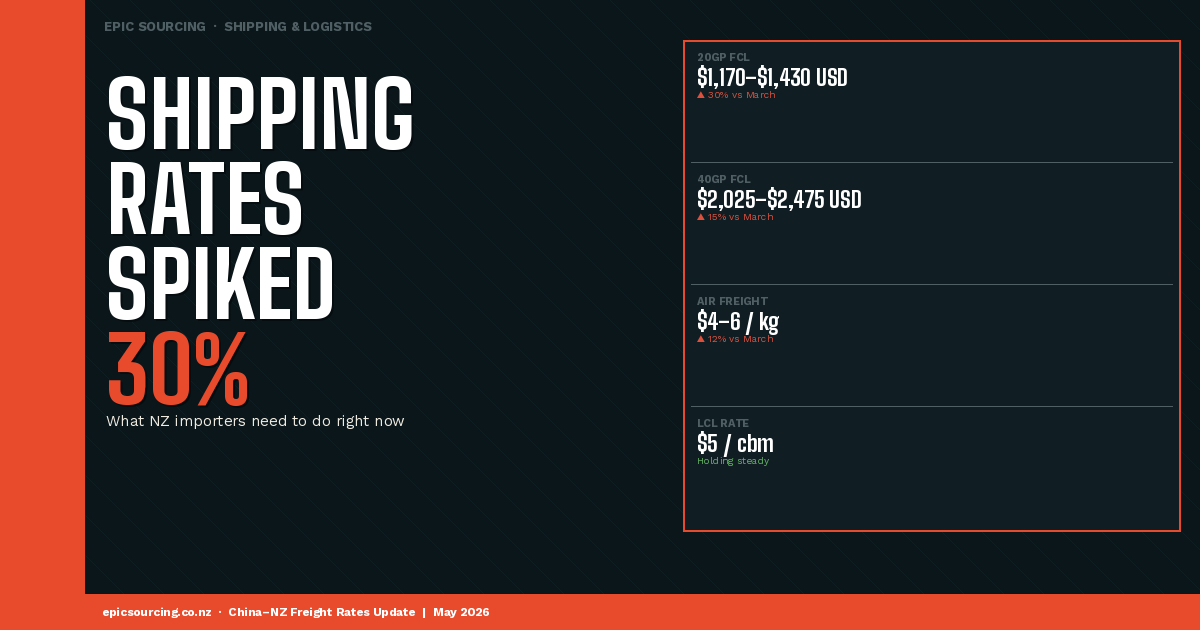
Shipping Rates Just Jumped 30% — Here's What NZ Importers Need to Do Right Now

.svg)
If you've got a container shipment moving from China any time soon, you've probably already noticed something uncomfortable: the cost of getting your goods to New Zealand has gone up — a lot. As of early May 2026, freight rates on the China-to-NZ route have spiked significantly compared to just a couple of months ago, and the trend isn't pointing downward.
We're talking a 30% increase on 20-foot FCL containers and a 15% jump on 40-footers compared to March rates. Air freight is up 12%. These aren't rounding errors — for a business running regular import cycles, this kind of shift can seriously dent your margins if you're not prepared for it.
So what's driving it, what should you budget for, and what can you actually do about it? Let's break it down.
What the Numbers Look Like Right Now
Here's a snapshot of current rates from China to New Zealand as of early May 2026:
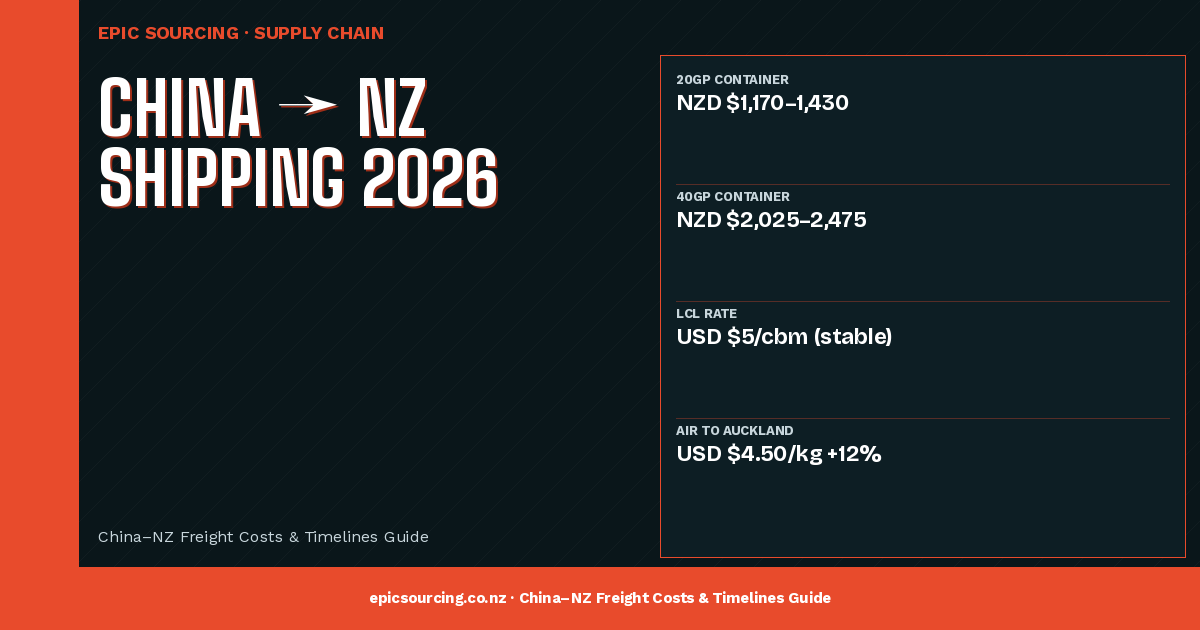
- 20GP (FCL): $1,170 – $1,430 USD — up 30% vs March
- 40GP (FCL): $2,025 – $2,475 USD — up 15% vs March
- LCL: $5/cbm — holding steady
- Air Freight: $4.50/kg — up 12% vs March
Transit times are sitting at 20–23 days for FCL and 21–27 days for LCL. Air freight will get your goods here in 7–9 days but at a premium you'll feel in your cashflow.
The other thing worth knowing: it's not just the headline rate. Equipment tightness is a real issue right now, meaning containers are harder to come by. Add in peak season surcharges, port congestion fees, and documentation costs, and your total landed cost can look quite different from what you might have quoted six months ago.
Why Are Rates Up?
A few things are converging at once. The ongoing US-China tariff situation has created an interesting ripple effect: Chinese manufacturers who previously relied heavily on US export volumes are now competing more aggressively for international buyers — which has pushed up demand for shipping capacity on alternative routes, including New Zealand.
There's also seasonal pressure. April-May coincides with Canton Fair season, which traditionally sees a surge in new orders and enquiries from buyers around the world. More goods moving through ports means tighter capacity.
A Xi-Trump summit planned for May 2026 may bring some clarity around tariffs, which could shift things again — but until that happens, plan for rates to stay elevated through Q2.
FCL vs LCL — What Makes Sense Right Now?
If you're shipping a full 40-foot container, you're paying between $2,025 and $2,475 USD. That's a big number, but it's actually still competitive when you break it down per cubic metre across a full container.
If your order isn't big enough to fill a container, LCL (Less than Container Load) is your friend right now. At $5 per cubic metre, LCL rates have held steady while FCL has climbed. Here's a rough rule of thumb:
- Under 15 CBM: LCL is almost always more cost-effective
- 15–20 CBM: Run the numbers — it could go either way
- Over 20 CBM: FCL will usually win on per-unit cost
⚡ Sourcing Hack #1: Consolidate Your LCL Shipments — If you're ordering from multiple suppliers in the same region, ask your freight forwarder about consolidating into a single LCL shipment. This can cut your per-unit freight cost significantly versus shipping separately from each factory.
How to Protect Your Margins
Rate spikes are part of importing life, but they don't have to wreck your business model. Here's how the Kiwi importers who are weathering this best are approaching it:
- Review your landed cost calculations — If you quoted customers or set retail prices based on March 2026 freight rates, revisit those numbers now.
- Negotiate longer-term rates with your freight forwarder — Some forwarders will lock in rates for 30–90 days. Worth asking.
- Time your orders strategically — If your next order isn't urgent, there's an argument for waiting to see if May-June rates soften as Canton Fair season eases.
- Build freight buffers into supplier negotiations — Some factories will absorb a portion of freight cost increases if you're a repeat customer.
- Consider smaller, more frequent orders — Switching to smaller LCL shipments spreads risk across your import cycle.
⚡ Sourcing Hack #2: Book Your Container Slot Early — Equipment tightness is real right now. If you know you've got a shipment coming in the next 6–8 weeks, book your slot with your freight forwarder now rather than waiting for the purchase order to be confirmed. You can often adjust the booking later, but you can't create capacity that isn't there.
What About Air Freight?
At $4.50/kg, air freight is up 12% and is best reserved for high-value, low-weight goods or urgent replenishments — think electronics components, samples, small runs of activewear or accessories. If you're importing furniture, fitness equipment, or bulk packaging, stick to sea freight.
The Bigger Picture for NZ Importers
Here's the thing: despite the rate increases, importing from China and Vietnam is still highly cost-effective for Kiwi businesses. Chinese factories are actually competing more aggressively for NZ buyers right now due to reduced US demand — which means better factory pricing in many categories, offsetting some of the freight cost increase if you negotiate well.
The businesses that come out ahead are the ones that plan their import cycles strategically, maintain good relationships with their freight forwarders, and don't let a short-term rate spike cause panic decisions.
If you'd like a hand working out your landed cost calculations or finding a freight forwarder who knows the NZ market, Epic Sourcing offers a free consultation for Kiwi businesses. We've been navigating these freight cycles for years and can help you import smarter. Book a free chat at epicsourcing.co.nz.
Related Articles
.webp)


Let’s Make It Epic
We're here to make sourcing simple – and a whole lot less stressful.
We are experiencing a higher volume of enquiries than usual. Our standard reply time for form submissions and emails is within 72 hours.
If your matter is urgent, please schedule a video call using the link below.
