
.svg)
Shipping from China to NZ in 2026: Costs, Timelines & How to Beat the Price Surge

.svg)
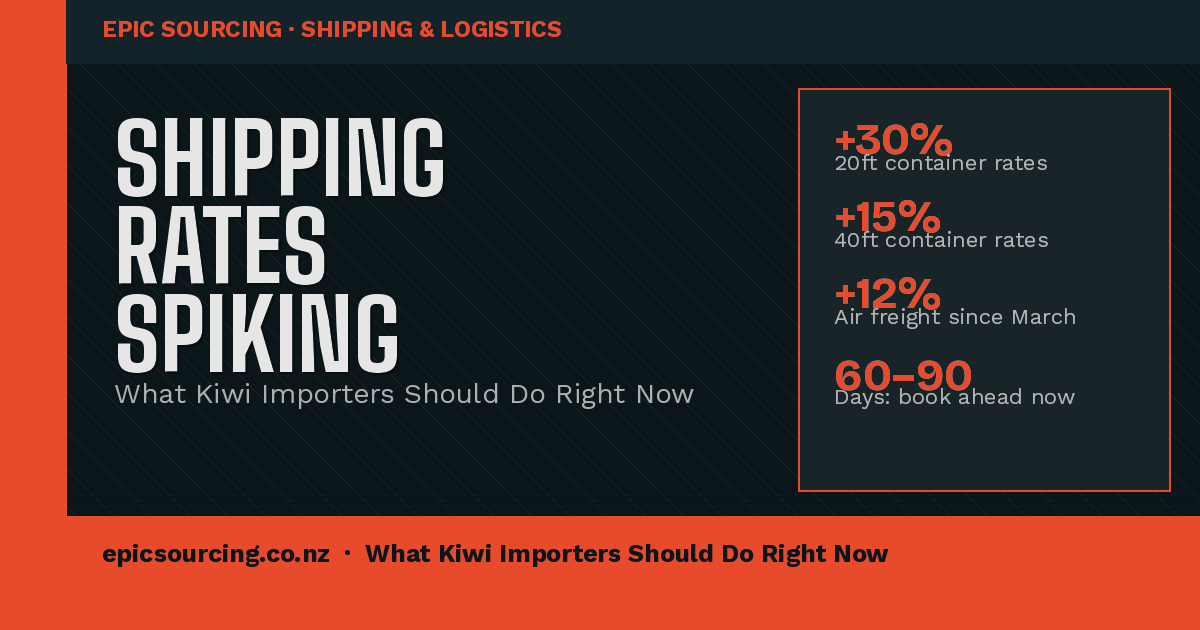
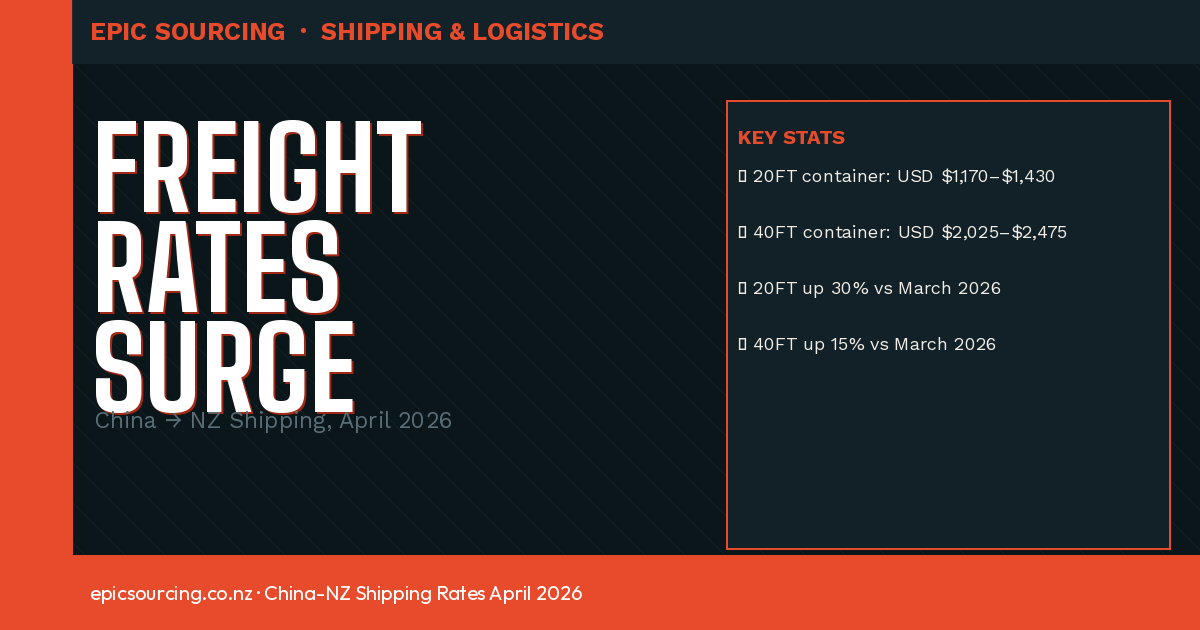
If you've been importing from China recently and had a bit of a shock when you got your latest freight quote — you're not imagining things. Shipping from China to New Zealand has jumped significantly in 2026, with sea freight rates for a standard 20-foot container up by as much as 30% compared to March. It's a real headache for Kiwi businesses who've built their margins around last year's numbers.
But here's the thing — while you can't control global freight markets, you absolutely can control how you respond to them. Whether you're importing activewear, furniture, kitchenware, or any other product from Chinese manufacturers, understanding what's driving rates and how to work smarter is the difference between a business that thrives and one that gets squeezed.
So, let's dive into what's actually happening with China-to-NZ freight in 2026, what it'll cost you, and — more importantly — what you can do about it.
What Are the Current Shipping Rates from China to NZ?
Here's the latest freight rate data as of May 2026 (sourced from Freightos and Sino-Shipping):
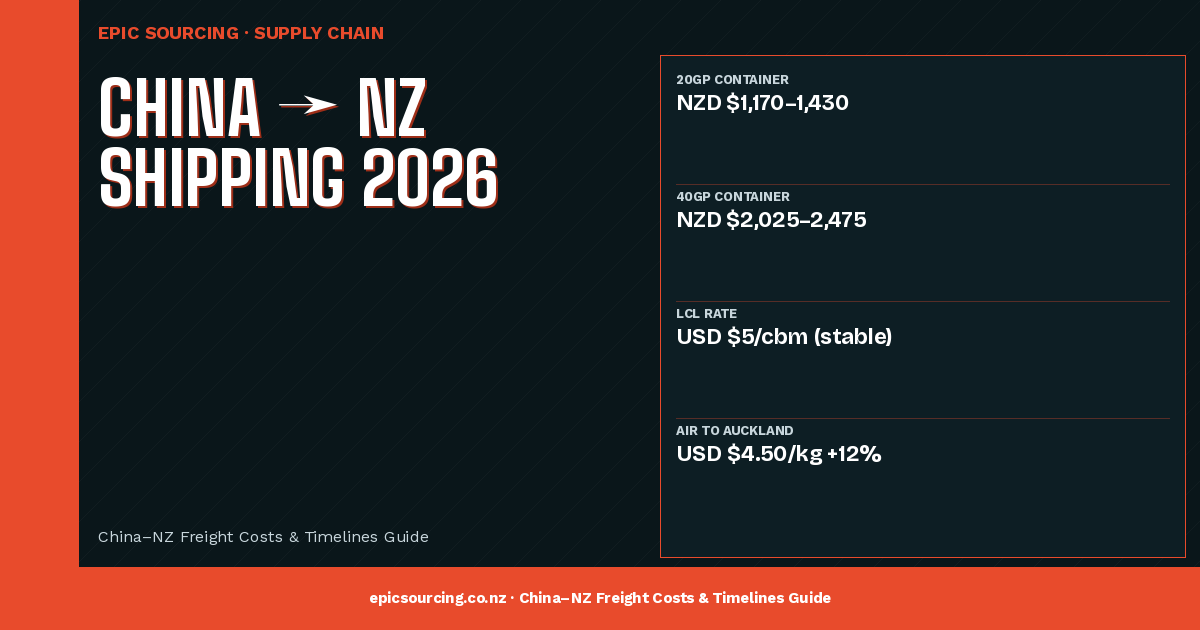
- Sea Freight — 20GP Container: NZD $1,170–$1,430 per container (up ~30% vs March)
- Sea Freight — 40GP Container: NZD $2,025–$2,475 per container (up ~15% vs March)
- LCL (Less than Container Load): USD $5/cbm — stable for now (great for smaller shipments)
- Air Freight to Auckland: USD $4.50/kg (up 12%) — best for urgent, high-value, or lightweight goods
The good news? LCL rates have stayed stable, which is a lifeline for smaller Kiwi importers who don't need a full container. If you're ordering smaller quantities, LCL is your mate right now.
Sourcing Hack #1: Use LCL When Your Volume Is Under 15 CBM — If your shipment fits in less than 15 cubic metres, LCL (Less than Container Load) is almost always cheaper than booking a full 20-foot container. At $5/cbm, it's a fraction of the cost — and rates have held steady while FCL prices spike. Ask your freight forwarder to quote both options every time.
Why Are Freight Rates Rising?
There are a few forces at play here, and understanding them helps you plan ahead rather than getting caught out:
- US-China trade tensions: With US tariffs on Chinese goods sitting at around 30%, global shipping lanes are being reconfigured. Cargo that used to go straight to the US is being rerouted, creating congestion and pushing up prices on routes like China-to-NZ.
- 'Amazing April' demand surge: Made-in-China.com saw global buyers boost China sourcing by 25% in April 2026. More cargo = less space = higher prices. Classic supply and demand.
- Port congestion and capacity constraints: Last-minute capacity is genuinely limited right now. If you're booking freight at the 11th hour, you're going to pay a premium — or wait weeks for space.
- Rising operational costs: Fuel surcharges, labour costs at Chinese ports, and currency fluctuations all factor into what ends up on your invoice.
How Long Does Shipping from China to NZ Actually Take?
Timelines vary depending on your shipment type and your Chinese supplier's location:
- Sea freight (FCL or LCL): 18–28 days from Chinese ports (Shanghai, Ningbo, Shenzhen) to Auckland or Tauranga. Add 3–5 days if your supplier is inland from the port.
- Air freight: 3–7 days door-to-door. Great for urgent restocks or product samples, but at $4.50/kg, it's not sustainable for bulk orders.
- Express courier (DHL/FedEx/TNT): 5–10 days for parcels under 30kg. Perfect for samples or small pilot orders.
Pro tip: factor in Chinese factory lead times (usually 2–6 weeks for production) BEFORE your freight timeline. When you're planning a seasonal product launch — say summer activewear or Christmas gifts — you need to be ordering 3–4 months out, not 3–4 weeks.
Sourcing Hack #2: Build a 'Ship Date Backwards' Calendar — Work backwards from when you need products on your shelves. Take your launch date, subtract transit time (28 days sea), subtract customs clearance (3–7 days in NZ), subtract production lead time (2–6 weeks), and add a 2-week buffer. That's your order confirmation deadline. Do this for every seasonal product and you'll stop paying air freight premiums to catch up.
5 Practical Ways to Keep Your Freight Costs Under Control
- Consolidate your orders: Instead of four small shipments a year, aim for two or three well-timed consolidated loads. Fewer bookings mean more negotiating leverage with freight forwarders.
- Book early: Seriously. Last-minute capacity is limited and expensive. If you can give a freight forwarder 4–6 weeks of notice, you'll get better rates and guaranteed space.
- Use a freight forwarder: They buy space in bulk and pass savings on. Don't book direct with shipping lines unless you have serious volume — a good forwarder will save you money.
- Consider the 40GP over two 20GPs: A 40GP container is almost double the volume but costs far less than two 20GP bookings. If your order volume justifies it, always go bigger.
- Renegotiate with suppliers: Ask your Chinese suppliers about EXW (Ex-Works) pricing — where you arrange freight yourself — vs FOB (Free on Board) where they include it. Sometimes managing freight yourself, through a NZ-based forwarder, is cheaper than whatever markup the supplier's logistics partner adds.
What About NZ Customs and Duties?
- NZ Customs duty: Varies significantly by product category. Some goods attract 0%, others up to 10%. Check the NZ Tariff Finder before committing to an order.
- GST on imports: 15% GST applies to goods over NZD $1,000 CIF (cost + insurance + freight). Budget for this.
- MPI biosecurity inspection: Certain products — particularly timber, food, leather, and natural materials — require MPI inspection. Factor in 1–3 days and potential treatment costs.
- Import documentation: You'll need a Commercial Invoice, Packing List, Bill of Lading (or Air Waybill), and sometimes a Certificate of Origin.
Is This a Good Time to Import from China?
Despite rising freight costs, yes — and here's why. China still offers unmatched manufacturing capability, capacity, and cost efficiency for the vast majority of manufactured goods. Chinese factories are also increasingly offering lower MOQs (minimum order quantities), in some industries as low as 50–100 units, which is a massive opportunity for Kiwi startups and SMEs to test products without massive upfront risk.
The real question isn't 'should I import from China?' — it's 'am I doing it smart enough?' That means timing your orders well, choosing the right freight mode, and working with people who know the market.
Need help navigating freight logistics and supplier relationships? That's exactly what the team at Epic Sourcing does every day for Kiwi businesses. Book a free consultation and we'll help you figure out the most cost-effective way to get your products from China to NZ shelves.
Related Articles


Let’s Make It Epic
We're here to make sourcing simple – and a whole lot less stressful.
We are experiencing a higher volume of enquiries than usual. Our standard reply time for form submissions and emails is within 72 hours.
If your matter is urgent, please schedule a video call using the link below.
