
.svg)
How NZ eCommerce Brands Are Winning with Social Commerce and Sourced Products

.svg)
Something interesting has happened to how Kiwis shop online. They're not just going to Google, typing in a product, and clicking "buy" anymore. They're discovering products on TikTok. They're seeing something in an Instagram Reel at 10pm and buying it before they've put down their phone. Social commerce — the merging of social media with transactional shopping — is reshaping NZ ecommerce faster than most people realise.
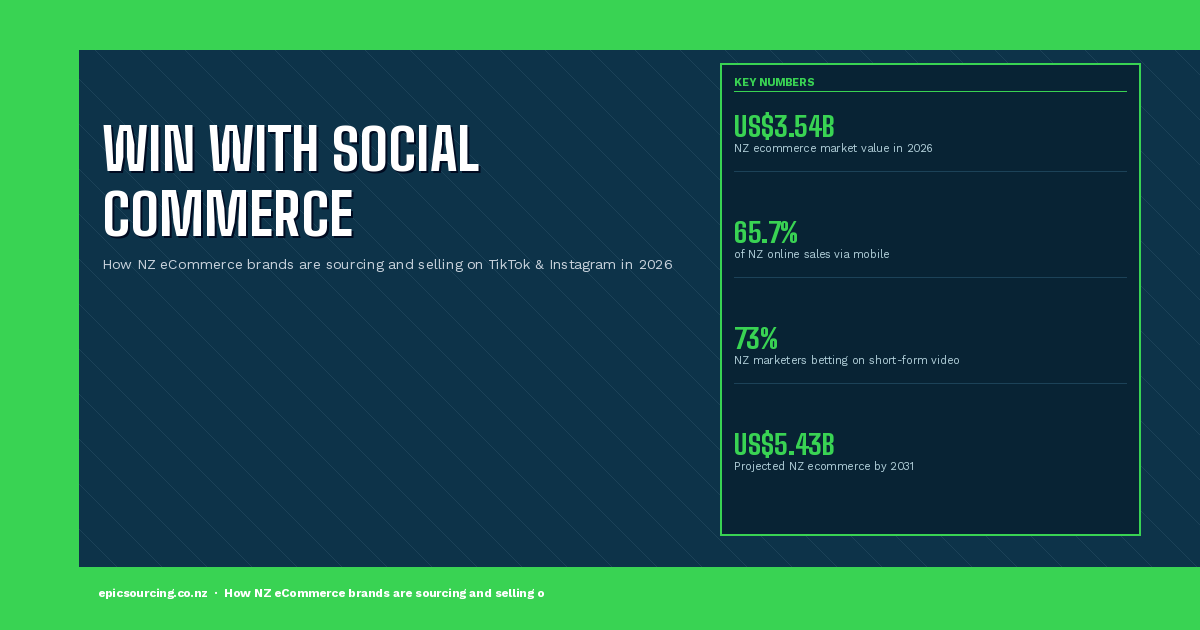
The numbers back this up. NZ's ecommerce market is worth US$3.54 billion in 2026 and is forecast to hit US$5.43 billion by 2031. Mobile generates 65.7% of all online sales. And 73% of NZ marketers now say short-form video will be their dominant content strategy for 2026.
For NZ brands sourcing products from China or Vietnam, this shift is a massive opportunity. The brands winning right now are the ones who've figured out how to pair smart sourcing with social-first marketing. Let's break down exactly how they're doing it.
Why Social Commerce Is Different from Traditional eCommerce
Traditional ecommerce is intent-driven — someone knows they want a yoga mat, they search for it, they compare prices, they buy. Social commerce is discovery-driven — someone didn't know they needed a self-heating eye mask until they saw it in a video, loved the story behind the brand, and bought it in three taps.
This changes everything about how you need to think about your products. In traditional ecommerce, you compete on price and SEO. In social commerce, you compete on visual appeal, storytelling, and emotional resonance. Products that look amazing on camera and have a clear "why" behind them perform disproportionately well.
Sourcing Hack #1: Source for the Camera, Not Just the Catalogue — When evaluating products from suppliers, ask yourself: "Would this stop someone scrolling?" Order samples specifically to photograph and video. Products with tactile textures, satisfying packaging, or visible transformation perform best on TikTok and Instagram. A mediocre product with great visual appeal will outsell a great product with boring presentation every time in social commerce.
The Products Killing It on Social Commerce Right Now
Looking at what's trending across TikTok Shop and Instagram Shopping, certain product categories consistently punch above their weight in social commerce — and they're all sourceable from China or Vietnam:
- Skincare and beauty tools — LED face masks, gua sha sets, silicone cleansing brushes. Visual transformation = massive social engagement.
- Home organisation — aesthetic storage, bamboo drawer organisers, matching kitchen containers. The "satisfying clean-up" video format is endlessly watchable.
- Activewear and athleisure — especially items with unique fabric technology (seamless, buttery-soft, sculpting). NZ women's activewear is a huge social commerce category.
- Eco-friendly lifestyle products — bamboo alternatives, reusable packaging, zero-waste kitchen items.
- Innovative single-purpose tools — cold brew coffee makers, avocado slicers, cable organisers. The "problem/solution" video format is tailor-made for these.
Building Your Social-Commerce-Ready Supply Chain
The brands winning at social commerce have figured out that their supply chain isn't just a cost centre — it's a competitive advantage. Here's what that looks like in practice:
- Start with small test orders: Thanks to dramatically lower MOQs from Chinese factories (as low as 50–100 units in 2026), you can test a product's social performance before committing to a large order.
- Fast reorder capability: When a product goes viral, you need to reorder quickly. Establish supplier relationships before you need them and have a second-source supplier identified.
- Packaging designed for unboxing: The unboxing video is a cornerstone content format. Custom coloured boxes and branded tissue paper can transform a commodity product.
- Consistent quality: A pre-shipment quality inspection ($250–$350) is cheap insurance when you're building a social brand. One bad experience shared online can tank you fast.
Sourcing Hack #2: Add Custom Packaging to Your China Order — Many NZ brands don't know that you can order custom printed boxes, bags, and inserts directly from Chinese suppliers for surprisingly low costs. A MOQ of 500 custom boxes typically runs $0.80–$1.50 per unit. Your product goes from "generic item in a brown box" to "branded experience" — and that difference is huge for social commerce content.
How to Use TikTok and Instagram as Sourcing Research Tools
Here's a hack most importers haven't figured out yet: TikTok and Instagram aren't just marketing channels — they're the best real-time product research tools available to you.
Search #TikTokMadeMeBuyIt and you'll see what's actually converting right now in your category. Browse trending products in the TikTok Shop. Follow content creators in your niche and look at which of their posts get the most engagement. That engagement data is telling you exactly what your target customer wants.
When you can identify a product that's trending in Australia, the UK, or the US on social commerce — and you can source it from China — you have a meaningful head start on the NZ market. NZ social commerce trends typically follow global trends by 3–6 months. That window is your opportunity.
The Mindful Consumer Factor
One nuance worth understanding about the 2026 NZ consumer: they're increasingly "mindful" shoppers. They research. They check brand ethics. They care about where products come from and how they're made.
This isn't bad news for importers — it's an opportunity to tell a genuine story. If you've visited your factory, you can show that. If your products are sustainably made, say so. If your supplier has certifications (BSCI, OEKO-TEX, ISO), feature them. The sourcing process that feels like a business overhead can become the most compelling marketing content you produce.
Sourcing Hack #3: Document Your Sourcing Journey for Content — Every step of your sourcing process is content gold. Sampling stage? Film the unboxing. Factory visit? Go live. Quality inspection? Share the before/after. First shipment arriving at port? That's a story. Behind-the-scenes content consistently outperforms polished product shots on social platforms because it's real — and real is what Kiwi consumers are seeking right now.
Keen to explore your options? Book a free consultation with the team at Epic Sourcing and let's map out a sourcing strategy that sets your social commerce brand up for success. No pressure, no jargon — just a straight-up conversation about what's possible.
Related Articles


Let’s Make It Epic
We're here to make sourcing simple – and a whole lot less stressful.
We are experiencing a higher volume of enquiries than usual. Our standard reply time for form submissions and emails is within 72 hours.
If your matter is urgent, please schedule a video call using the link below.
