.svg)
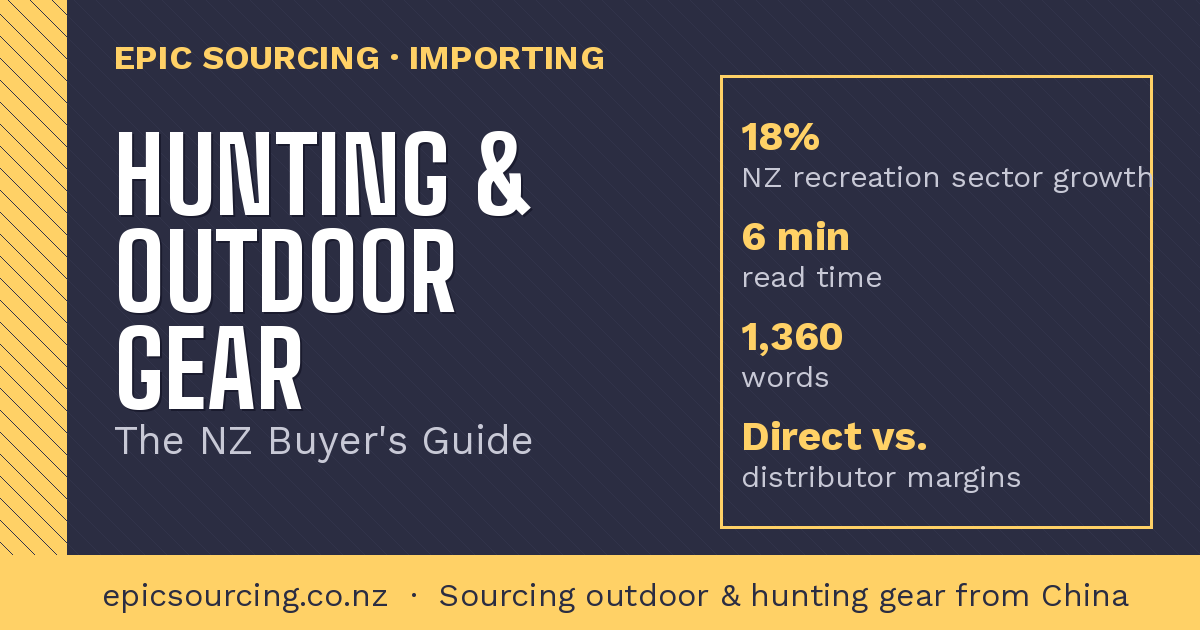
How to Source Hunting and Outdoor Gear from China: The NZ Buyer's Guide

.svg)
Why China for Hunting and Outdoor Gear?
New Zealand is one of the world's great outdoor nations. Hunting, tramping, fishing, and adventure sports are woven into the Kiwi identity — and the businesses that serve those communities have been growing fast. The NZ recreation and outdoor sector is up 18% year-on-year as of mid-2026, driven by domestic tourism, a growing hunting culture, and Kiwis investing seriously in quality gear.
A significant portion of the hunting and outdoor gear sold in New Zealand — from camo jackets to rifle cleaning kits, from hunting packs to fishing tackle — is manufactured in China. And Kiwi businesses who source directly (rather than buying through a distributor) are capturing the margin difference.
China has become the world's dominant manufacturer of outdoor equipment for a few specific reasons:
- Manufacturing clusters — Zhejiang, Guangdong, and Shandong provinces have dense clusters of outdoor gear manufacturers who share suppliers, tooling, and technical expertise
- Material sourcing — Chinese factories have direct access to ripstop nylon, cordura fabric, high-tensile aluminium, stainless steel, and technical polymers
- Certification capability — reputable factories can produce to CE, ANSI, and international safety standards
- Customisation — private label and custom design options are widely available, including custom colourways, logo embroidery, and bespoke product design
What Outdoor Products Source Well from China?
Not every outdoor product is equally suited to Chinese sourcing. Here's a practical breakdown:
Strong fit — high volume, quality readily available:
- Camouflage clothing (jackets, pants, base layers, beanies, gaiters)
- Hunting packs and day packs (Molle systems, hydration-compatible designs)
- Sleeping bags and bivouac gear
- Tents and shelters (dome, tunnel, and modular styles)
- Fishing tackle and accessories (lures, rod holders, tackle boxes, landing nets)
- Hunting accessories (game bags, bone saws, skinning tools, gloves)
- Optics accessories (scope rings, lens cloths, carry cases)
Workable with the right factory and QC:
- Footwear (hunting boots, gumboots) — requires careful sizing review and QC
- Knives and cutting tools — customs regulations apply; check NZ import rules for fixed blades
- Electronic devices (trail cameras, GPS mounts) — compliance testing required
Approach with caution:
- Firearms and ammunition — heavily regulated, not suitable for direct China import to NZ
- Safety-critical equipment (harnesses, ropes) — requires CE/ANSI certification and very rigorous QC
Finding the Right Supplier for Hunting and Outdoor Gear
The hunting and outdoor category has a lot of factories on Alibaba and Made-in-China.com, but quality varies enormously. Here's how to filter effectively:
- Search for factories, not trading companies. Look for 'manufacturer' in the Alibaba listing type and verify with a factory audit. Trading companies add margin; going direct saves money.
- Look for export experience to English-speaking markets. Factories that supply Australian, UK, or US outdoor brands understand quality expectations — a good proxy for NZ standards.
- Ask about material sourcing. 'What fabric do you use for your waterproof jackets?' If they can't give you the spec (e.g. 20D nylon, 10,000mm waterproof rating), they're a reseller, not a manufacturer.
- Request a product test report. For technical apparel and gear, ask for a recent SGS or Bureau Veritas test report on relevant properties (waterproofing, seam strength, colorfastness).
- Order samples from 3–5 factories and test them properly — not just look at them. Put the jacket in the rain. Stress-test the zippers. Wear the boots on a short tramp.
Sourcing Hack #1: Attend Vietnam International Sourcing 2026 (VIS 2026) — The VIS 2026 event is running Aug–Sep 2026 with 400+ purchasing delegations from 60+ countries. Vietnam is strong on apparel and light outdoor gear. Face-to-face vetting at sourcing events gives you access you can't replicate on Alibaba.
Private Label Outdoor Gear — Building Your Own NZ Brand
One of the most exciting opportunities in the NZ outdoor market right now is private labelling. Rather than competing with Macpac and Kathmandu on their turf, Kiwi entrepreneurs are building niche brands targeting specific outdoor communities — hunters, high-country station workers, fishing guides, and adventure tourism operators.
Private label outdoor gear from China works particularly well for:
- Camo clothing for NZ hunters — designs based on NZ landscapes (tussock, bush, high country) are hugely popular and differentiated
- Branded hunting accessories (game bags, knives, packs) sold as a coordinated range
- Adventure tourism operator uniforms and gear with custom branding
- Corporate gift sets for hunting and fishing lodges (branded mugs, knives, hats)
The key to private label success in the outdoor space is specificity. A brand that is specifically built for NZ deer hunters, or for South Island fishing guides, can build a loyal following with premium pricing that broader brands can't match.
Quality Control for Hunting and Outdoor Gear
Your QC checklist for outdoor gear should include:
- Pre-production material confirmation — verify the fabric GSM, composition, and waterproof rating before production starts
- Mid-production inspection — check stitching density, zipper function, hardware attachment strength, and print/embroidery quality
- Pre-shipment drop test for hard goods — bags, packs, and hard cases should be tested for structural integrity under load
- Sizing compliance — NZ sizing conventions differ from Chinese domestic sizing; specify measurements in cm and request a size chart for approval
Sourcing Hack #2: Negotiate a 'B-grade' policy with your supplier — Ask your supplier to set aside any units that don't pass QC as 'B-grade' rather than destroying them. You can inspect these and decide whether to accept at a discount for outlet sale or reject outright. This gives you visibility over your defect rate without losing the product entirely.
The Business Case: What Does Sourcing Outdoor Gear From China Actually Cost?
A private label hunting jacket (waterproof, breathable, camo print, 200-unit minimum order):
- Ex-factory price: USD $38–$52 per unit
- Sea freight to NZ (40GP FCL at August 2026 rates): USD $4,455–$5,445 for a full container
- NZ landed cost (including freight, customs clearance, GST): approximately NZD $85–$110 per unit
- Wholesale price to outdoor retailers: NZD $160–$200 per unit
- Retail price (D2C or in-store): NZD $250–$340 per unit
The margin at wholesale is already healthy. If you sell direct to consumer, the economics are even more compelling. And freight rates, while elevated right now, are expected to normalise through Q4 2026 as peak season capacity comes online.
The outdoor market in NZ is underserved by purpose-built, locally-branded hunting and outdoor gear. There's a real opportunity for Kiwi entrepreneurs who are willing to do the work to find the right suppliers and build something genuinely good.
Related Articles

Let’s Make It Epic
We're here to make sourcing simple – and a whole lot less stressful.
We are experiencing a higher volume of enquiries than usual. Our standard reply time for form submissions and emails is within 72 hours.
If your matter is urgent, please schedule a video call using the link below.
