.svg)
China+1: Why Smart NZ Importers Are Diversifying Their Supply Chains in 2026

.svg)
If you follow global trade news, you've probably noticed the phrase 'China+1' popping up a lot lately. But what does it actually mean — and more importantly, should Kiwi businesses be paying attention?
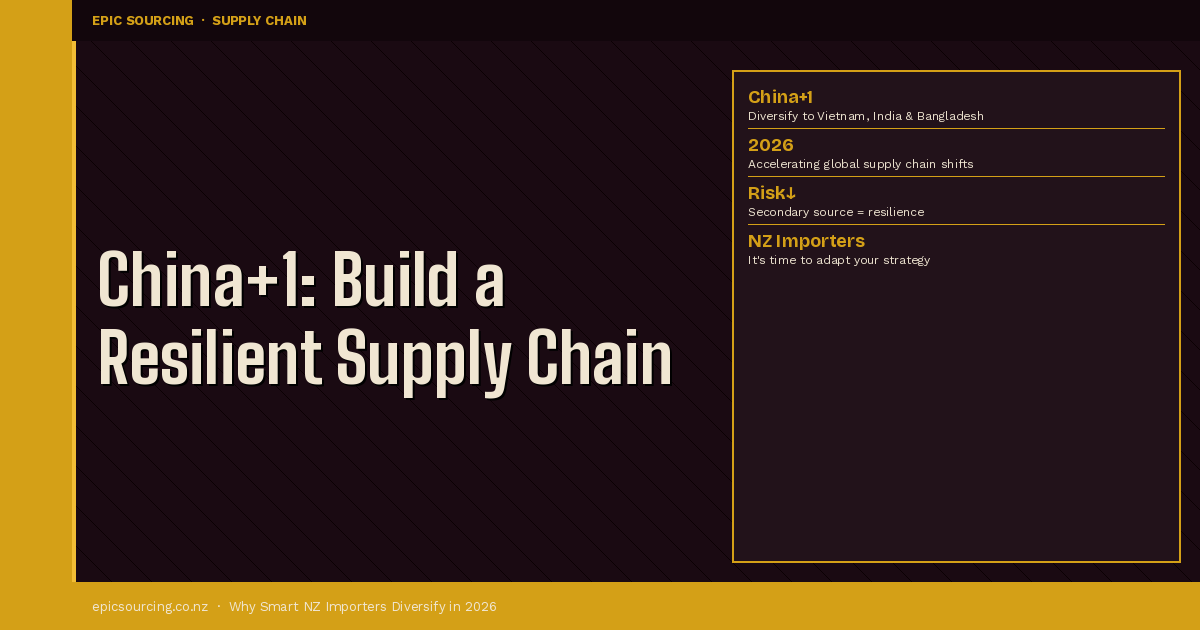
Here's the short version: the China+1 strategy is about not putting all your sourcing eggs in one basket. Rather than relying solely on Chinese suppliers, businesses add at least one alternative sourcing country — typically Vietnam, India, or Bangladesh — to their supply chain mix. It's a risk management strategy as much as it is a cost play.
In 2026, this trend is accelerating. But here's the nuance: China isn't going anywhere. Let's look at what's actually happening, why China still dominates despite the diversification push, and how NZ importers can build a smarter, more resilient sourcing strategy without throwing out what's already working.
What Is the China+1 Strategy? (And Who's Already Doing It)
The China+1 concept emerged during the US-China trade war and truly accelerated during COVID-19, when businesses worldwide discovered the hard way what happens when your entire supply chain runs through a single country.
The idea is simple: keep China as your primary sourcing country, but develop at least one secondary source in another country. If disruption hits one source — geopolitical tension, a factory fire, a pandemic-level event, port congestion — you have a genuine backup.
Global data from 2026 shows the combined market share of the top 3 supplier countries (China, India, and Vietnam) for North American buyers fell from 61% to 54% in just one year. This reflects real buyer behaviour: spreading orders across more countries and suppliers. It's not just corporate strategy talk anymore — it's actually happening.
Sourcing Hack #1: Start China+1 with a single product line, not your whole range — Don't try to diversify your entire supply chain at once — it's overwhelming and expensive. Instead, pick your most volume-sensitive product line and develop a secondary supplier in a different country for that specific product. Build the relationship over 6-12 months before committing significant volume.
Why China Still Dominates — And Likely Will for Years to Come
Here's what sometimes gets lost in the China+1 narrative: China isn't going anywhere. Despite all the diversification activity, China holds 65% of global sourcing for most product categories. NZ-China trade hit NZ$30 billion in 2025 — up 12% year-on-year — and China commands a 28.23% share of all NZ imports.
Why? Because the manufacturing fundamentals are still incredibly strong:
- Unmatched manufacturing infrastructure — supply chains built over decades that no other country can replicate quickly
- Economies of scale — sheer production volume keeps per-unit costs low in ways emerging hubs can't match yet
- Technology adoption — Chinese factories are rapidly integrating AI quality control and 3D printing, improving both quality and speed
- Established relationships — trust, trade terms, and institutional knowledge that takes years to rebuild with a new supplier
The lesson: China+1 doesn't mean China minus. It means China plus somewhere else, for specific reasons and specific product lines.
The Best China+1 Countries for NZ Importers in 2026
Vietnam is the clear frontrunner for apparel and textiles. NZ-Vietnam two-way trade reached NZD 2.68 billion in 2024, with both countries targeting NZD 3 billion by 2026. For resort wear, activewear, and leggings specifically, Vietnam is rapidly becoming the preferred alternative to China — and Epic is seeing more Vietnam sourcing enquiries than ever before.
India is excellent for home textiles, handicrafts, jewellery, and leather goods. Handcrafted rugs from Jaipur are a great example — outstanding quality at competitive prices for the segment.
Bangladesh remains the world leader in garment manufacturing by volume, with very competitive pricing for basics (t-shirts, polos, simple knitwear). MOQs can be higher, but for the right product categories it makes strong business sense.
Which Product Categories Make Sense to Diversify
- Apparel and textiles — labour-intensive with multiple viable alternatives. The #1 category where NZ businesses are actively diversifying in 2026
- Furniture and homewares — Vietnam has excellent timber and rattan furniture manufacturing; India for handcrafted decorative pieces
- Seasonal products — anything you need in large, predictable annual volumes is worth dual-sourcing to protect your peak selling window
- Products in tariff-sensitive categories — alternative sourcing countries may attract more favourable duty rates
The Real Costs of Diversification: What Nobody Tells You
Diversification costs real money and time — at least upfront. Relationship development takes 12-24 months minimum. You can't just switch suppliers overnight.
Landed costs in 2026 now include new line items: CBAM compliance costs, geopolitical risk premiums, cost of capital, and compliance documentation for new trade corridors. Before you assume a Vietnamese supplier is 'cheaper,' do a full landed cost analysis — the comparison often surprises people.
Freight logistics are also more complex with multiple source countries: two separate shipping lanes, order consolidation, and different biosecurity requirements at the NZ border.
Sourcing Hack #2: Run a full landed cost analysis before committing to a new source country — Take your top-selling product and model the complete landed cost from both your current Chinese supplier AND a shortlisted alternative. Include: factory price, sea freight, insurance, duties (check CPTPP and AANZFTA rates), customs clearance, and compliance costs. The result often changes the decision significantly.
How to Build a Resilient Dual-Source Supply Chain
- Audit your current supplier risk — which suppliers are single-source? Which product lines would hurt most if supply was disrupted for 3 months?
- Prioritise by volume and vulnerability — start diversifying your highest-volume, highest-risk lines first
- Identify and qualify alternative suppliers — start with one country and develop relationships with 2-3 factories for your priority product
- Place trial orders — use your alternative supplier for 10-20% of usual volume while maintaining your primary
- Build the relationship over time — visit the factory or use a sourcing agent to conduct quality inspections
- Review and rebalance annually — your sourcing mix should evolve as your business grows
Working with a sourcing partner who already has established relationships in China, Vietnam, and India can dramatically accelerate this process. Instead of spending 12-18 months building trust from scratch, you can leverage existing networks and start placing trial orders within weeks.
The China+1 strategy isn't about abandoning China — it's about being smarter. Building resilience into your supply chain now means less disruption, more negotiating power, and a business better equipped to handle whatever global trade throws at it next.
Ready to take the next step? Book a free consultation with Epic Sourcing New Zealand — no sales pitch, just straight-up advice from people who source for a living. Visit epicsourcing.co.nz to get in touch.
Related Articles



Let’s Make It Epic
We're here to make sourcing simple – and a whole lot less stressful.
We are experiencing a higher volume of enquiries than usual. Our standard reply time for form submissions and emails is within 72 hours.
If your matter is urgent, please schedule a video call using the link below.
