.svg)
Sourcing Office Furniture and Commercial Fit-Outs from China: A Practical NZ Business Guide

.svg)
Sourcing Office Furniture and Commercial Fit-Outs from China: A Practical NZ Business Guide
If you've recently priced a commercial fit-out in New Zealand — whether it's a new office, a co-working space, a clinic, or a retail premises — you've probably had a moment of sticker shock. NZ commercial furniture pricing is brutal. A decent task chair runs $400-$800+. A simple sit-stand desk costs $800-$1,500. A six-person meeting table with chairs? You might be looking at $6,000-$15,000 from local suppliers.
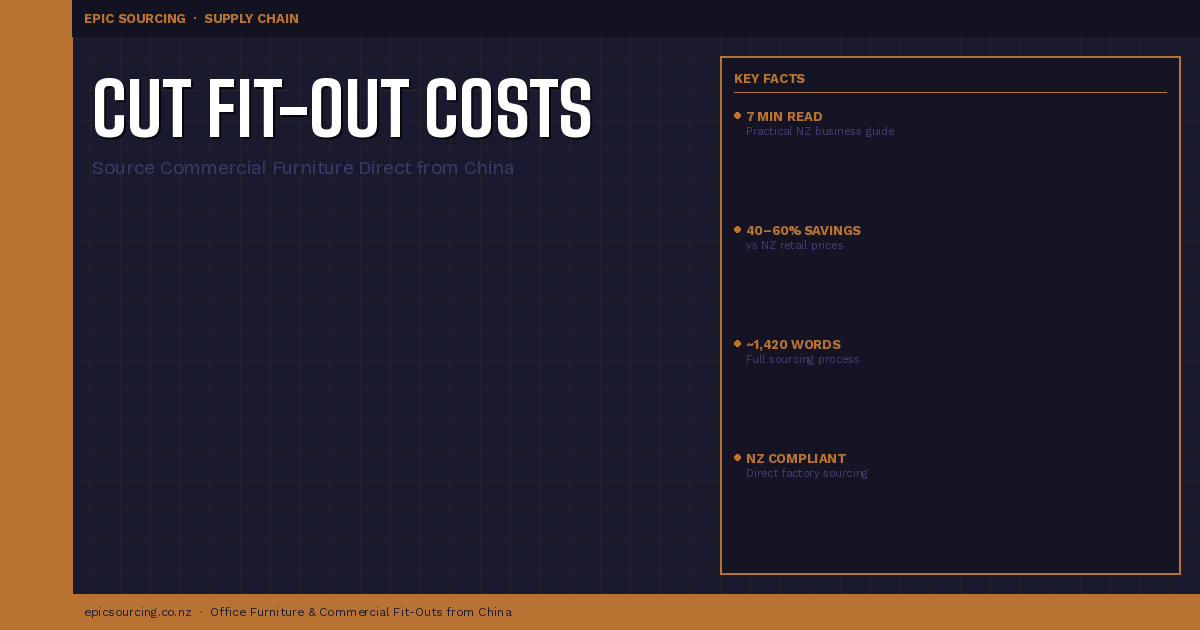
Here's what many NZ property developers, commercial interior designers, and business owners are discovering: you can source the same category of product directly from China — often from the same factories supplying the NZ retailers — for a fraction of the cost. We're talking savings of 40-60% on comparable quality items when you cut out the importer and retailer margins.
It's not without its complexities. But done right, direct sourcing from China for a commercial fit-out is one of the highest-ROI moves a NZ business can make. Here's how it works.
1. What Types of Commercial Products Can You Source from China?
The scope of what's available from Chinese commercial furniture and fit-out manufacturers might surprise you. You're not limited to basic desks and chairs. Here's what NZ businesses commonly source:
- Task chairs and ergonomic seating — from budget through to mid-tier ergonomic designs with mesh backs, adjustable lumbar, and 4D armrests
- Sit-stand desks and workstation systems — electric height-adjustable frames with NZ-standard power supplies are readily available
- Meeting room tables and boardroom furniture — solid timber veneer, glass tops, or laminate — choose your finish
- Reception counters and reception seating — custom dimensions and finishes are easily achievable
- Breakout and lounge furniture — sofas, ottomans, cafe-style tables and stools, booth seating
- Storage solutions — lockers, shelving, filing cabinets, credenzas
- Acoustic panels and room dividers — hugely popular for open-plan offices
- Commercial lighting — pendant lights, track lighting, LED panels for fit-out projects
- Joinery hardware and fittings — handles, hinges, drawer systems for custom cabinetry
2. The Key Sourcing Hubs for Commercial Furniture in China
Knowing where to look in China makes a significant difference to the quality and price you'll find:
- Foshan, Guangdong — the undisputed capital of Chinese furniture manufacturing. Particularly strong for seating, hotel furniture, and office furniture. Multiple wholesale markets including Lecong make it easy to view product in person.
- Shunde District, Foshan — home to hundreds of ergonomic chair manufacturers. This is where many well-known ergonomic chair brands have their OEM factories.
- Nanhai District, Foshan — strong for metal and aluminium furniture components, including sit-stand desk frames.
- Linyi, Shandong — one of China's largest wood-based panel markets. Great source for flat-pack furniture, laminate boards, and solid wood components.
- Yiwu, Zhejiang — the world's largest small commodities market. Good for accessories, hardware, and smaller furniture items in smaller quantities.
3. Minimum Orders and Lead Times — What to Expect
Unlike retail purchases, commercial furniture from China requires planning around lead times and MOQs. Here's what a typical commercial fit-out sourcing project looks like in terms of timeline:
- Supplier identification and quoting: 1-2 weeks
- Sample order and review: 2-4 weeks (shipping included)
- Production of your order: 3-6 weeks depending on complexity and volume
- Sea freight to NZ: 3-5 weeks
- Customs clearance and delivery: 1-2 weeks
Total from order placement to product on site: approximately 10-15 weeks. This means you need to start your sourcing process at least 3-4 months before your fit-out date. That's longer than buying from a NZ supplier, but the savings often justify it — especially on larger projects.
Regarding MOQs: for standard catalogue items (e.g. a standard task chair model), many suppliers will accept small orders of 20-50 units. For customised or bespoke items (custom dimensions, bespoke upholstery, branded elements), MOQs are typically higher — often 50-100+ units.
Sourcing Hack #1: Request a Batch Test Report for Upholstery — For commercial seating, always ask your supplier for a batch test report from an independent testing lab (SGS, Intertek, or Bureau Veritas). You specifically want to see results for abrasion resistance (Martindale test — commercial grade is typically 25,000+ rubs), flammability compliance, and foam density rating. These test reports are standard in the industry and reputable suppliers will have them readily available. If a supplier can't provide them, walk away.
4. Quality and Compliance: What NZ Businesses Need to Know
This is where many first-time commercial importers come unstuck. There are specific standards and requirements you need to be across before your products arrive in NZ:
- Seating standards — commercial chairs should ideally be tested to BIFMA standards (US) or EN 16139 (European). These are internationally recognised and indicate a product that'll survive commercial use.
- Electrical compliance — any electrically powered items (sit-stand desks, powered meeting tables) must comply with NZ electrical safety standards. Look for items that include SAA or CE certification, and be prepared to verify compliance with a local electrician.
- Fire retardancy — for commercial fit-outs subject to council compliance (particularly in buildings with high occupancy), upholstered items may need to meet specific fire-retardancy standards. Check with your architect or building consent officer.
- Material safety — for items that will be used in offices with staff all day, ensure paints, laminates, and adhesives are low-VOC. Ask for SGS or equivalent certificates for formaldehyde emissions (especially for wood-based panels and MDF).
5. Logistics — Getting Your Fit-Out from China to Site in NZ
The logistics of a commercial fit-out shipment are more complex than a standard import, because you're typically dealing with large, bulky items. Here's what to plan for:
- Sea freight is almost always the right mode — air freight for commercial furniture is prohibitively expensive. Budget for a 20ft container (~$1,800-$2,500 USD) or 40ft container (~$2,500-$3,500 USD) depending on your volume.
- Consolidation is an option — if your order doesn't fill a full container, you can use LCL (Less than Container Load) consolidation. It's slightly more per cubic metre but eliminates the need to fill a whole container.
- Flat-pack wherever possible — request flat-pack options for any furniture that can be assembled on-site. This dramatically reduces cubic metres and therefore freight costs.
- Customs and duty — most commercial furniture attracts a 5% import duty in NZ. GST of 15% applies on top of the landed cost. Factor these into your budget.
- Delivery to site — make sure your freight forwarder's quote includes NZ delivery to your site. Some quotes are only to the NZ port.
Sourcing Hack #2: Order 3-4 Months Before Your Project Start Date — This seems obvious, but it's the most common mistake commercial fit-out projects make when sourcing from China. People leave sourcing too late, then panic and either pay premium prices locally or face site delays. Add China sourcing to your project plan at the same time you're finalising your design brief. If your fit-out starts in October, you should be placing orders in June. Build this into your project management process and you'll never have a timeline problem.
6. Working with a Sourcing Agent for Commercial Projects
For commercial fit-outs, working with a sourcing agent is often the smartest investment you can make. Here's why:
- Factory verification — agents can physically visit and audit factories in China, confirming they're legitimate and capable of your specification before you commit a dollar
- Quality control on the ground — pre-shipment inspections at the factory, before your goods are loaded into the container
- Negotiation — experienced agents know what's fair to pay and where there's room to negotiate on price, MOQ, lead time, and packaging
- Logistics coordination — handling the end-to-end freight, customs documentation, and delivery coordination
- Problem solving — if something goes wrong (a production delay, a quality issue, a customs hold), you have someone in the supply chain who can act on your behalf
For a $50,000 fit-out project, a sourcing agent's fee is typically a fraction of the savings they generate. And the peace of mind of having someone experienced managing the process is worth a lot more than its cost.
Thinking about sourcing your next commercial fit-out from China? Epic Sourcing NZ works with construction companies, interior designers, property developers, and business owners across NZ to source commercial furniture and fit-out components from reputable Chinese manufacturers. Book your free consultation at epicsourcing.co.nz — we'd love to see how much we could save you on your next project.
Related Articles


Let’s Make It Epic
We're here to make sourcing simple – and a whole lot less stressful.
We are experiencing a higher volume of enquiries than usual. Our standard reply time for form submissions and emails is within 72 hours.
If your matter is urgent, please schedule a video call using the link below.
