
.svg)
The US-China Tariff Truce Expires in November 2026 — What NZ Importers Should Do Right Now

.svg)
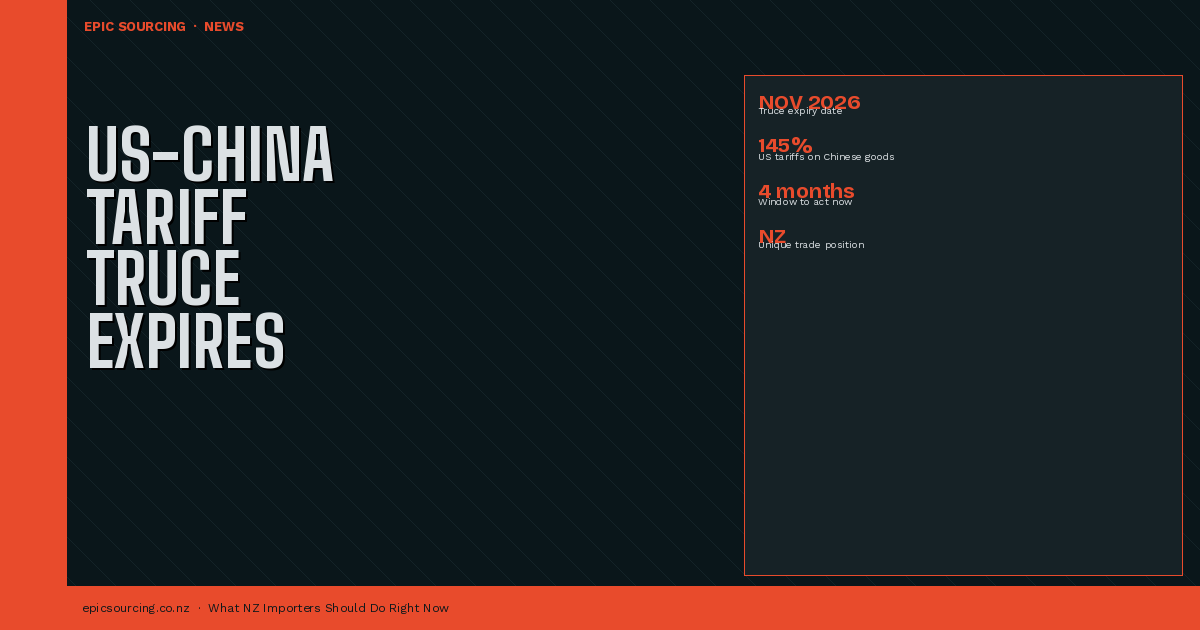
If you've been importing products from China and quietly hoping the tariff drama would sort itself out... well, mate, it's time to pay attention. The US-China tariff truce — the one that's kept global trade from going completely sideways since May 2025 — is set to expire in November 2026.
That gives Kiwi importers roughly four months to get their ducks in a row. The good news is that New Zealand sits in a pretty unique position here. But if you're not thinking ahead, the ripple effects could catch you off guard.
Let's break down what's happened, why it matters for your business, and the concrete steps you should be taking right now.
A Quick Recap: What Is the US-China Tariff Truce?
Back in April 2025, the US imposed tariffs of up to 145% on Chinese goods — essentially making it economically impossible for American businesses to buy directly from Chinese factories. China retaliated with its own tariffs, and global supply chains braced for impact.
Then, in May 2025, the two countries agreed to a temporary truce. US tariffs on Chinese goods were reduced (not removed) to roughly 30%, and China's retaliatory tariffs eased accordingly. The truce has been extended a couple of times, but the current extension expires in November 2026. After that? Nobody knows. Talks could succeed, tariffs could spike back to 145%, or we could land somewhere in the middle.
Why This Matters for NZ Importers (Even Though We're Not American)
Here's the thing about global trade: it's all connected. When US buyers — who represent a massive chunk of Chinese factory output — largely exited the market due to 145% tariffs, Chinese manufacturers had to find new buyers. And they found them in markets like New Zealand, Australia, and Southeast Asia.
What that meant for Kiwi businesses was actually pretty good: more factory capacity available, more competitive pricing, faster lead times, and suppliers who were genuinely hungry for your business. Some importers noticed they were getting better deal terms in late 2025 and early 2026 than they'd seen in years.
The flip side? When the US starts buying again, that factory capacity tightens up. Lead times stretch out. Pricing gets less flexible. The playing field shifts.
Sourcing Hack #1: Time Your Orders Around Trade Policy — Keep a light watch on US-China trade news. When US buyers are out of the market (high tariff periods), Chinese factories are more flexible on MOQs, pricing, and lead times. This is your window to negotiate harder or lock in better terms.
The Four Things to Do Before November 2026
- Lock in pricing agreements with your key suppliers. Get quotes confirmed for orders you're planning for Q4 2026 and early 2027. Some suppliers will honour a price for 3–6 months if you give them reasonable volume commitments.
- Review your inventory buffers. If you've been running lean, consider building a bit more safety stock for fast-moving lines. Lead time assumptions may not hold post-November.
- Diversify your supplier base. If you're relying on a single factory for a critical product line, qualify a backup supplier — either in China or in Vietnam, India, or Bangladesh as a hedge.
- Talk to your freight forwarder. Ask them how they're planning for potential disruption post-November. Book capacity in advance for Q4 shipments.
The NZ Advantage (And How to Use It)
New Zealand has something most countries don't: a free trade agreement with China. Under the NZ-China FTA, most products imported from China already enjoy 0% or reduced duty rates. That means Kiwi importers have been somewhat insulated from the cost pressures that US businesses have been dealing with.
We're also a small, nimble trading partner. Chinese factories are generally happy to work with NZ businesses — we're not caught in the political crossfire the same way American companies are. That's a genuine competitive advantage.
Sourcing Hack #2: Use the FTA as a Negotiating Tool — When talking to Chinese suppliers, mention that you're based in NZ and import under the NZ-China FTA. Some suppliers don't realise this means you face lower duty costs than US or European buyers — and that you're a more reliable, lower-risk customer to work with. It can tip the negotiation your way.
What About Shipping Rates?
Here's another layer: ocean freight rates from China to New Zealand have already jumped significantly in July 2026. A 40-foot container (40GP) has risen roughly 38% from June to July alone, now sitting in the $3,735–$4,565 range. If there's a tariff shock post-November — in either direction — expect shipping capacity and rates to swing accordingly.
The takeaway: don't wait until October to book your Q4 shipments. Freight space and rates are much easier to manage when you're not booking at the last minute.
The Bottom Line
The US-China tariff truce expiring in November 2026 is a genuine uncertainty in the global trade environment. For NZ importers, the direct risk is manageable — but the indirect effects on factory capacity, shipping rates, and supplier flexibility are worth planning for now, not later.
Lock in pricing, build your buffers, diversify where you can, and keep your freight forwarder in the loop. Four months is plenty of time to get prepared — but only if you start now.
If you'd like a hand reviewing your supply chain setup before the November deadline, Epic Sourcing offers a free consultation for NZ businesses. We'll help you identify your exposure and build a plan that makes sense for your specific product mix and budget. Book your free chat at epicsourcing.co.nz.
Related Articles



Let’s Make It Epic
We're here to make sourcing simple – and a whole lot less stressful.
We are experiencing a higher volume of enquiries than usual. Our standard reply time for form submissions and emails is within 72 hours.
If your matter is urgent, please schedule a video call using the link below.
