
.svg)
Sourcing Hotel Furniture & FF&E From Asia: The Complete NZ Hospitality Guide

.svg)
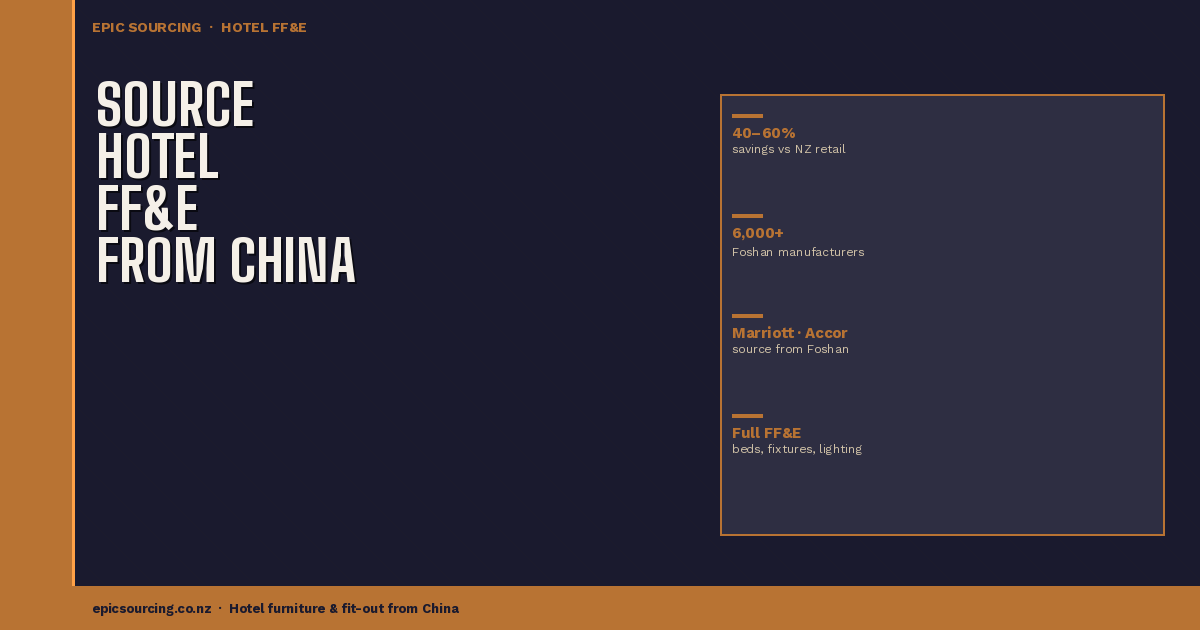
If you're fitting out a hotel, motel, lodge, or serviced apartment in New Zealand, you already know that FF&E — that's Furniture, Fixtures, and Equipment — is one of the biggest line items in your project budget. A 30-room boutique hotel might spend $500,000 or more on FF&E alone. And increasingly, savvy NZ hospitality operators are turning to Asia — particularly China and Vietnam — to stretch that budget without compromising on quality.
But sourcing hotel furniture and FF&E from overseas isn't quite the same as ordering a container of retail products. There are specification requirements, fire ratings, durability standards, and coordination challenges that can catch first-timers off guard.
This guide will walk you through exactly what you need to know: how to find the right suppliers, what to specify, how to manage quality from 10,000 kilometres away, and how to get your FF&E to site on time and on budget. Let's get into it.
Why NZ Hospitality Businesses Are Sourcing FF&E From Asia
The math is hard to argue with. A custom-made timber bed frame sourced from a Vietnamese furniture factory might land in New Zealand at $180–$280 NZD. The equivalent from a local NZ joiner could be $800–$1,200. Multiply that across 30 rooms, and you're looking at savings in the tens of thousands of dollars.
Beyond price, Asian manufacturers — particularly in Vietnam and China's Guangdong province — have decades of experience producing hospitality-grade furniture. Major international hotel chains source heavily from these regions. The capability is real, the quality is there, and the product range is extraordinary.
The key is knowing how to access it properly — and that's where most NZ operators either win or lose.
China vs Vietnam for Hotel Furniture — Which Should You Choose?
Both countries are strong options, and the right choice depends on your product mix, budget, and timeline.
China is best for: upholstered furniture (sofas, ottomans, headboards), soft goods, custom joinery, lighting, and hard goods. Strengths include enormous factory capacity, full fit-out capability, competitive pricing, and fast sampling. Watch out for longer freight times to NZ (20–23 days FCL) and Chinese New Year disruption.
Vietnam is best for: timber furniture, rattan and woven pieces, resort-style and natural aesthetic pieces, and technical textiles. Strengths include high-quality timber craftsmanship, CPTPP trade agreement benefits (meaningful tariff reductions), and a growing hospitality manufacturing sector. Watch out for fewer 'one-stop shop' suppliers — you may need multiple factories for a complete fit-out.
For most NZ hospitality projects, a split approach works well: timber case goods from Vietnam, upholstery and soft goods from China.
⚡ Sourcing Hack #1: Create a Detailed FF&E Schedule Before You Approach Suppliers — Before reaching out to any factory, put together a proper FF&E schedule: a spreadsheet listing every item, quantity, dimensions, material specifications, and finish requirements. Suppliers can't give you accurate pricing without this, and it also protects you legally — it's the document against which you'll measure what arrives on site.
What to Look for in a Hospitality Furniture Supplier
Not every furniture factory is set up to handle hospitality projects. Here's what separates the ones that can from the ones that can't:
- Hospitality experience — Ask specifically whether they've supplied hotels before, and request photos. A factory that makes residential furniture may not understand the durability requirements of a commercial environment.
- Fire rating compliance — In New Zealand, commercial furniture in hospitality settings must comply with specific flammability standards. Make sure your supplier understands this and can supply certification. This is non-negotiable.
- MOQ flexibility — Some large factories won't take small orders. For a 20–30 room property, you need a supplier who can work with smaller quantities without cutting corners.
- Customisation capability — Most hospitality FF&E involves customisation: your colour, your fabric, your finish. Check the factory has a proper sampling process and design team.
- Quality control systems — Ask what their internal QC process looks like before goods leave the factory. Then add your own pre-shipment inspection on top of that.
Lead Times and Logistics for FF&E Orders
This is where hospitality projects often come unstuck. Furniture production takes time, and ocean freight from Asia to New Zealand takes 20–23 days. If your project has a hard opening date, you need to plan backwards carefully.
A typical FF&E timeline for a NZ hospitality project sourcing from Asia:
- Supplier selection and briefing: 2–4 weeks
- Sample production and approval: 4–8 weeks
- Production of full order: 6–12 weeks
- Pre-shipment inspection: 3–5 days
- Sea freight to NZ: 20–23 days
- Customs clearance and delivery to site: 5–10 days
Add that up and you're looking at a minimum of 4–6 months from initial supplier contact to goods on site. Many projects that "go to plan" actually start 8–10 months before opening, with buffer built in for revision rounds and potential delays.
⚡ Sourcing Hack #2: Phase Your Orders to Manage Cash Flow and Risk — Rather than ordering everything in one massive shipment, consider phasing FF&E across two or three containers. This spreads your cash outlay, reduces the risk of a single delay wiping out your opening date, and gives you a chance to review the first delivery before the rest ships.
Quality Control — Getting It Right Before It Ships
Pre-shipment inspection is not optional for FF&E. This is where you find out whether the factory actually made what you specified — before it's on a ship and 23 days away from your site.
Hire a third-party QC company in China or Vietnam to inspect your goods before they ship. They'll check:
- Dimensions and construction against your specifications
- Materials and finishes (are the fabrics the right weight? Is the timber the right species?)
- Workmanship quality (joinery, upholstery, hardware fitting)
- Quantity (is everything accounted for?)
- Packaging adequacy for sea freight
The cost of a professional pre-shipment inspection — typically $200–$500 USD per day — is trivial compared to the cost of receiving a container of furniture that doesn't meet your standards.
The True Cost of Hotel FF&E Sourcing From Asia
To budget accurately, you need to think beyond the ex-factory price. Your total landed cost includes:
- Ex-factory price (what the supplier charges)
- Freight forwarder fees and documentation
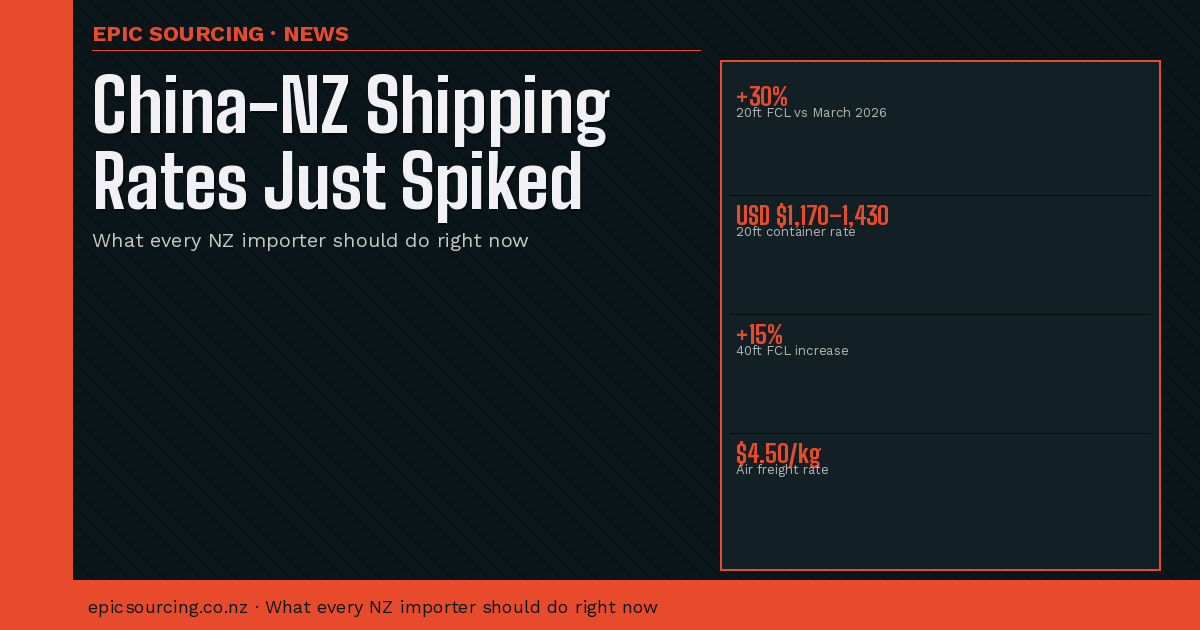
- Ocean freight (currently $2,025–$2,475 USD per 40ft container from China)
- Port charges and terminal handling at the NZ end
- Customs duty (varies by HS code — typically 0–5% for furniture)
- Delivery from port to site
- Any damage replacement or re-order costs
A rough rule of thumb: add 25–35% on top of the ex-factory price to get your NZ landed cost for sea freight. This varies by product weight, volume, and current freight rates.
When you run those numbers, even with current elevated freight rates, Asian-sourced FF&E typically lands in NZ at 40–60% of what you'd pay through local suppliers. For a hospitality business, that's a material competitive advantage — and it's why more and more NZ operators are making the switch.
Epic Sourcing has experience managing hotel FF&E projects across NZ, helping hospitality operators source quality furniture from China and Vietnam on time and on budget. If you've got a project coming up and want to explore what's possible, book a free consultation at epicsourcing.co.nz — we'd love to help make your fit-out budget work harder.
Related Articles

Let’s Make It Epic
We're here to make sourcing simple – and a whole lot less stressful.
We are experiencing a higher volume of enquiries than usual. Our standard reply time for form submissions and emails is within 72 hours.
If your matter is urgent, please schedule a video call using the link below.
