
.svg)
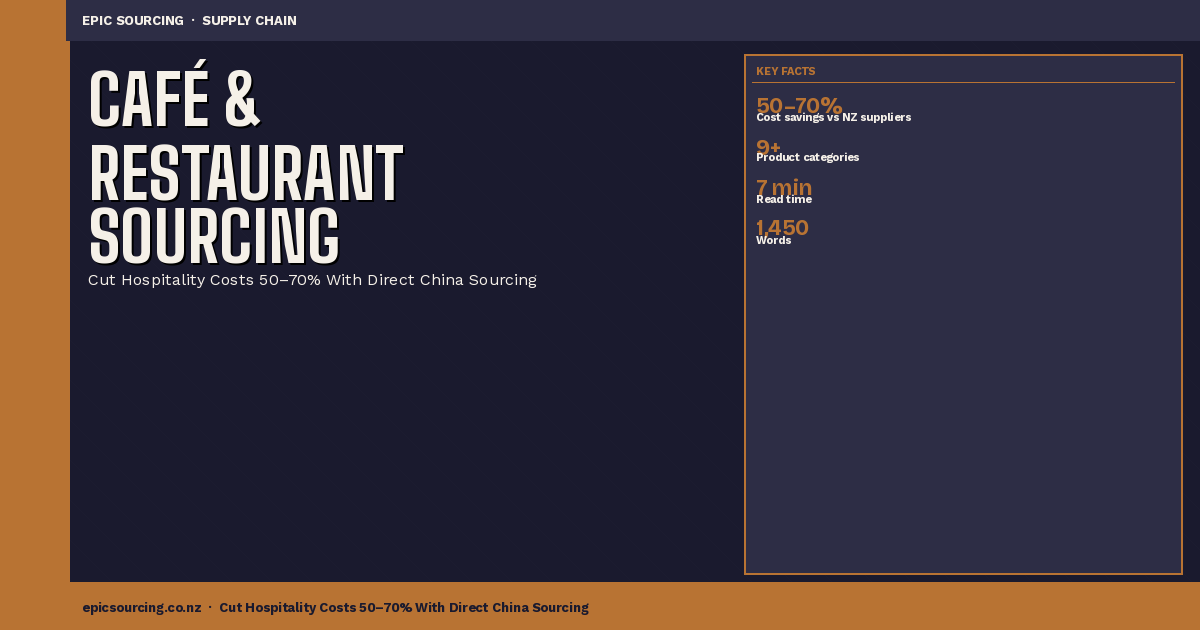
Sourcing Café & Restaurant Supplies from China: The NZ Hospitality Owner's Guide

.svg)
Running a café or restaurant in New Zealand is genuinely hard work. You're managing staff, wooing customers, and watching your cost of goods like a hawk. And one area where most NZ hospitality operators leave serious money on the table? Their supplies. Plates, glassware, takeaway cups, crockery, small appliances, kitchen tools — most of it gets ordered through a NZ distributor at 3–5x what the same item costs sourced directly from a Chinese manufacturer.
That's not a knock on your distributor — they add real value through convenience and local stock. But for smart NZ café and restaurant owners who plan ahead, sourcing your own hospitality supplies directly from China can cut your cost per unit by 50–70%, and that adds up fast when you're fitting out a new venue or restocking 200 sets of crockery. Let's walk through exactly how it works.
What Hospitality Supplies Can You Source from China?
The short answer: almost everything that doesn't require NZFSA certification or local compliance testing. Here's what NZ hospitality businesses are already sourcing directly:
- Crockery and tableware — dinner plates, side plates, bowls, platters, ramekins (often sourced from Guangdong and Fujian provinces)
- Glassware — water glasses, wine glasses, espresso cups, iced coffee glasses
- Cutlery and serving utensils — stainless steel cutlery sets, serving tongs, ladles
- Commercial kitchen equipment — food processors, blenders, induction hobs, bain maries
- Takeaway packaging — eco cups, paper bags, compostable containers, branded sleeves
- Front-of-house display items — chalkboard signs, menu holders, table numbers, condiment holders
- Bar equipment — cocktail shakers, pourers, ice moulds, cocktail strainers
- Uniforms and aprons — custom embroidered aprons, chef whites, front-of-house uniforms
- Coffee-related accessories — tampers, milk jugs, reusable cups (great for branded merchandise)
The sweet spot for sourcing is items that you buy in volume, don't have NZ-specific compliance requirements, and have a long enough shelf life that you can hold stock. Crockery and glassware are the classic starting point because the margin gain is huge and the risk is low.
The Numbers: What Does a Hospitality Owner Actually Save?
Let's make this tangible. Say you're setting up a 60-seat café and need to stock crockery. Through a NZ hospitality supplier, a basic café-grade side plate might cost NZD $4–7 each. Order 200 and you're paying NZD $800–1,400.
Source the same side plate from a Chinese porcelain manufacturer in Guangdong: roughly NZD $0.80–1.50 ex-factory. With sea freight and NZ customs duties, your landed cost sits around NZD $1.50–2.50/unit. Order 200, and you're paying NZD $300–500 all up.
That's a saving of NZD $500–900 on plates alone. Multiply that across your full tableware, glassware, and kitchen tools order, and you could easily save NZD $5,000–15,000 on a single venue fit-out.
Sourcing Hack #1: Fit-Out Orders Are the Best Time to Import — If you're opening a new venue or doing a major refit, this is the ideal moment to import directly. You have enough lead time to do it properly (allow 14–16 weeks from enquiry to delivery), and your order volume will be high enough to justify the logistics. A dedicated sourcing agent can pull together your whole fit-out order — crockery, glassware, uniforms, display items — into one consolidated shipment, saving on freight costs too.
What You Need to Know About Quality and Compliance
Quality is the obvious concern, and it's a fair one. The good news is that China produces an enormous range of quality levels — from budget hotel-grade crockery to porcelain that would look at home in a fine dining restaurant. Your job is to be specific about what you need and order samples before committing.
Key quality specs to communicate when sourcing crockery and glassware:
- Lead-free and cadmium-free glazing (essential — always specify this, and ask for test reports)
- Chip resistance — ask for bone china vs. vitrified porcelain options depending on your venue style
- Dishwasher durability — ask about cycle ratings and request test data
- Weight and thickness — provide reference weights from your existing preferred items
- Finish — matte, gloss, coupe-style, rimmed — be precise
For commercial kitchen equipment, NZ requires AS/NZS 3000 compliance for electrical items. This means you need to source from suppliers who can provide documentation that their products meet Australian/NZ electrical standards, or work with a sourcing agent who handles compliance testing.
Takeaway Packaging: The Sustainability Opportunity
NZ's single-use plastics rules have reshaped what hospitality operators can and can't use. The good news is that China is now a major manufacturer of compostable and eco-friendly takeaway packaging — and the quality and variety have improved dramatically.
Kiwi café operators are sourcing PLA (polylactic acid) hot cups, sugarcane bagasse containers, kraft paper bags, and plant-based cold cups directly from Chinese manufacturers at 30–50% less than NZ distributor pricing. For a café doing 500 covers a day, the savings on cups alone can be NZD $8,000–15,000 per year.
When sourcing compostable packaging, always verify the certification: look for BPI (Biodegradable Products Institute), EN 13432, or AS 4736 (the Australian standard NZ recognises). Your supplier should be able to provide third-party test certificates.
Sourcing Hack #2: Consolidate Your Hospitality Supply Order — Rather than placing separate packaging orders through different suppliers, brief a sourcing agent to consolidate everything into a single factory-direct order. Combining crockery, glassware, takeaway packaging, and display items into one 20-foot container can reduce your per-unit freight cost by 40–60% compared to air freight or LCL shipments, and you'll typically get better pricing from each factory when they know you're buying across multiple categories.
How the Sourcing Process Works: From Brief to Delivery
Here's a typical timeline for a NZ hospitality sourcing project:
- Week 1–2: Brief your sourcing agent with a product list, quantities, quality requirements, and reference photos
- Week 2–4: Supplier identification and quote collection from 3–5 vetted factories per product category
- Week 4–6: Sample ordering via air freight to NZ for your review (NZD $150–400 courier cost)
- Week 6–7: Sample review and sign-off — approve, request amendments, or try another factory
- Week 7–10: Production — most hospitality supply orders take 3–5 weeks in production
- Week 10–14: Sea freight from China to NZ (20–27 days) plus customs clearance (3–5 days)
- Week 14–16: Delivery to your venue
Allow 14–16 weeks from initial brief to delivery for a full fit-out order. As of July 2026, sea freight rates are running 36–38% higher than earlier in the year — making advance planning even more important to lock in competitive rates.
Is It Worth It for Smaller Hospitality Businesses?
If you're a solo café owner ordering 50 cups and 100 plates — probably not worth the complexity for a first order. The economics really kick in at volumes that justify the 14–16 week lead time. The sweet spot is hospitality businesses that are fitting out or refitting a venue, have regular high-volume consumption (takeaway cups at scale), are planning a rebrand requiring custom crockery, or are running multiple venues and can consolidate orders.
If you've been thinking about it, the time to start is now — not next month. An order placed in July will arrive in October/November, perfectly timed for the summer season.
Want expert help sourcing hospitality supplies for your NZ venue? Book a free consultation with Epic Sourcing — we've helped hundreds of Kiwi businesses import smarter, cheaper, and with way less stress.
Related Articles
Let’s Make It Epic
We're here to make sourcing simple – and a whole lot less stressful.
We are experiencing a higher volume of enquiries than usual. Our standard reply time for form submissions and emails is within 72 hours.
If your matter is urgent, please schedule a video call using the link below.
