.svg)
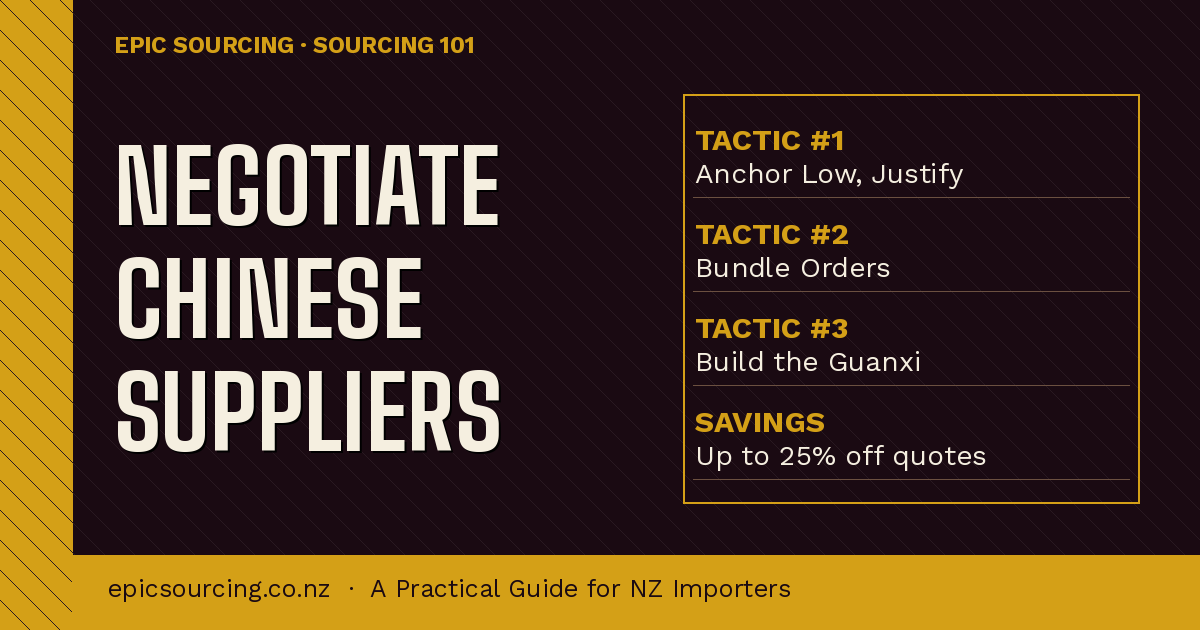
How to Negotiate with Chinese Suppliers: A Practical Guide for NZ Importers

.svg)
Welcome back to the Epic Sourcing NZ blog. If you've ever received a price quote from a Chinese supplier and wondered 'is this the real price, or just their opening gambit?' - you're not alone. Negotiating with overseas suppliers is one of the parts of sourcing that new importers find most daunting. And honestly? It doesn't have to be.
The truth is, negotiating with Chinese suppliers is a skill - and like any skill, it gets easier with practice and the right framework. Today we're going to arm you with the exact tactics and mindset you need to negotiate confidently, get better prices, and build stronger supplier relationships. Because yes, getting a good deal and building a good relationship are not mutually exclusive - in fact, in Chinese business culture, they're deeply connected.
So, let's dive in.
Understanding the Chinese Business Mindset First
Before we get into tactics, it helps to understand a bit of context. In Chinese business culture, negotiation is expected. If you accept the first price without any pushback, suppliers often wonder if they've set their price too low - or worse, they assume you're inexperienced and might look for other ways to cut corners.
Negotiation isn't adversarial in Chinese business culture; it's collaborative. The concept of guanxi (relationships built on mutual trust and respect) matters enormously. Suppliers who like and trust you will give you better prices, better service, and better treatment when things go wrong. The goal isn't to squeeze every last cent out of your supplier - it's to reach an arrangement that works for both parties over the long term.
With that being said, let's look at how to negotiate like a pro.
Step 1: Do Your Research Before Opening Any Negotiation
The strongest negotiating position is one backed by information. Before you even contact a supplier, know:
- The approximate market price - get quotes from at least 3-5 suppliers for the same product. This gives you a genuine benchmark and shows suppliers you're a serious buyer doing due diligence.
- Your target price - what price do you need to make your business model work? Work backwards from your retail price and desired margin.
- Your walk-away point - what's the maximum you can pay and still make the numbers work? Know this before you negotiate, not during.
- Their competition - if you know Supplier A and Supplier B both make the same product, you have genuine leverage.
Never go into a negotiation cold. It takes an hour of research to save thousands of dollars.
Sourcing Hack #1: Use Multiple Quotes as Leverage Without Lying
You don't need to bluff. If Supplier A quotes $12/unit and Supplier B quotes $9.50/unit, you can simply say to Supplier A: 'I've received some very competitive quotes from other factories at around $9.50. Can you match that or get close?' This is factual, fair, and effective. You're not inventing a number - you're using real market data. Suppliers respect this approach far more than vague bluffing.
Step 2: Negotiate on More Than Just Price
New importers fixate on unit price. Experienced importers know that price is just one of many variables you can negotiate. Here are others worth discussing:
- Minimum order quantity (MOQ) - especially important for startups. A higher unit price might be worth paying if you can start with 100 units instead of 500.
- Payment terms - standard is 30% deposit, 70% before shipment. Some suppliers will offer better terms for repeat orders.
- Lead time - if you're under time pressure, a faster production window may be more valuable than a slightly lower price.
- Packaging and labelling - can the supplier include custom packaging in the quoted price, or is that an add-on?
- Quality control inspections - who pays? Negotiating the supplier's responsibility for failed QC inspections matters.
- Samples - always negotiate for samples to be provided (ideally free, or at low cost with the cost credited against your first order).
Think of each negotiation as a package deal, not just a price conversation.
Step 3: Build Rapport Before You Negotiate
This might sound soft, but it's genuinely one of the most effective things you can do. Chinese suppliers get approached by buyers from around the world every day. The ones who get the best treatment are the ones who build genuine relationships.
Before diving into price negotiation:
- Spend a few messages getting to know your contact.
- Show genuine interest in their factory and capabilities.
- Be responsive and professional in your communication.
- If you're ordering for the first time, acknowledge that you're new to working together and that you see this as a long-term relationship.
Suppliers who see you as a long-term partner - not a one-off transaction - will often extend better pricing and more flexibility, because they're investing in the relationship too.
Sourcing Hack #2: Offer Volume Commitments in Exchange for Better Pricing
You don't have to commit to a huge order today to get better pricing. Instead, try this approach: 'We're starting with an order of 300 units, but we expect to grow this to 1,000+ units per order within 12 months as we scale. Can you offer us a price based on that expected volume?' Many suppliers will offer volume pricing for future orders if they believe you're a serious buyer. Put it in writing so there's a record.
Step 4: Know How to Handle Counter-Offers
So you've asked for a better price, and the supplier has come back with a counter - maybe they dropped $0.50/unit from their original quote. Here's what to do:
- Don't accept immediately - even if it's acceptable, pause and acknowledge the offer: 'Thank you for that. Let me review this against our budget.'
- Come back with a specific counter - instead of 'can you do better?', say 'we need to get to $10.20/unit to make this work. Is there any way to get there?'
- Justify your counter - give a reason. 'Our logistics costs to NZ are high, so we need to offset that somewhere in the unit cost.' Reasons make counters feel fair, not arbitrary.
- Be willing to give something in return - if you're asking for a lower price, offer something in exchange: faster payment, larger volume, simpler packaging, fewer colour variants.
Negotiation is a dialogue, not a demand. Always frame your asks in a way that acknowledges the supplier's perspective.
Step 5: Get Everything in Writing
Once you've agreed on terms, get them documented - clearly and in full. A proper purchase order (PO) should include:
- Product specifications (exact dimensions, materials, colours, weights)
- Agreed unit price and total order value
- MOQ and quantities ordered
- Packaging and labelling requirements
- Lead time and shipment date
- Payment terms
- Quality standards and inspection rights
Don't rely on WeChat messages or verbal agreements alone. Miscommunication is the most common cause of supplier disputes - and having a clear written record protects both parties.
The Bottom Line
Negotiating with Chinese suppliers is a learnable skill, not a dark art. Go in prepared, negotiate on multiple variables, build genuine rapport, and always get things in writing. The importers who consistently get the best deals aren't the most aggressive - they're the most prepared and the most professional.
If you'd like someone in your corner who negotiates with Chinese suppliers every single day, book a free consultation with the Epic Sourcing NZ team. We handle supplier negotiations on behalf of Kiwi businesses all the time - it's kind of our thing.
Related Articles



Let’s Make It Epic
We're here to make sourcing simple – and a whole lot less stressful.
We are experiencing a higher volume of enquiries than usual. Our standard reply time for form submissions and emails is within 72 hours.
If your matter is urgent, please schedule a video call using the link below.
