.svg)
How to Pay Overseas Suppliers Without Getting Burned
.jpg)
.svg)
Last updated: August 2026
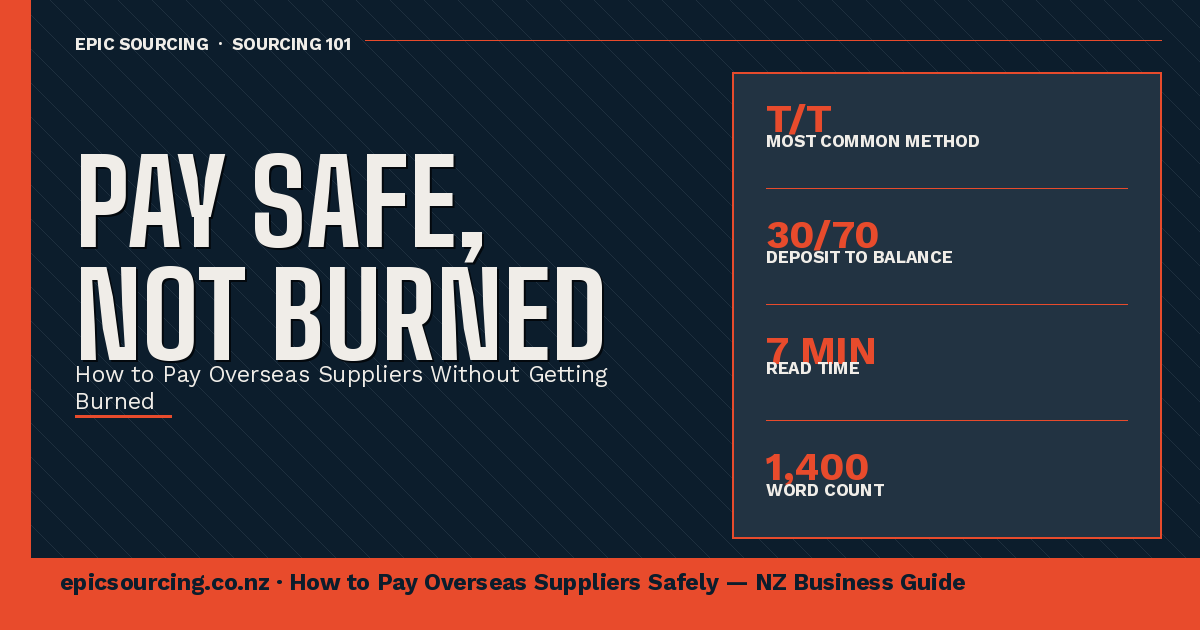
The safest way to pay an overseas supplier is a T/T (telegraphic transfer) split: 30% deposit before production, and 70% balance after a pre-shipment inspection confirms the goods match your spec. That structure protects you without scaring off a legitimate factory, and it's the industry standard for good reason.
Wiring money to a factory you've never met, in a country you may have never visited, is one of the most nerve-wracking parts of sourcing for the first time. This guide covers the payment methods your supplier accepts, how to structure terms that give you real leverage, and the red flags that should make you stop and walk away before you transfer a cent.
What Payment Methods Do Overseas Suppliers Accept?
Most factories in China, Vietnam, and other Asian sourcing countries work with a handful of standard methods. They're not all equal, and knowing the difference before you get to the payment conversation matters.
T/T (telegraphic transfer, also called a bank wire) is the workhorse of B2B sourcing. You send money directly from your bank to the supplier's. It's fast, widely accepted, and relatively low cost. The catch: once the funds leave your account, there's no chargeback process. Your protection isn't built into the payment method, it comes from your payment structure and how well you vetted the supplier before you agreed to anything.
Alibaba Trade Assurance is a payment protection layer built into the Alibaba platform. You pay through Alibaba rather than wiring directly to the supplier, and if there's a significant failure (wrong specs, goods didn't arrive, quality well below what was agreed), you can raise a dispute. Alibaba investigates, and refunds are possible. It's not bulletproof, but combined with a clear purchase order and photos of your approved sample, it's a solid safety net for smaller orders.
Letter of Credit (L/C) is the most formal option. Your bank guarantees payment to the supplier once they present shipping documents proving the goods were sent. It's the most legally robust method, but also the most complex and expensive to set up. Most Kiwi SMEs don't use L/Cs, but for a large first order with a brand-new supplier, it's worth knowing they exist.
PayPal and credit cards are accepted by some trading companies and smaller operators, rarely by direct factories. The fees hit the supplier hard, and most won't offer competitive pricing if they're absorbing PayPal charges on top.
Wise (formerly TransferWise) is worth using as a way to convert NZD to USD at a better rate than most banks. You're still sending a direct transfer to the supplier's account though, so the same structural rules apply: split payments, inspection before you release the balance.
How Should You Structure Your Payment Terms?
Payment terms are not fixed. They're negotiable, and getting them right is one of the best risk management moves you can make before your first order lands.
The standard starting point for a new supplier relationship is a 30/70 split: 30% deposit paid upfront (before production starts), and 70% balance paid after a pre-shipment inspection confirms your goods are good to go. This structure is widely understood, expected by most factories, and creates a clear incentive structure: the supplier wants the remaining 70%, so they have a real reason to deliver what you ordered.
From there, terms can shift as you build a track record:
- 20/80 becomes achievable once you've placed two or three orders and the supplier trusts that you'll follow through
- 30/70 with balance on arrival (after goods reach NZ rather than before shipment) is possible for buyers with meaningful order volumes, but most factories won't agree to it for a first order
- For very small first orders, some suppliers will push for 50% upfront. That's not automatically a red flag, just them managing their own exposure. Still ask for 30/70 first.
Sourcing Hack #1: Always ask for 30/70 first, even if you're ordering small quantities. The worst they can say is no, and many suppliers will accept it straight away on a first order. Paying 50% upfront when you could have paid 30% is money that didn't need to leave your account before production had even started.
Free Download: Supplier Risk Mitigation Framework
A practical framework Kiwi importers use to protect every overseas payment: from structuring 30/70 T/T splits to spotting BEC scams before they cost you.
Does Alibaba Trade Assurance Protect You?
Yes, with caveats. Trade Assurance is a real and useful protection layer, not just a trust badge. If you're ordering through Alibaba and a Trade Assurance supplier is available in your category, use it, especially for your first order.
Here's what it can protect you against: goods that don't arrive, quantities that are significantly short, or quality that fails to match your agreed specification. Alibaba mediates disputes, and refunds do happen.
Here's what it won't cover: vague purchase orders that give the supplier wiggle room, minor quality variations that are within normal manufacturing tolerances, or situations where you can't prove what was agreed. The protection is only as strong as the paper trail you've created.
Sourcing Hack #2: Lock down your spec before you pay the deposit, not after. Your purchase order should include exact product specifications, a reference to your approved sample (with photos), packaging requirements, and a delivery deadline. Trade Assurance disputes are decided on evidence. A detailed purchase order is your evidence. A vague one is not.
What Red Flags Should You Watch Out For?
Fraud in overseas supplier payments is real, and most of it follows recognisable patterns. Here's what to watch for:
Personal bank account instead of a company account. A legitimate exporting factory has a business bank account. If a supplier asks you to send payment to an individual's personal account, that's a serious warning sign. Either the operation is dodgy, or, increasingly common, you're dealing with a Business Email Compromise (BEC) scam where a fraudster has intercepted your email thread and swapped in their own account details.
Sudden change of bank account details mid-order. This is the classic BEC scam. You're mid-negotiation with a real supplier, a scammer intercepts the thread, and sends you "updated payment instructions" with their own account. Always verify changed bank details by calling the factory directly on a number you've previously confirmed, not a number provided in the email making the change.
Western Union or MoneyGram payment requests. These are consumer-to-consumer transfer services. No legitimate manufacturing facility wants payment this way. If a "supplier" insists on this, end the conversation.
Full payment demanded before any production proof. 100% upfront on a first order with a supplier you've never worked with is a hard no. Walk away.
Sourcing Hack #3: Before your very first wire transfer to a new supplier, call the factory directly and read the account number back to them. Ten minutes on the phone has saved Kiwi importers from losing their entire first order payment to a scammer. Add it to your standard process and don't skip it.
What If You're Using a Sourcing Agent?
Working with a sourcing agent changes the payment flow. Typically you'll pay the agent, who then pays the factory on your behalf. This adds a layer of accountability (a good agent won't pay a factory that's already shown red flags) and means you're dealing with someone who speaks the language and knows the norms.
Make sure your sourcing agreement is clear on three things: when payments to the factory are made, what happens if quality fails before the balance is released, and how disputes are handled. A reputable sourcing partner will have all of this in their standard terms of engagement.
Frequently Asked Questions
What's the safest payment method for paying Chinese suppliers?
T/T (bank wire) with a 30/70 split is the standard and most practical method: 30% deposit before production, 70% balance after a pre-shipment inspection. For orders placed through Alibaba, Trade Assurance adds an extra layer of protection. Avoid Western Union, MoneyGram, or 100% upfront payment to any supplier you haven't built a track record with.
What does a 30/70 T/T payment split mean?
A 30/70 split means you pay 30% of the total order value as a deposit before the factory starts production, and the remaining 70% after a pre-shipment inspection confirms the goods match your specification. It's the industry-standard structure for new supplier relationships and balances risk fairly for both sides.
Is Alibaba Trade Assurance useful?
Yes, with clear limits. Trade Assurance protects you if goods don't arrive, quantities are significantly short, or quality fails to match your agreed specification. It won't help if your purchase order was vague or you can't prove what was agreed. Use it as one layer of protection alongside a clear spec, an approved sample, and a pre-shipment inspection.
Can I use Wise to pay Chinese suppliers?
Yes. Wise (formerly TransferWise) is a practical option for converting NZD to USD at better rates than most NZ banks. You're still making a direct bank transfer to the supplier's account, so the same structural rules apply: use a split payment structure and don't release the balance until after inspection.
What is a Business Email Compromise (BEC) scam and how do I avoid it?
A BEC scam is where a fraudster intercepts your email communication with a real supplier and sends you fake 'updated payment instructions' pointing to their own bank account. To avoid it: always verify any change to bank account details by calling the supplier directly on a previously confirmed phone number, never by replying to the email where the change appeared.
Do I need a letter of credit when importing from China?
Most Kiwi SMEs don't use letters of credit. They're the most legally robust payment method but also the most complex and expensive to set up. A T/T split combined with Trade Assurance (for Alibaba orders) or a trusted sourcing agent provides solid protection for most import volumes without the L/C overhead.
Free Download: Supplier Risk Mitigation Framework
A practical framework Kiwi importers use to protect every overseas payment: from structuring 30/70 T/T splits to spotting BEC scams before they cost you.
Stay in the Loop
Get weekly sourcing tips, market updates, and supplier insights from the Epic Sourcing team, delivered straight to your inbox.
Subscribe to the NewsletterBy TK Wang, Director and Supply Chain Manager at Epic Sourcing New Zealand, working with Kiwi businesses to make overseas sourcing simpler and a lot less stressful.
Related Articles
Let’s Make It Epic
We're here to make sourcing simple – and a whole lot less stressful.
We are experiencing a higher volume of enquiries than usual. Our standard reply time for form submissions and emails is within 72 hours.
If your matter is urgent, please schedule a video call using the link below.
