.svg)
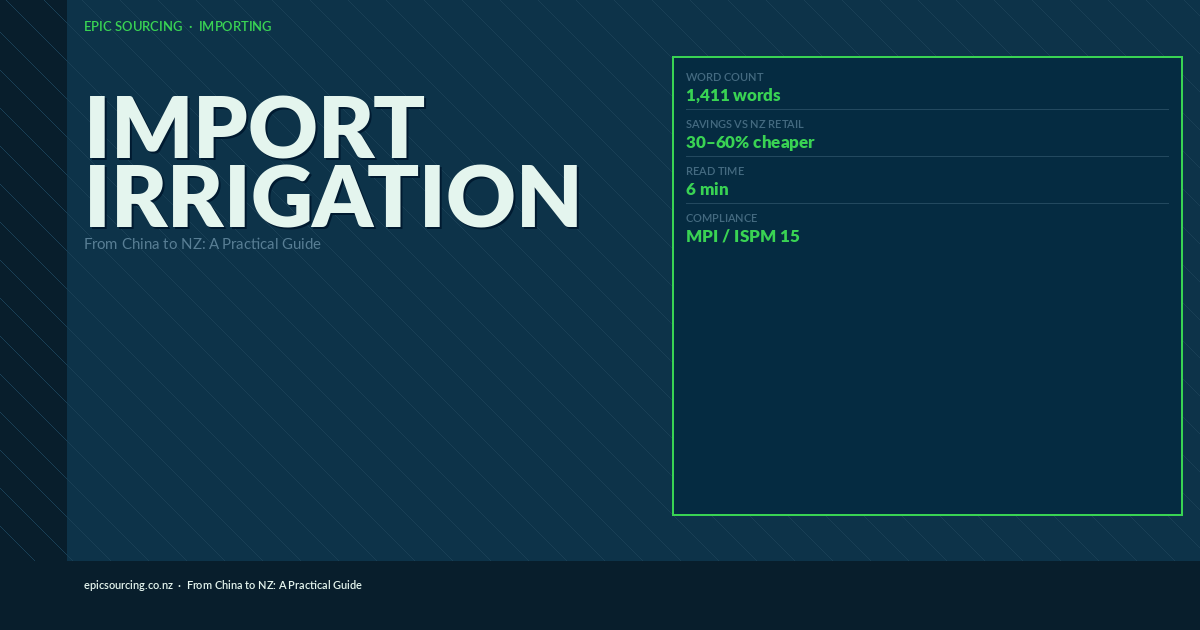
Importing Irrigation & Water Management Equipment from China to NZ: A Practical Guide

.svg)
If you farm anywhere on the east coast or the upper North Island, you've probably already had the water conversation this year. El Niño is forecast to bite hard through 2026, and dry paddocks have a way of focusing the mind. Suddenly that irrigation upgrade you've been putting off — the drip lines, the extra storage, the decent pump — has moved from 'someday' to 'before spring'.
Here's the thing, though: walk into your local rural supplier and price up a full irrigation setup, and you might need a cuppa and a sit-down. Quality gear isn't cheap in New Zealand. What most Kiwi farmers don't realise is that a huge share of the world's irrigation equipment — including plenty of what's already on NZ shelves — comes out of Chinese factories. Buying closer to the source can shave 30–60% off retail prices.
So can you actually import irrigation equipment from China to NZ yourself, without it turning into a biosecurity headache or a box of leaky fittings? You can — if you go about it the right way. Let's dive in.
Why NZ farmers are turning to China for irrigation gear
Three forces are pushing this trend along. First, the weather: drought forecasts mean demand for water storage and efficient irrigation is climbing right across rural New Zealand, from Hawke's Bay orchards to Waikato lifestyle blocks. Second, the economics: with farm input costs up across the board, a 30–60% saving on capital equipment is genuinely material. Third, the supply side: China dominates global manufacturing of drip tape, fittings, HDPE pipe, pumps and tank hardware. The factories making gear for big international irrigation brands will often happily quote you directly.
Add in stable China–NZ shipping (ocean freight is currently running 33–41 days port to port on the main routes like Shanghai to Auckland and Ningbo to Lyttelton), and the maths starts looking very attractive for anyone ordering more than a few hundred dollars' worth of kit.
What irrigation products can you import from China?
Pretty much the whole water chain, honestly. The categories we see most often:
- Drip irrigation systems — drip tape (16mm is the workhorse), emitters, inline drippers, filters and venturi fertiliser injectors
- Sprinkler and micro-spray systems — impact sprinklers, rotators, risers and fittings for pasture, orchards and market gardens
- Pumps — submersible bore pumps, surface transfer pumps, pressure pumps and solar-powered options
- Tank fittings and valves — brass and poly outlets, float valves, ball valves, camlocks and manifolds
- Pipe and hose — HDPE and LDPE pipe, layflat hose, and all the joiners, tees and end caps that go with them
- Water monitoring — tank level sensors, flow meters and basic soil moisture kits
One note on big poly water tanks: they're technically importable but bulky, so freight often eats the savings. Most importers do better bringing in the high-value, dense items — pumps, fittings, drip tape, valves — and buying tanks locally.
What does it cost vs NZ retail?
Every order is different, but here are ballpark comparisons we see regularly (landed cost includes freight, duty and GST):
- 16mm drip tape: roughly $25–$40 per 500m roll landed, vs $70–$120 at NZ retail
- Submersible bore pump (1.5kW): roughly $250–$450 landed, vs $800–$1,500 locally
- Brass tank outlet kits and float valves: often 50–70% below NZ shelf price when ordered in volume
- Layflat hose and HDPE fittings: typically 40–60% savings at carton quantities
The catch? Minimum order quantities. Factories aren't set up to sell one pump; they're set up to sell pallets. The sweet spot is a consolidated order — your whole season's irrigation needs in one shipment — or going in with others.
Sourcing Hack #1: Consolidate with the neighbours — If your own order won't fill a pallet, team up with two or three nearby farms and share an LCL shipment. Freight is priced largely on volume, so splitting a consolidated load can cut everyone's per-item landed cost by 20–30% — and you'll hit factory MOQs without over-ordering.
MPI and biosecurity: what you need to know before importing
This is the bit you can't skip. New Zealand's biosecurity rules exist for good reason, and irrigation gear touches a few of them:
- Cleanliness is non-negotiable. Equipment must arrive free of soil, plant material and water residue. Factory-new gear is generally fine; anything used or factory-tested with water should be drained and dried before packing.
- Wood packaging must be ISPM 15 compliant. Pallets and crates need the treatment stamp, or your shipment can be held, treated or re-exported at your cost.
- Some items attract closer inspection. Rubber seals, gaskets and certain plastics can be flagged, and anything that could harbour pests (coiled hose, open-ended pipe) should be sealed and clean.
- Check the ATF list. Some goods require treatment before arrival — our guide to NZ biosecurity and the ATF list at epicsourcing.co.nz/nz-biosecurity-import walks through it.
Get the paperwork right — commercial invoice, packing list, treatment certificates where needed — and customs clearance is usually smooth. Get it wrong and you're paying inspection fees while your pump sits in a bonded warehouse.
How to find a reliable Chinese irrigation supplier
The difference between a bargain and a box of regret is almost always the supplier. A few rules of thumb:
- Buy from manufacturers, not traders, where you can. Factories in irrigation hubs like Shandong and Zhejiang give you better pricing and real accountability for quality.
- Verify before you pay. Business licence, export history, third-party audits — a legitimate factory won't blink at the request.
- Always sample first. One roll of drip tape and a couple of fittings by air courier costs little and tells you everything about wall thickness, UV stabilisation and thread quality.
- Specify NZ conditions. UV resistance matters more here than in many markets — our sunlight is brutal on cheap poly. Ask for UV-stabilised compounds and put it in writing.
- Use quality control before shipment. A pre-shipment inspection (see our quality control service) catches under-spec product while it can still be fixed — not after it's crossed the Pacific.
Sourcing Hack #2: Ask for the pressure-test video — Before releasing final payment, ask your supplier to film your actual pumps and valves on the factory test bench — serial numbers visible, gauges in frame. It costs them nothing, takes an hour, and weeds out the traders who never see the product they sell.
Step-by-step: how Epic Sourcing can help
If that all sounds doable but time-consuming — that's exactly the gap we fill. Here's how a typical irrigation sourcing project runs with Epic:
- Tell us what you need. Send your product list — even a photo of the gear you'd buy locally works.
- We find and vet the factories. Our China-based team shortlists manufacturers, checks credentials and negotiates in Mandarin.
- Samples to your door. You approve the actual product before committing to the full order.
- Production, QC and freight handled. We inspect before shipment, manage the biosecurity paperwork, and land it to your nearest port or door.
- You get on with farming. One invoice, one point of contact, no 2am WeChat negotiations.
First time importing? Our first-time importer guide covers the basics in plain English.
FAQ
What's the minimum order to make importing irrigation gear worthwhile?
As a rule of thumb, NZ$3,000–$5,000 of product is where savings comfortably outweigh freight and clearance costs. Below that, a consolidated or shared shipment makes more sense.
How long does it take?
Allow 2–4 weeks for production on stock items plus 33–45 days ocean freight, so roughly 8–10 weeks door to door. Ordering before winter sets you up nicely for spring installation.
Is Chinese irrigation equipment good quality?
The factories supplying major global brands are excellent — the same lines often produce branded and unbranded product. The risk isn't 'China', it's buying blind from an unverified seller. Vetting and inspection close that gap.
Do I need an import licence in NZ?
No licence is needed for general irrigation equipment, but shipments over NZ$1,000 require a client code from NZ Customs, and GST plus any duty applies at the border.
Water security is shaping up to be the theme of 2026, and the farms that sort their irrigation early will be the ones smiling come summer. If you'd like a hand pricing up a shipment — or just want a sanity check on a supplier quote — book a free consultation with the Epic Sourcing team. No pressure, no jargon, just straight answers about what your gear should really cost.
Related Articles

![How to Import Gym Equipment from China to New Zealand [2026 Guide]](https://cdn.prod.website-files.com/688a8969df3fa58c211fb141/69a4bc6994dd6b0ce2c1439b_Import%20Directly%20from%20China.png)
Let’s Make It Epic
We're here to make sourcing simple – and a whole lot less stressful.
We are experiencing a higher volume of enquiries than usual. Our standard reply time for form submissions and emails is within 72 hours.
If your matter is urgent, please schedule a video call using the link below.
